

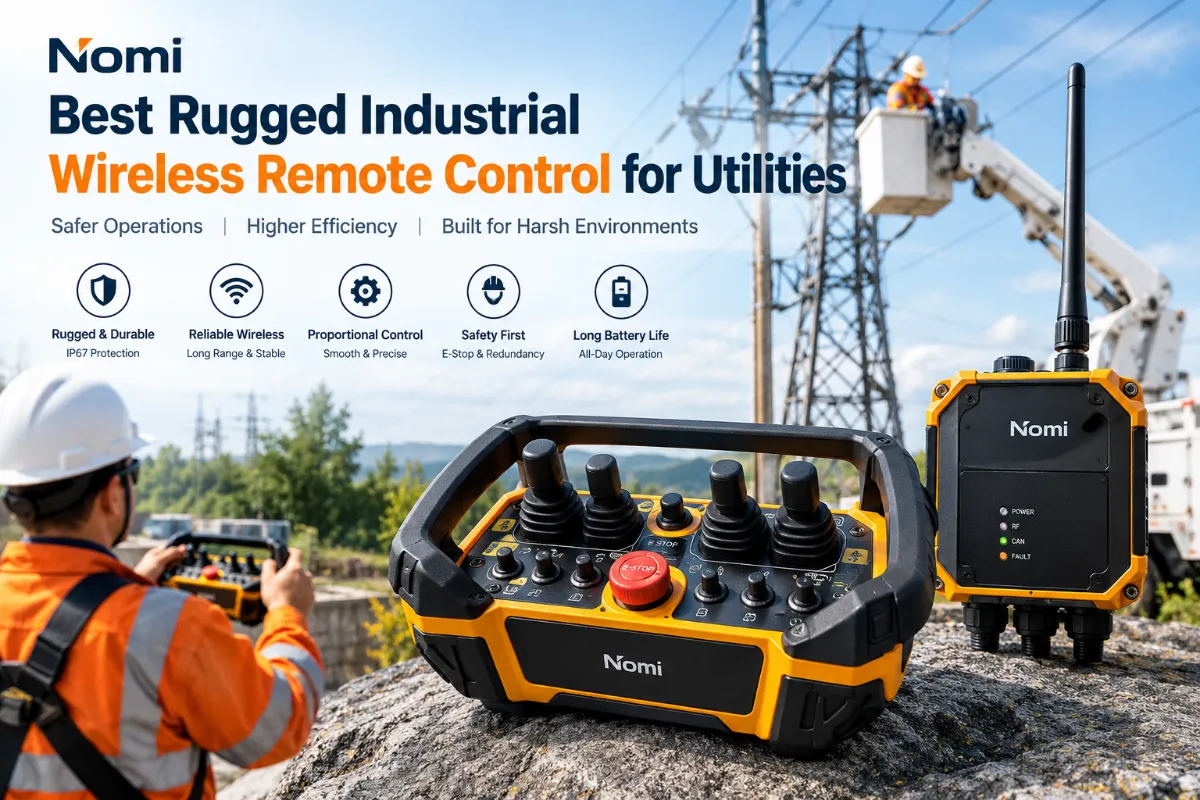
The best rugged industrial wireless remote control for utilities is not simply the remote with the longest range or highest IP rating. The right system must match the utility machine, hydraulic or electrical control architecture, operating environment, required control functions, radio conditions, and safety system.
Utility equipment can operate outdoors in rain, dust, mud, vibration, temperature changes, oil contamination, traffic areas, and other demanding conditions. A remote control used on a sewer truck, aerial work platform, vacuum truck, crane, snowplow, or hydraulic service vehicle therefore needs to be evaluated as part of the complete machine control system, not as an isolated handheld transmitter.
For buyers comparing industrial wireless remote controls, the most important questions are:
- What machine functions must be controlled?
- Does the machine require proportional or simple on/off commands?
- What environmental protection is actually required?
- How much operating range is needed at the worksite?
- What happens if the radio link is interrupted?
- How is the emergency-stop function implemented?
- How will the receiver interface with the machine?
- Which certifications and technical documents are required?
- Can the supplier customize the transmitter and receiver for the application?
Nomi provides industrial wireless remote control systems for hydraulic machinery, cranes, construction equipment and other heavy-duty applications, including joystick, push-button and hydraulic proportional configurations. Its published product information includes application-specific options rather than treating every machine as requiring the same remote architecture.
What Makes a Wireless Remote Control Suitable for Utility Equipment?
Utility work creates a different set of requirements from indoor factory automation.
A remote may be exposed to rain, dust, mud, hydraulic oil, vibration, accidental drops and frequent temperature changes. At the same time, the operator may need to stand away from the machine to obtain a better view of a load, boom, hose, excavation area, vehicle or work zone.
Utility applications can include:
| Utility application | Typical remote-control requirements |
|---|---|
| Aerial work platform | Precise movement, emergency stop, reliable radio link, weather resistance |
| Sewer cleaning truck | Multiple hydraulic functions, outdoor durability, contamination resistance |
| Vacuum truck | Pump and auxiliary function control, rugged enclosure, ergonomic operation |
| Truck-mounted crane | Proportional movement, multi-axis control, emergency stop |
| Snowplow | Simple hydraulic functions, reliable outdoor operation, gloves-friendly controls |
| Recovery vehicle | Winch, boom and auxiliary hydraulic control |
| Utility service truck | Multiple hydraulic and auxiliary functions |
| Hydraulic lifting equipment | Proportional control, receiver compatibility and fail-safe behavior |
Utility remote-control manufacturers commonly identify aerial platforms, sewer trucks, snowplows, firefighting vehicles, cranes, vacuum trucks and other mobile equipment as relevant applications.
The important point is that “utility equipment” is an application category, not a technical specification.
A remote designed for a simple auxiliary hydraulic function may not be appropriate for a machine requiring multiple proportional hydraulic movements.
1. Start With the Machine, Not the Remote
One of the most common purchasing mistakes is choosing a transmitter first and trying to determine later whether it can operate the machine.
The selection process should start with the equipment.
Before requesting a quotation, document:
- Machine type
- Manufacturer and model
- Hydraulic system type
- Electrical supply voltage
- Number of functions
- Proportional functions
- On/off functions
- Required emergency-stop behavior
- Required operating distance
- Outdoor environmental conditions
- Existing receiver or control cabinet
- Required communication interface
- Local regulatory requirements
For hydraulic equipment, the buyer should also determine whether the machine uses proportional valves, directional valves, pilot controls, solenoid valves, CAN communication, or another control architecture.
A wireless transmitter cannot compensate for an incompatible machine-side interface.
Nomi’s hydraulic remote-control systems are designed around the relationship between the transmitter, receiver and machine control system. Its published hydraulic product information includes receiver supply options, relay outputs, adjustable operating parameters and different frequency configurations.
2. Proportional Control or Push-Button Control?
This is one of the most important decisions.
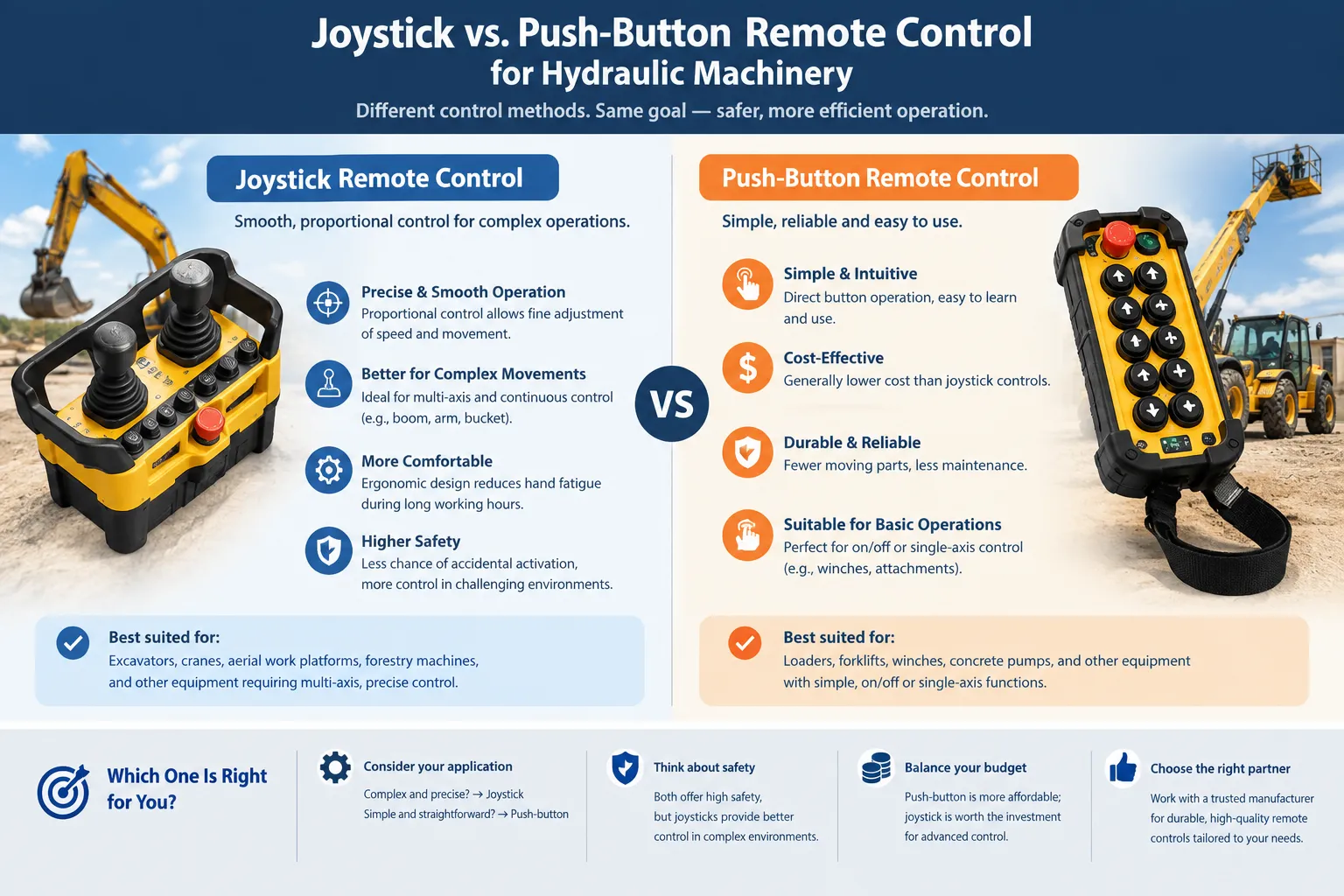
A push-button remote normally provides discrete commands. Pressing a button activates a defined function, such as raise, lower, extend, retract, start or stop.
A joystick or proportional remote provides a variable command. The amount and direction of joystick movement can be translated into a proportional output.
The choice should therefore follow the machine’s control requirements.
| Requirement | Push-button remote | Joystick/proportional remote |
|---|---|---|
| Simple ON/OFF function | Very suitable | Possible |
| Start/stop command | Suitable | Usually unnecessary |
| Raise/lower function | Suitable | Suitable |
| Variable hydraulic speed | Limited | Suitable |
| Fine positioning | Limited | More suitable |
| Multi-axis hydraulic movement | Less intuitive | More suitable |
| Large number of auxiliary functions | Suitable | Can be combined with buttons |
| Simple operator interface | Suitable | Depends on configuration |
Nomi’s own technical comparison similarly distinguishes discrete push-button commands from variable joystick control. A joystick configuration is generally more appropriate when the machine requires continuous speed adjustment, smooth movement or fine positioning.
When proportional control makes sense
Proportional control is particularly relevant when the operator must control the speed of a hydraulic movement rather than simply command the machine to move.
Examples include:
- Crane boom movement
- Hydraulic winch operation
- Aerial platform movement
- Excavator functions
- Concrete pump equipment
- Hydraulic lifting systems
- Precise positioning operations
Nomi’s joystick industrial remote-control product information describes two cross joysticks, function buttons and an emergency-stop button, with a published response time of ≤20 ms and a nominal 225 m straight-line control distance for the specified configuration.
These figures should be treated as product-specific specifications rather than universal performance values for every Nomi remote.
3. IP Rating Matters, but It Is Not the Whole Definition of “Rugged”
When buyers search for a rugged industrial remote, IP protection is usually one of the first specifications they encounter.
The IP rating describes protection against ingress of solids and water under the applicable test conditions. It does not by itself describe:
- Drop resistance
- Vibration resistance
- Chemical resistance
- UV exposure
- Temperature performance
- Radio performance
- Battery life
- Ergonomics
- Functional safety
- Mechanical durability
For this reason, a buyer should not select a remote simply because its IP number is higher.
Nomi publishes different environmental specifications for different product categories. Its hydraulic and push-button product information lists IP65/IP68 protection, while its joystick product information specifies IP66/NEMA 4 for the transmitter and receiver enclosure configuration described on that page.
This illustrates an important procurement principle:
Check the IP rating of the actual model and actual component being installed. Do not assume that the rating of one transmitter applies to the entire remote-control system.
The receiver, connectors, antenna connection and machine-side enclosure can have different environmental requirements.
4. Operating Temperature Can Be More Important Than Maximum Radio Range
Utility equipment often works in conditions that are outside a controlled factory environment.
Temperature can affect:
- Battery performance
- Display operation
- Electronic components
- Mechanical switches
- Hydraulic equipment
- Radio electronics
- Operator handling
Nomi’s published hydraulic and push-button specifications list an operating temperature range of approximately -40°C to +85°C, while the joystick product page specifies approximately -25°C to +85°C.
These differences matter.
If a utility fleet operates in cold climates, hot regions, or vehicles exposed to direct sunlight, the buyer should request the operating-temperature specification for the exact transmitter, receiver and battery configuration.
Do not assume that a general statement such as “industrial grade” means the product has been validated for every temperature condition.
5. Do Not Choose a Remote Based Only on Advertised Range
Radio range is one of the most frequently misunderstood specifications in wireless remote control.
A manufacturer may specify a maximum range measured under open-area or line-of-sight conditions. Actual range can change because of:
- Buildings
- Metal structures
- Vehicles
- Terrain
- Electrical equipment
- Other RF devices
- Antenna location
- Antenna orientation
- Radio-frequency regulations
- Installation quality
For example, Nomi’s published hydraulic remote-control specification lists 225 meters as a straight-line distance in an open area, while some configurations can be customized. Its push-button product information similarly lists 225 meters and indicates that longer-distance configurations may be available.
That does not mean a buyer should assume 225 m of reliable control in every utility environment.
A better specification request is:
“Please confirm the expected reliable operating range under our actual site conditions and installation configuration.”
For a truck-mounted utility machine, 100 meters of reliable control may be more useful than a theoretical multi-kilometer range that cannot be achieved at the worksite.
6. RF Reliability Is a System Requirement
A rugged enclosure protects the electronics physically, but the radio link must also be suitable for the operating environment.
Industrial wireless systems may use different frequency bands and communication methods depending on the product and region.
Nomi’s published product specifications include configurations using frequency bands such as 315 MHz, 433 MHz, 868 MHz and 915 MHz, with other configurations available depending on the product.
The correct frequency cannot be selected solely according to which number is larger or smaller.
The buyer should verify:
- Permitted frequency in the target market
- Transmitter power
- Receiver sensitivity
- Antenna configuration
- Interference environment
- Channel spacing
- Communication protocol
- Pairing method
- Signal-loss behavior
Nomi’s hydraulic remote-control specification, for example, lists receiver sensitivity of -115 dBm, a 32-bit special address code and a CRC verification method for the specified product configuration.
These specifications are more useful for technical evaluation than simply asking whether a remote has “strong signal.”
7. Emergency Stop and Fail-Safe Functions Need Separate Verification
An emergency-stop button on a transmitter is not, by itself, proof that the entire machine-control system satisfies a required safety architecture.
Safety must be evaluated across the complete control chain:
Operator → transmitter → radio link → receiver → machine control system → hydraulic/electrical actuator
The safety-related parts of a machine control system may include multiple components, not just the wireless remote.
ISO 13849-1:2023 provides a methodology and requirements for designing and integrating safety-related parts of control systems, including systems using electrical, hydraulic, pneumatic and mechanical technologies. It does not itself define the required performance level for every specific machine.
IEC 60204-1 addresses electrical, electronic and programmable electronic equipment and systems on machines and includes requirements related to emergency stop, control circuits, EMC and other machine electrical equipment considerations.
Therefore, buyers should ask suppliers:
- What happens when the transmitter loses power?
- What happens when the receiver loses the radio signal?
- Does the machine stop automatically?
- What output state occurs after communication loss?
- How is emergency stop transmitted?
- Is the emergency stop independent of normal operating commands?
- Which safety standard or safety architecture has been evaluated?
- What documentation is available for the complete safety function?
This is much more meaningful than simply asking whether the remote has an emergency-stop button.
8. Receiver Compatibility Is Often More Important Than the Transmitter
A visually attractive transmitter does not guarantee compatibility with the machine.
The receiver needs to communicate correctly with the machine-side control architecture.
Depending on the application, the receiver may need to provide:
- Relay outputs
- Analog outputs
- Proportional outputs
- Digital outputs
- CAN or other communication interfaces
- Specific supply-voltage compatibility
- Valve-driver outputs
- Configurable channels
For example, Nomi’s hydraulic remote-control specifications describe receiver supply-voltage options ranging across different AC/DC ranges and relay-type output configurations.
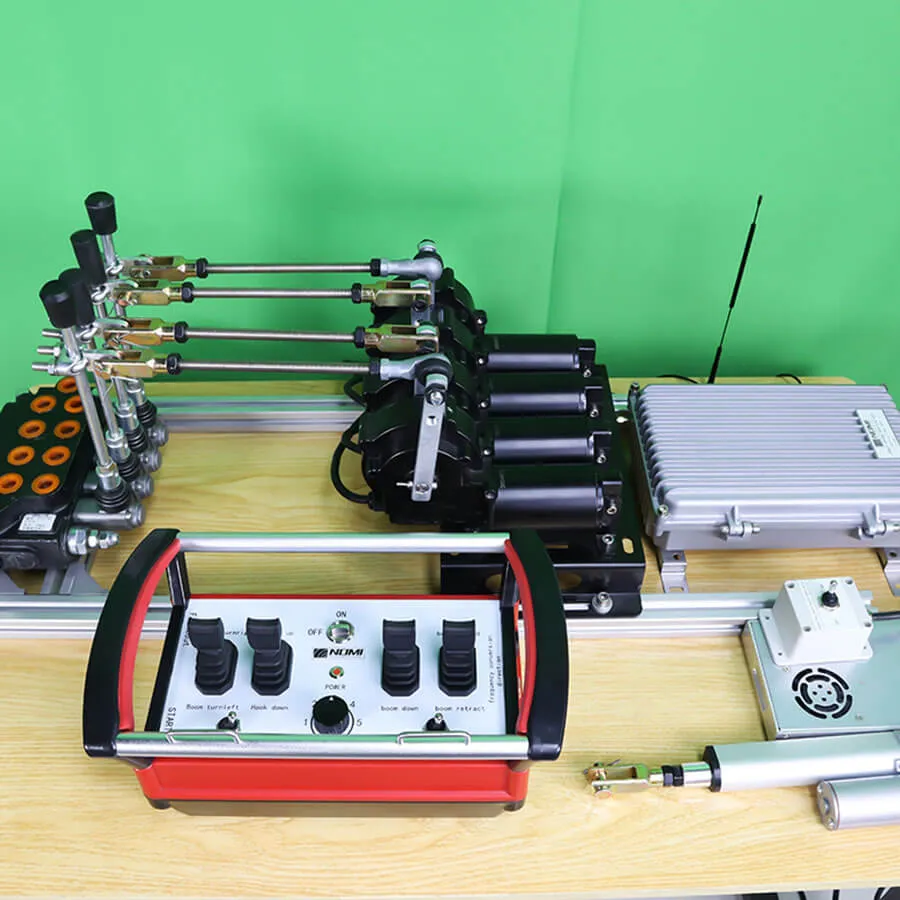
For a hydraulic utility vehicle, the buyer should provide the supplier with the machine’s existing electrical or hydraulic control information whenever possible.
Useful documents include:
- Electrical schematic
- Hydraulic schematic
- Valve model
- Solenoid voltage
- Connector information
- Existing controller information
- Machine model
- Photographs of the control cabinet
- Existing joystick or pendant wiring
This can dramatically reduce the risk of ordering a remote that cannot be integrated without additional engineering.
9. Ruggedness Includes Mechanical Construction and Operator Ergonomics
Utility operators may wear gloves, work outdoors for extended periods and operate machinery while standing or walking around the equipment.
The transmitter therefore needs to be practical, not merely technically impressive.
Consider:
Housing
The enclosure should be appropriate for the expected impact, dust, water and contamination conditions.
Controls
Buttons, joysticks and switches should be large enough to operate reliably when the operator is wearing work gloves.
Emergency stop
The E-stop should be easy to identify and actuate without confusing it with normal controls.
Weight
A heavy transmitter can become uncomfortable during long operating periods.
Carrying method
Depending on the application, a handheld unit, shoulder strap, belt-mounted unit or belly-pack configuration may be appropriate.
Feedback
Battery status, signal status or machine feedback can be useful when the application requires it.
Aarcomm, for example, describes utility applications including hydrovac excavators, vacuum pump trucks, combination sewer-cleaning machines and other mobile equipment, and its published handheld specification includes IP66/IP67 protection, proportional and digital inputs, CAN J1939 and two-way communication.
The important lesson is not that one particular product should be selected, but that utility remote controls need to be evaluated as operator interfaces as well as radio devices.
10. What Should a Utility Equipment Buyer Ask a Supplier?
Before requesting a quotation, prepare a technical specification rather than simply asking:
“Please quote a rugged wireless remote control.”
A useful RFQ should include the following information.
| Item | Information to provide |
|---|---|
| Machine | Manufacturer and model |
| Application | Sewer, aerial, crane, vacuum, snowplow, etc. |
| Control type | Hydraulic, electrical, electro-hydraulic |
| Functions | Number of functions |
| Proportional functions | Number and required control type |
| On/off functions | Number |
| Emergency stop | Required configuration |
| Supply voltage | Machine-side voltage |
| Operating range | Required practical distance |
| Environment | Outdoor, dust, water, oil, vibration |
| Temperature | Minimum and maximum expected |
| IP requirement | Required enclosure protection |
| Radio frequency | Market-specific requirement |
| Receiver output | Relay, analog, CAN, etc. |
| Feedback | Required or not required |
| Battery | Replaceable or rechargeable |
| Certification | Required market documentation |
| Quantity | Prototype, replacement, fleet or OEM |
| Customization | Logo, buttons, enclosure, software, wiring |
The more complete the specification, the easier it becomes for the supplier to recommend a technically appropriate configuration.
11. Common Buying Mistakes
Mistake 1: Choosing the longest-range remote
Longer range is not automatically better.
If the actual operating area is 50 to 100 meters, excessive range may add unnecessary cost or introduce other design considerations.
Mistake 2: Treating IP67 as a complete ruggedness specification
IP protection addresses ingress under defined test conditions. It does not automatically prove resistance to impact, vibration, chemicals, temperature extremes or long-term outdoor use.
If the machine requires smooth hydraulic movement, simple on/off commands may not provide the required level of control.
Mistake 4: Assuming all joystick remotes are interchangeable
Joystick output type, signal resolution, receiver input, valve interface and machine control architecture all matter.
Mistake 5: Ignoring the receiver
The transmitter is only one part of the system.
Mistake 6: Asking only about certifications
A certification mark does not replace application-specific safety analysis.
Ask what certification applies to the exact model and what technical documentation is available.
Mistake 7: Ignoring local radio regulations
Frequency availability and radio requirements can differ between countries and regions.
The supplier should confirm that the proposed configuration is appropriate for the target market.
Mistake 8: Not testing signal-loss behavior
A wireless system should be evaluated for what happens when communication is interrupted.
This should be part of commissioning and safety verification where applicable.
12. When Should You Consider a Nomi Industrial Wireless Remote?
Nomi’s product range is focused on industrial radio remote controls for hydraulic machinery, cranes, construction equipment and other specialized equipment.
Its current product range includes:
- Hydraulic industrial radio remote controls
- Joystick industrial radio remote controls
- Push-button industrial radio remote controls
- Crane remote controls
- Hoist control systems
- Concrete pump truck remotes
The industrial hydraulic remote control systems are relevant when the application involves hydraulic machinery and requires remote operation of hydraulic functions.
For applications requiring variable movement, a joystick remote control can be considered where proportional control is required.
For applications based mainly on discrete commands, a push-button remote control may provide a simpler operator interface.
For lifting applications, Nomi also provides construction crane remote controls and overhead crane and hoist control systems.
Nomi’s published product information indicates that configurations can be customized for different applications, including frequency, control distance, button functions and other control requirements.
For concrete pump and similar hydraulic applications, Nomi also publishes dedicated concrete pump truck remotes, including proportional configurations.
The appropriate solution still needs to be confirmed against the actual machine and control architecture.
13. A Practical Selection Framework
A useful way to evaluate a rugged utility remote is to work through six questions.
Question 1: What does the operator need to control?
If the functions are mainly start, stop, raise, lower and auxiliary commands, a push-button configuration may be sufficient.
If the operator needs variable hydraulic speed and precise movement, consider proportional controls.
Question 2: Where will the remote operate?
Determine:
- Indoor or outdoor
- Dry or wet
- Clean or contaminated
- Normal or extreme temperature
- Low or high vibration
- Low or high RF interference
Question 3: How far away will the operator be?
Define the actual working distance rather than selecting the maximum advertised range.
Question 4: What does the machine require?
Check:
- Voltage
- Number of channels
- Output type
- Hydraulic valves
- Communication protocol
- Existing controller
Question 5: What safety functions are required?
Determine the required emergency-stop behavior, signal-loss response and applicable safety architecture.
Question 6: What documentation does the project require?
Depending on the market and application, the procurement package may need:
- Product datasheet
- Wiring diagram
- User manual
- Declaration or certification documents
- Radio compliance information
- Safety documentation
- Test documentation
- Installation instructions
This framework is more useful than selecting a remote based on a single specification.
FAQ
1. What is the best rugged industrial wireless remote control for utilities?
There is no single configuration that is best for every utility application. The appropriate remote depends on the machine, control functions, hydraulic or electrical architecture, environmental conditions, operating distance and required safety functions.
2. What IP rating should an industrial utility remote have?
The required IP rating depends on the actual exposure to dust and water. IP rating should be evaluated together with temperature, impact, vibration, chemical exposure and connector protection rather than being treated as the complete definition of ruggedness.
Neither is universally better. Push buttons are suitable for discrete commands, while joysticks are more appropriate when the operator needs variable or proportional control. A hybrid transmitter can combine both types.
4. How far can an industrial wireless remote control work?
The practical range depends on the specific radio system and operating environment. Open-area, line-of-sight specifications should not automatically be treated as guaranteed range at an industrial worksite.
5. Can a wireless remote control hydraulic equipment?
Yes, industrial wireless remote-control systems can be integrated with hydraulic machinery through an appropriate receiver and electro-hydraulic interface. The valve type, control signal, voltage and machine architecture must be confirmed before selection.
6. Does a higher IP rating mean the remote is safer?
No. IP protection primarily addresses ingress protection. Functional safety depends on the complete control system, including emergency-stop design, signal-loss behavior, safety-related control components and the machine’s overall safety architecture.
7. What information should I send a remote-control manufacturer?
At minimum, provide the machine model, application, number of functions, proportional functions, voltage, hydraulic or electrical control information, required operating distance, environmental conditions and target market.
8. Can Nomi customize industrial wireless remote controls?
Nomi’s published product information indicates OEM/ODM and customization capabilities, including configurable control functions and application-specific remote-control solutions. The exact customization available should be confirmed for the machine and required quantity.
9. Are industrial wireless remote controls suitable for sewer and vacuum trucks?
They can be suitable when the transmitter, receiver and control interface are correctly specified for the vehicle. Sewer and vacuum trucks are recognized utility applications for industrial radio remote-control systems.
10. What should I verify before purchasing a rugged utility remote?
Verify the exact model’s IP rating, temperature range, radio frequency, practical operating range, control outputs, machine compatibility, emergency-stop behavior, signal-loss response, certifications and available technical documentation.
Final Takeaway
A rugged industrial wireless remote control for utilities should be selected as part of the complete machine-control system, not as a standalone handheld device.
The most important factors are not simply maximum range or the highest IP number. Buyers should evaluate:
machine compatibility + control type + environmental protection + RF reliability + safety architecture + receiver interface + documentation.
For simple utility functions, a rugged push-button remote may be sufficient. For equipment requiring smooth hydraulic movement, proportional joystick control may be more appropriate. For complex machines, a combined joystick and push-button configuration can provide both proportional movement and discrete auxiliary controls.
Nomi’s range covers hydraulic, joystick and push-button industrial wireless remote-control configurations, allowing the system to be matched to different machine architectures rather than forcing every application into the same transmitter design.
For an actual utility equipment project, the most useful next step is not simply asking for the “best remote.” Send the supplier the machine model, hydraulic/electrical schematic, required functions, operating environment and target market. The supplier can then determine whether the application requires proportional control, push-button control, a hybrid interface, or a customized receiver configuration.
