

Excavator wireless remote control safety depends on what the complete machine does when the operator presses the emergency-stop button, the wireless communication link fails, or a control-system fault occurs. A remote controller with a red stop button is not sufficient by itself. The transmitter, receiver, safety-related control circuits, hydraulic system, and machine behavior must work together to achieve the response required by the application’s risk assessment.
Two protective functions deserve particular attention: manual emergency stopping and automatic protection against loss of valid communication. They address different initiating events. The operator may deliberately request a stop because a person enters the work area, while signal-loss protection must respond automatically when valid commands can no longer be received. Both functions need clearly defined behavior, suitable implementation, and documented verification before the excavator is used.
For equipment owners, maintenance engineers, and procurement teams, the practical question is not simply whether a remote-control system has these features. It is whether the features perform as required on the specific excavator, including its hydraulic functions, travel behavior, operating modes, and potential stored energy.
Emergency Stop, Normal Stop, and Signal Loss Are Different Events
These three events should not be treated as interchangeable. Understanding the distinction helps buyers evaluate product specifications and prevents a common mistake: assuming that releasing a joystick or switching off a transmitter necessarily provides the required emergency response.
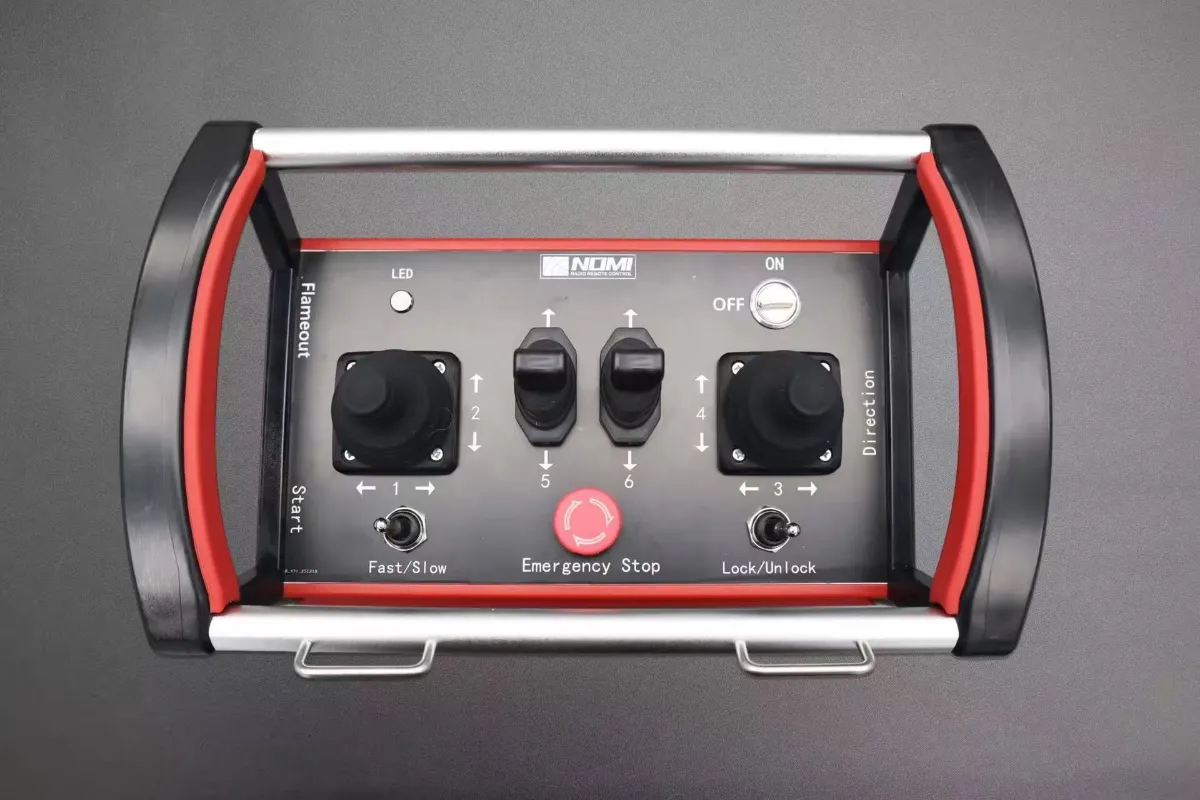
Emergency stop: a deliberate protective action
An emergency stop is initiated when a person recognizes a potentially hazardous situation and activates the designated stop control. On a wireless remote, this is commonly a prominent stop button on the handheld transmitter or operator control station.
The stop command must be transmitted and processed through the system’s intended safety-related path, producing the required machine-level response. The exact response depends on the machine design and risk assessment. It may need to stop hazardous movement, disable certain commands, or initiate other measures to control residual risk.
Pressing the emergency-stop button should not be confused with switching off the remote as an ordinary operating action. The safety function must be designed for its intended purpose, rather than relying on a general power-off behavior whose consequences have not been evaluated.
Normal stop: releasing the operating control
A normal stop occurs when the operator returns a joystick or another operating control to its neutral position, or issues an ordinary stop command. It is part of routine operation, not necessarily an emergency response.
For example, releasing the travel control may remove the travel command, but the excavator’s actual behavior also depends on the machine’s drive, braking, hydraulic, and control architecture. Releasing a joystick does not automatically prove that every hazardous movement or stored-energy condition has been controlled.
Signal loss: an automatic fault response
Signal loss occurs when the machine can no longer receive valid commands from its paired transmitter within the limits defined by the system design. Possible causes include excessive distance, radio interference, a transmitter fault, a depleted battery, or a receiver-side communication problem.
The receiving system must detect the relevant fault and initiate its designed response without waiting for the operator to press the emergency-stop button. The required action depends on the particular machine and its hazards.
| Event | Initiating condition | What needs to be verified |
|---|---|---|
| Emergency stop | Operator deliberately activates the stop control | The designated safety function reaches the required machine-level response |
| Normal stop | Operator releases a control or issues a routine command | The machine responds correctly to the ordinary stop or neutral command |
| Signal loss | Valid wireless commands are no longer received as specified | The automatic fault response occurs within the system’s documented limits |
| Power failure | Transmitter, receiver, or relevant machine-side supply loses power | Loss of power does not create an unacceptable hazardous condition |
| Fault recovery | Communication or power returns after a fault | The machine follows its documented recovery process and does not restart unexpectedly |
The distinction between these events should appear in the system documentation, operator training, and commissioning test plan.
How an Excavator Wireless Emergency Stop Should Work
The emergency-stop function is a system-level requirement. Its performance cannot be established by examining the button alone.
1. The operator activates the stop control
The operator presses the designated emergency-stop control after identifying a hazardous situation. The control must be identifiable, accessible during the intended operation, and described clearly in the operating instructions.
Its location and design matter because an operator may need to react quickly while holding or wearing a handheld transmitter. Training should cover how to activate the stop control without confusing it with ordinary operating switches.
2. The system detects and processes the stop command
The transmitter and receiving system must be configured to recognize the stop request and initiate the intended protective response. The system architecture should identify which receiver outputs, safety-related circuits, controllers, and machine functions are involved.
A generic statement such as “the receiver stops the machine” is not enough to describe the design. The responsible integrator should be able to explain how the stop command propagates through the control system and which hazardous functions it affects.
3. The excavator reaches its intended stopping condition
Stopping a wireless command and stopping a physical machine are not necessarily the same event.
An excavator may have moving tracks, a rotating upper structure, a raised boom, an attachment carrying material, and hydraulic energy remaining in its circuits. Depending on the situation, simply removing an electrical command may not be sufficient to control every hazard.
The stopping behavior must be selected for the machine and application. For instance, the design may need to consider how travel stops, how swing motion comes to rest, and how hazardous movement or a load-holding condition is managed. These decisions belong in the machine’s safety design and must not be improvised during operation.
4. The system prevents an unsafe restart
After emergency-stop activation, releasing the button or restoring the wireless link must not cause an unintended movement.
The reset process and the conditions for resuming operation should be defined. Depending on the architecture, the operator may need to reset the stop control, restart or re-enable the remote-control system, and deliberately issue a new movement command.
The actual sequence must follow the approved equipment instructions. A reset command should not be assumed to mean that the excavator is safe to move immediately.
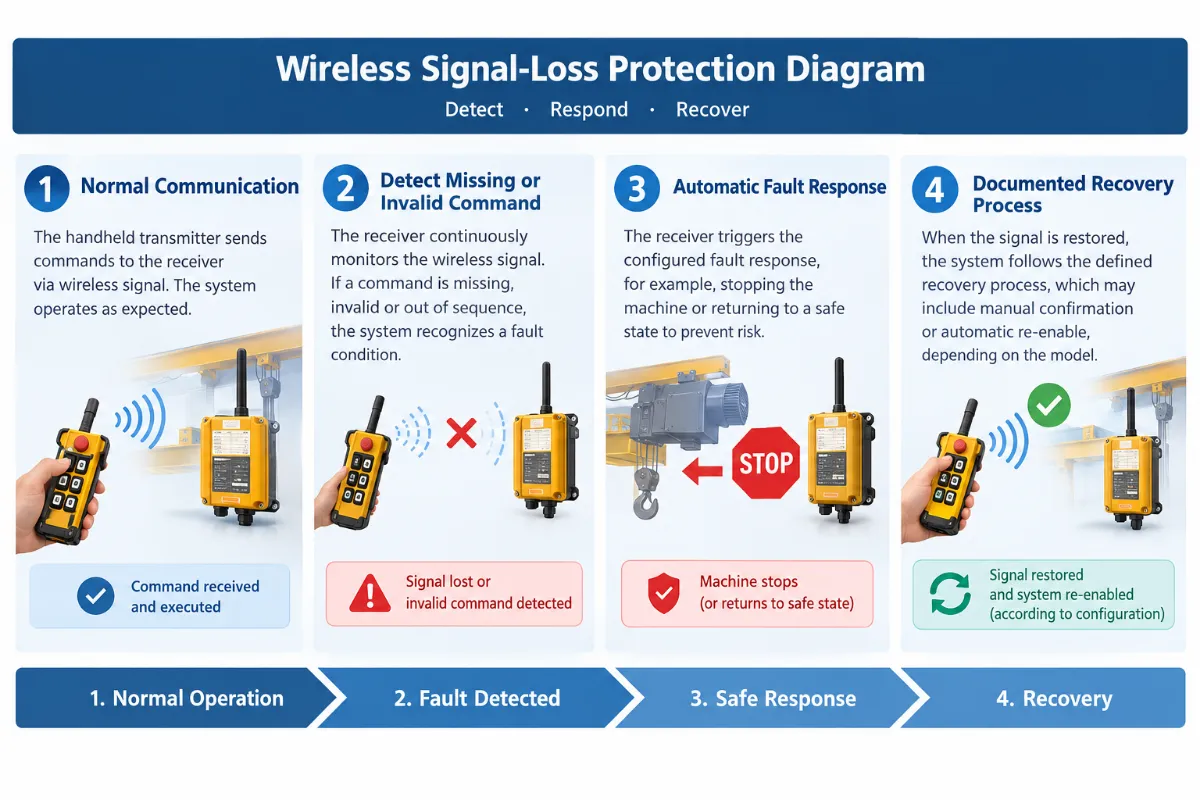
What Happens When Wireless Communication Is Lost?
Signal-loss protection is especially important because the operator may not know that a communication fault has occurred until the machine response or a status indicator makes it apparent.
Industrial radio remote-control systems can be designed to monitor valid communication and interrupt configured outputs when the link becomes unavailable. The exact method, timeout, diagnostic indication, and output behavior vary by model.
Caterpillar’s published description of Command for Excavating provides one manufacturer example: its specified remote-control configuration includes protective behavior that stops excavator movements if wireless communication is lost or the remote shutdown switch is activated. This demonstrates an implementation for a defined system, not a universal performance guarantee for every aftermarket remote controller. See Caterpillar’s excavator remote-control announcement.
What can cause signal loss?
Several different faults can interrupt communication or prevent the machine from accepting commands.
- Operating beyond the effective range: The operator moves farther away than the link can reliably support under actual site conditions.
- Radio interference: Other radio equipment, electromagnetic disturbances, or local environmental conditions affect communication.
- Transmitter power problems: A depleted battery, power-supply fault, or internal transmitter failure prevents valid commands from being sent.
- Receiver or machine-side failure: The receiving unit, its power supply, or its supporting control electronics malfunction.
- Antenna or installation problems: Damage, a loose connection, poor placement, or environmental exposure affects the communication path.
- Invalid or unrecognized commands: The receiver may reject signals that fail the system’s configured communication checks.
These conditions can have different diagnostic indications. A low-battery warning, an out-of-range alarm, and a receiver fault should not automatically be treated as the same event.
What should the machine do after communication loss?
The required response must be established during system design. It should be documented for the actual excavator and verified through an approved test procedure.
| Question | Evidence to request |
|---|---|
| How is loss of valid communication detected? | Manufacturer documentation describing monitoring and fault detection |
| What happens to movement commands? | Description of the receiver and machine-side output response |
| How are hazardous movements managed? | System-level explanation covering relevant machine functions and energy states |
| Is there an alarm or fault indication? | Operating instructions describing the indication and operator response |
| What happens when communication returns? | Documented recovery and re-enable procedure |
| How is the response verified? | Commissioning records and applicable test results |
There is no universal radio timeout that can be applied to every excavator remote-control system. A timeout used by one manufacturer must not be presented as the correct value for another machine without supporting design documentation.
The important requirement is that the detection and response meet the applicable safety design, work conditions, and documented acceptance criteria.
Does signal loss always mean that all hydraulic outputs should immediately switch off?
Not necessarily as a universal design rule. The response must be appropriate to the machine’s hazards and the function being controlled.
Removing a drive command may be necessary, but the resulting machine condition must also be considered. Depending on the equipment, abrupt deactivation, loss of holding capability, residual movement, or unexpected release of stored energy may introduce additional hazards.
The responsible engineering team must establish which outputs are disabled, which functions need to hold or brake, and how the machine reaches a safe condition. The final arrangement should be supported by an appropriate risk assessment and system verification, rather than a blanket assumption that de-energizing every output always resolves every hazard.
Protection Against Unexpected Movement
Emergency-stop and signal-loss functions are not the only safety considerations. A wireless controller must also prevent or detect unintended commands where required by the system design.
Neutral-position and unintended-command protection
An excavator should not begin moving merely because a transmitter is powered on, a battery is replaced, or communication is restored when an operating command remains active.
Relevant safeguards can include checks that movement controls are in their neutral positions, appropriate enabling logic, command validation, and defined restart conditions. Which measures are required depends on the system and its safety assessment.
Buyers should ask how the system behaves if a joystick is stuck away from neutral, a switch fails, or the transmitter is activated while a command control is already displaced. The answer should come from model-specific documentation, not an assumption based on the presence of a joystick spring or a visual inspection.
Transmitter and receiver identity
The system should establish which transmitter is authorized to control the receiver. This is particularly important at sites where more than one remotely controlled machine operates nearby.
The commissioning and operating procedures should address pairing or identification, use of spare transmitters, replacement equipment, and any controls needed to prevent an operator from unintentionally commanding the wrong machine.
The actual mechanism will depend on the product architecture. Buyers should verify the documented arrangement and follow the manufacturer’s procedure when adding or replacing a transmitter.
Battery and equipment condition
A damaged stop button, compromised enclosure, faulty joystick, loose connector, or low battery can interfere with reliable operation. A controller that appears to power on may still have a defective control or protective function.
Pre-use inspection should therefore include the checks specified in the manufacturer’s instructions. Any suspected safety-related defect should result in the unit being taken out of service until it has been assessed and repaired by an appropriate person.
Nomi provides information about radio interference and controller safety in its industrial wireless remote-control safety FAQ. The exact protective features and performance of a proposed Nomi configuration should still be confirmed against the applicable model documentation.
How Should Emergency Stop and Signal-Loss Protection Be Tested?
Protective functions should be verified during commissioning and maintained according to the manufacturer’s instructions. The objective is to show that the integrated system behaves as specified, rather than merely confirming that the transmitter and receiver can communicate.
Tests must be conducted by qualified personnel under an approved procedure. They should not involve exposing people to hazardous movement, creating a real uncontrolled radio failure during normal production, or bypassing the machine’s safety features.
Use a documented acceptance plan
Before testing, identify the required behavior for every safety-related event. The acceptance plan should be linked to the actual machine, the installed control configuration, and the relevant risk assessment.
The following table provides a planning framework, not a substitute for manufacturer-approved test instructions.
| Test area | What should be checked | Acceptance evidence |
|---|---|---|
| Emergency-stop control | The stop request is received and triggers the required response | Recorded test result against the defined requirement |
| Normal stop and neutral state | Releasing controls does not produce unexpected movement | Verified response for applicable operating functions |
| Signal-loss protection | The prescribed communication-fault response occurs | Test record showing the observed behavior meets the approved specification |
| Power interruption | Relevant transmitter or receiver power faults are handled as designed | Documented response and recovery behavior |
| Restart protection | Restoring communication does not unexpectedly restart movement | Successful verification of the required re-enable sequence |
| Command mapping | Controls operate the intended functions and directions | Completed function-by-function check |
| Fault indication | The operator can recognize relevant alarms and faults | Confirmed indications and instructions |
| Machine-side response | Hydraulic and mechanical behavior is consistent with the safety design | Assessment and test records from the responsible integrator |
Verify the complete machine, not just the radio link
A wireless link can pass its communication test while the integrated machine still contains a problem. Incorrect output wiring, an incompatible valve interface, a controller configuration error, or a machine-side fault may prevent the intended response from occurring.
The commissioning procedure should therefore evaluate the receiving system and relevant machine functions as a complete installation.
The test method must also reflect the machine’s actual hazards. A test that is suitable for an isolated laboratory receiver may be inappropriate for an excavator with raised equipment or people working nearby.
Define retesting after maintenance or modification
Safety-related behavior may need to be checked again after relevant repairs, component replacement, parameter changes, or machine modifications.
The maintenance plan should identify which changes require inspection, functional testing, or renewed validation. Any change to a transmitter, receiver, control output, safety circuit, or machine-side interface should be reviewed for its effect on the approved configuration.
Which Safety Standards Should Buyers Check?
Standards provide technical frameworks for evaluating machine and control-system safety. Their relevance depends on the excavator, the control architecture, the modification, and the country where the equipment is used.
The following references are particularly relevant to evaluating a remote-controlled excavator.
ISO 15817:2012
ISO 15817:2012, Earth-moving machinery: Safety requirements for remote operator control systems specifically addresses essential safety requirements for remote operator control systems used on earth-moving machinery defined by ISO 6165.
The ISO catalogue confirms that the 2012 edition remains current following its review in 2023. This makes it a particularly relevant starting point when evaluating remote operator control for an excavator.
The scope matters: ISO states that the standard does not apply to autonomous control systems that enable a machine to operate without an operator’s assistance, nor does it apply to remote control of attachments on machines that are not themselves remotely controlled.
ISO 13849-1:2023
ISO 13849-1:2023, Safety of machinery: Safety-related parts of control systems provides a methodology and associated requirements for designing and integrating safety-related parts of control systems.
Its published scope makes clear that it does not specify the required performance level for every application. The appropriate requirements must be determined from the machinery and its hazards, together with any applicable machine-specific standard.
Consequently, a supplier’s reference to ISO 13849-1 does not by itself prove that the completed excavator has achieved a particular performance level.
IEC 60204-1:2016+A1:2021
IEC 60204-1:2016+A1:2021, Safety of machinery: Electrical equipment of machines addresses machine electrical, electronic, and programmable electronic equipment. Its published scope includes requirements concerning emergency stops and control-circuit protection.
Whether and how this standard applies to a particular mobile machine or retrofit must be assessed with the other applicable standards and regulations. It should not be treated as a replacement for the earth-moving machinery requirements.
Legal requirements and site rules
Applicable legal obligations can differ by country and region. For example, the UK Health and Safety Executive’s guidance on mobile work equipment states that remote-controlled, self-propelled work equipment must have a means to stop safely and automatically when it leaves its control range if it presents a safety risk while moving. The guidance also covers safeguarding against crushing and impact hazards.
This is a UK-specific source. Buyers operating in other markets should check the applicable local machinery, radio-equipment, and workplace-safety requirements.
A standard reference is not the same as product certification. A supplier should provide the documents that apply to the exact model and configuration being offered, and the responsible party should determine whether the installed system meets the project’s applicable requirements.
What Should Buyers Ask a Remote-Control Supplier?
A safety-focused quotation should identify more than the transmitter model, radio frequency, operating distance, and enclosure protection rating.
It should explain how the complete system addresses foreseeable hazards and what evidence supports the relevant claims.
| Supplier question | Why it matters |
|---|---|
| What happens when the emergency-stop control is activated? | Establishes the intended machine-level response |
| What happens when valid wireless communication is lost? | Confirms automatic fault behavior and recovery requirements |
| Does communication restoration cause automatic movement? | Addresses unexpected restart risk |
| How are unintended commands or controls held away from neutral handled? | Clarifies the protection against unintended operation |
| Which machine functions are included in the stop response? | Prevents ambiguity about the protective scope |
| What safety-related components are included? | Distinguishes ordinary radio control from relevant safety-system components |
| Which standards and requirements apply? | Establishes the technical basis for evaluation |
| Which declarations, certificates, or test records are available? | Provides documentary evidence for specific claims |
| Who is responsible for machine integration and validation? | Clarifies accountability across the control system |
| What inspections and maintenance checks are required? | Supports safe operation after handover |
A quotation that uses terms such as failsafe, safety-rated, SIL, or PL should be backed by model-specific information and appropriate evidence. Buyers should not infer a particular rating from the use of a safety button, a dual-channel connector, or a general statement that a system is designed for industrial use.
For buyers evaluating a Nomi configuration, the industrial hydraulic remote-control systems category and the excavator remote-control product page provide product starting points. The exact model, scope, safety documentation, and intended application should be confirmed before a purchase decision.
Common Mistakes When Evaluating Excavator Remote-Control Safety
Assuming the emergency-stop button proves the whole system is safe. The button is only one component of the protective function. The receiving system, machine-side circuits, and hydraulic behavior also need to be evaluated.
Treating signal loss as an ordinary stop command. An automatic communication-fault response must operate without relying on an operator who may not realize that valid commands are no longer being received.
Assuming all products use the same timeout. Detection intervals, fault responses, and restart rules vary by system. Generic figures should not replace the applicable technical documentation.
Equating an electrical output shutdown with a safe machine state. Hazardous movement, residual energy, holding requirements, and the behavior of the hydraulic system must be considered.
Assuming that the radio link returning means operation can resume. The restart sequence should be clearly defined, tested, and understood by the operator.
Accepting a safety rating without supporting documents. Confirm exactly which product, configuration, safety function, and certification or assessment the documentation covers.
Testing protective functions during uncontrolled production. Emergency-stop and signal-loss verification must follow an appropriate test plan with suitable precautions. Deliberately creating a fault in an operating machine without such controls is not an acceptable substitute for commissioning.
Ignoring operator training and maintenance. Safety behavior depends on correct use, equipment condition, inspection, and response to faults, not just the system’s original design.
How Nomi Can Support an Excavator Remote-Control Safety Inquiry
Nomi offers industrial wireless remote-control products for hydraulic machinery, including excavator-related control solutions. Evaluating a suitable configuration starts with the excavator model, required functions, machine-side interface, operating environment, and safety requirements.
For a useful technical inquiry, provide the excavator’s make and model, its existing control arrangement, the movements that need to be controlled remotely, and any available hydraulic or electrical diagrams. State the emergency-stop and signal-loss requirements explicitly.
Ask for the technical documentation relevant to the proposed model, including its defined fault response, restart behavior, applicable declarations or certificates, and available test evidence. If the project requires machine integration, clarify who is responsible for the engineering assessment, commissioning, and acceptance of the completed system.
Nomi’s contact page can be used to discuss project requirements and request a configuration-specific quotation.
The central purchasing principle is straightforward: evaluate the demonstrated behavior of the complete excavator control system, not merely the features printed on the remote controller’s datasheet.
Frequently Asked Questions
1. What is the difference between an emergency stop and signal-loss protection?
An emergency stop is initiated deliberately by the operator. Signal-loss protection is an automatic response when the system can no longer receive valid commands under its defined communication rules. Both require appropriate system-level behavior, but they have different triggers and should be tested separately.
Not necessarily in the sense of coming to a physical standstill at the instant the button is pressed. The control system must initiate the specified stop response, while actual machine movement can involve inertia, hydraulic behavior, or stored energy. The required response must be established through the machine’s safety design and verified for the intended application.
3. What causes an excavator wireless remote control to lose its signal?
Potential causes include operation beyond the effective communication range, interference, transmitter battery or power problems, antenna damage, receiver faults, and other communication failures. The exact cause should be diagnosed using the manufacturer’s instructions and the system’s available status indications.
4. Should the excavator restart automatically when the wireless connection returns?
Unexpected restart should be prevented where it could create a hazard. The permitted recovery procedure should be defined by the system design and operating instructions, then verified during commissioning.
5. Is a fail-safe receiver enough to guarantee excavator safety?
No. The receiver is only part of the integrated system. Safety also depends on the machine-side outputs, control logic, hydraulic system, stopping behavior, restart conditions, and other protective measures required by the risk assessment.
6. How often should the emergency-stop function be checked?
Follow the inspection and test intervals specified by the manufacturer, site procedures, and applicable regulations. Pre-use checks should be performed as required by the operating instructions, with more formal functional testing carried out according to the documented maintenance and verification plan.
7. Does IP67 protection mean a remote controller is safety-rated?
No. An ingress-protection rating concerns protection against the entry of solids and water under specified test conditions. It does not establish the safety performance of the emergency-stop function, signal-loss response, or complete machine integration.
8. What is the difference between SIL and PL?
Safety Integrity Level (SIL) and Performance Level (PL) belong to different functional-safety frameworks and assessment approaches. They should not be treated as interchangeable labels. The applicable methodology and required performance depend on the machine, the safety function, and the relevant standards.
9. Which standard is specifically relevant to remote control of earth-moving machinery?
ISO 15817:2012 specifically addresses safety requirements for remote operator control systems used on earth-moving machinery. Other standards may apply to safety-related control-system parts and electrical equipment, depending on the particular design and regulatory context.
10. What safety documents should be requested from a remote-control supplier?
Request the technical datasheet, operating and maintenance instructions, description of emergency-stop and signal-loss behavior, relevant declarations or certificates, applicable safety documentation, and supporting test records. Confirm that the documents apply to the exact model and configuration being purchased.
