

An industrial wireless remote control can operate anywhere from tens or hundreds of meters to significantly longer distances, depending on the radio system, antenna configuration, installation environment, interference, and application requirements. There is no single distance that applies to every industrial remote control.
Manufacturer specifications illustrate this variation. Some industrial systems specify around 100 m, while other systems publish typical ranges around 180 m, 300 ft / 100 m line of sight, or up to 1 km depending on the application and operating conditions.
If your project requires the use of Industrial Wireless Remote Control, you can contact us for a free quote.
The important point for an engineer or buyer is that advertised range is not necessarily the same as reliable working range at the machine.
For a hydraulic excavator, crane, concrete pump, hoist, or other heavy machine, the right question is not simply “How many meters can the remote control reach?” A better question is:
Can the wireless link maintain reliable and predictable control throughout the entire area where the operator needs to work?
What Does “Operating Range” Actually Mean?
Operating range is the maximum distance over which a transmitter and receiver can maintain the required wireless communication.
However, the number can be defined differently by different manufacturers.
A published range may represent:
- Maximum communication distance under favorable conditions.
- Typical operating distance.
- Line-of-sight distance.
- Outdoor distance.
- Distance measured with a particular antenna.
- Distance under a specific radio configuration.
- Distance including feedback communication..
- A tested range for a particular machine or application.
These conditions matter.
For example, Cattron describes operating range as application-dependent and identifies antenna placement, interference, physical obstructions, and environmental conditions as important factors.
This means that a specification such as “range: 300 m” should not automatically be interpreted as:
“The operator can stand 300 m away from the machine and expect identical communication performance in every environment.”
A more useful specification should tell the buyer how the distance was determined.
Maximum range vs reliable operating range
These two concepts should be separated.
| Term | What it means | Why it matters |
|---|---|---|
| Maximum range | Longest distance at which communication may still be maintained | Useful as a reference, but not enough for system selection |
| Typical range | Distance normally achievable under stated conditions | More useful for initial comparison |
| Line-of-sight range | Distance with relatively unobstructed radio propagation | Often differs substantially from industrial environments |
| Reliable operating range | Distance at which communication remains suitable for the intended application | Most important for machine operation |
| Required operating range | Distance the operator actually needs to control the machine | Should be defined before selecting the system |
For industrial machinery, required operating range and reliable operating range are more important than the theoretical maximum.
How Far Do Industrial Wireless Remote Controls Typically Work?
There is no universal industry-wide range.
Published manufacturer specifications show substantial differences between systems.
For example, JUUKO lists a typical operating range of 100 m for one of its industrial radio remote-control series.
Cattron’s industrial systems include products with operating ranges around 100 m, 180 m typical, and approximately 600 ft depending on the specific model and operating conditions.
Other industrial radio systems specify considerably longer distances. Cattron’s XBMCU, for example, lists an operating range of up to 1 km depending on the application and conditions.
These specifications demonstrate an important principle:
Range is a system characteristic, not a universal characteristic of “industrial wireless remote controls.”
The appropriate range depends on the machine and its operating environment.
For example:
- A factory hoist may only require approximately 50 to 100 m.
- A construction machine may require a larger working area.
- A mining machine may require substantially greater separation between the operator and machine.
- A large outdoor site may require an extended-range communication architecture.
- A machine operating inside a steel-heavy building may experience shorter practical range than an equivalent system tested outdoors.
The application should therefore determine the range requirement, rather than choosing the application based on a manufacturer’s largest advertised number.
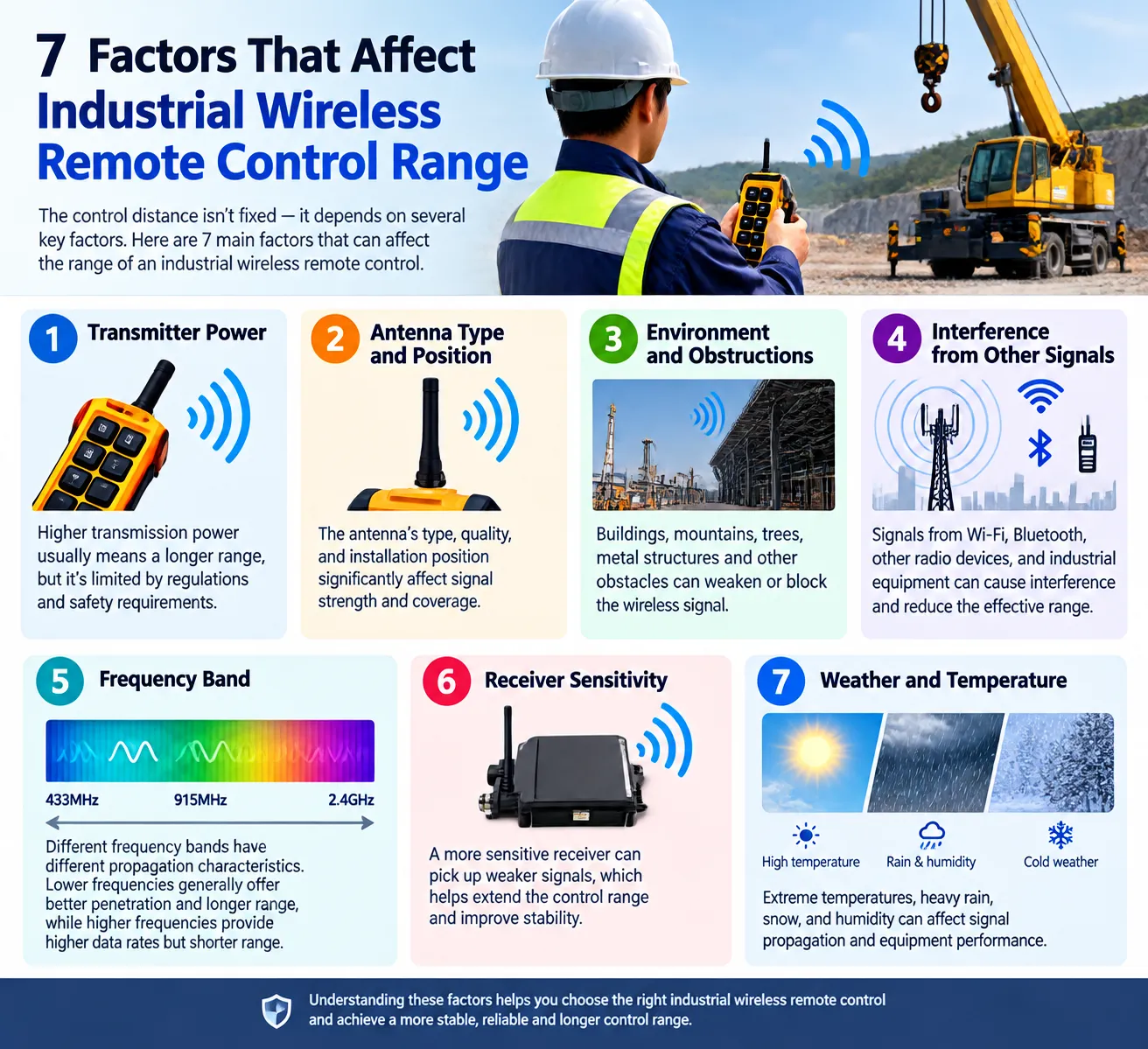
7 Factors That Affect Industrial Wireless Remote Control Range
1. Line of Sight
Line of sight is one of the simplest factors to understand.
When there is a relatively clear path between the transmitter and receiver, radio communication generally has fewer physical obstructions to overcome.
The situation changes when the signal must pass through:
- Steel walls
- Concrete structures
- Machinery
- Storage racks
- Buildings
- Containers
- Vehicles
- Hills or terrain
- Other large physical structures.
Cattron specifically identifies line-of-sight considerations and physical obstructions as factors that can reduce effective operating range.
This is particularly relevant to industrial machinery because many industrial facilities contain large amounts of metal.
An operator may technically be only 150 m from a machine, but if the receiver antenna is positioned behind several large steel structures, the radio path can be much less favorable than the physical distance suggests.
2. Antenna Position
A good radio system can still perform poorly if the antenna is installed in an unfavorable location.
The receiver antenna should be considered as part of the complete wireless system, not simply as an accessory attached after installation.
Important considerations include:
- Antenna height.
- Antenna orientation.
- Distance from large metal structures.
- Distance from high-power electrical equipment.
- Cable routing.
- External vs internal antenna.
- Receiver location.
- Whether the antenna has an unobstructed path toward the typical operating area.
Some industrial remote-control systems provide external antenna options specifically to accommodate installation requirements. JUUKO, for example, lists both internal and external antenna configurations on some receiver products.
For a machine that regularly operates over a large area, antenna installation can be just as important as the nominal radio specification.
3. Physical Obstructions
Radio waves do not simply behave like a laser beam traveling through empty space.
Industrial environments contain many objects that can alter propagation.
Examples include:
- Steel frames
- Crane structures
- Hydraulic equipment
- Large vehicles
- Concrete walls
- Factory equipment
- Shipping containers
- Storage systems
- Buildings
The effect depends on the material, geometry, frequency, antenna arrangement, and radio system.
A remote control that works well across an open yard may behave differently inside a factory filled with steel structures.
This is why a supplier should ideally know the intended operating environment before confirming a specific range.
4. Radio Interference
Industrial facilities can contain many sources of electromagnetic activity.
Potential sources include:
- Welding equipment
- Variable-frequency drives
- Motors
- Inverters
- Other wireless systems.
- Industrial communication equipment.
- Nearby radio devices.
Cattron identifies interference as one of the factors that can affect operating range and notes that license-exempt bands can contain multiple wireless technologies.
Modern industrial radio systems may use techniques such as frequency diversity or automatic channel switching to improve communication in environments where interference occurs.
For example, JUUKO describes automatic channel switching that can move communication to another frequency when interference is detected.
This does not mean that a frequency-hopping or channel-switching system is immune to every radio problem. It means that the communication architecture has been designed to improve robustness under certain interference conditions.
5. Radio Frequency
Frequency is another factor buyers often misunderstand.
Industrial remote controls may be available in different frequency bands, including sub-GHz frequencies and 2.4 GHz systems. Product specifications from industrial remote-control manufacturers demonstrate that multiple frequency configurations are used in real applications.
However, it is not accurate to say:
“A lower frequency always gives longer range.”
Frequency interacts with antenna design, transmitter power, receiver sensitivity, modulation, bandwidth, installation, regulatory limits, and the surrounding environment.
Therefore, frequency should be treated as one part of the radio design, not as a standalone range guarantee.
When comparing two systems, ask the supplier for the actual tested or specified range under comparable conditions rather than choosing solely from the frequency number.
6. Antenna and Receiver Configuration
The transmitter is only one half of the communication link.
The receiver, receiver antenna, antenna cable, installation location, and communication architecture all influence the practical result.
Some industrial systems support external antennas or different antenna arrangements. JUUKO, for example, lists internal and external antenna options on its receiver series.
This can be important when the receiver is installed inside a metal enclosure or on a machine with substantial metal structures.
For a demanding application, the buyer should therefore ask:
Where will the receiver antenna be installed?
rather than asking only:
How powerful is the transmitter?
7. Environmental Conditions
The surrounding environment can also influence radio communication.
Industrial applications may involve:
- Indoor and outdoor operation.
- Rain
- Moisture
- Dust
- Temperature extremes.
- Large moving machinery.
- Dense industrial structures.
- Changing machine positions.
Cattron identifies environmental conditions as one of the factors that should be considered when evaluating industrial wireless operating range.
The important distinction is that environmental protection and radio range are related to the overall system design, but they are not the same specification.
For example, an IP-rated enclosure indicates protection against specified environmental ingress conditions. It does not automatically mean that the radio will have a longer operating distance.
Why Advertised Range Can Be Different From Real-World Range
A common mistake in purchasing is comparing products only by their largest range number.
Imagine two products:
| Product | Advertised range | Test condition |
|---|---|---|
| System A | 100 m | Typical industrial specification |
| System B | 300 m | Open-area or line-of-sight specification |
At first glance, System B appears to have three times the range.
But this comparison may be misleading if the two manufacturers used different test conditions.
A useful RF specification should ideally identify:
- Frequency
- Transmitter power
- Antenna type
- Antenna location
- Receiver configuration
- Test environment
- Line-of-sight condition
- Whether feedback is included
- Whether the distance represents typical or maximum operation.
Without this information, a range number alone is difficult to compare.
This is one reason Cattron recommends evaluating operating range according to the actual application and environment rather than simply selecting the longest-distance system.
Does a Longer Range Always Mean a Better Industrial Remote Control?
No.
A longer operating range is not automatically an advantage.
In some applications, the operator needs to remain relatively close to the machine so that direct visual observation is maintained.
For example, Hexagon’s mining radio remote-control system specifies operation from up to 1,000 ft outdoors and 300 ft underground while emphasizing direct visual contact with the machine.
This illustrates an important engineering principle:
Communication range and safe operating distance are not the same thing.
A radio system may technically communicate over a much greater distance than the operator should use during normal machine operation.
There are also applications where excessive operating range can create an undesirable operating zone if the control system is not properly configured.
Some industrial systems therefore include range-limiting functions. JUUKO describes range limiting as a feature that can restrict the distance within which a transmitter can start or operate the system.
The correct range is therefore the range required by the application, not necessarily the maximum range that the radio can achieve.
What Range Should You Specify When Buying a Hydraulic Remote Control?
For a hydraulic machine, start with the actual working area.
Do not simply tell the supplier:
“I need a long-range wireless remote.”
Instead, provide information such as:
Machine: Excavator
Application: Demolition
Required operating distance: 150 m
Environment: Outdoor construction site
Line of sight: Mostly clear
Hydraulic control: Proportional
Machine voltage: 24 VDC
Feedback required: Yes / No
Receiver location: Inside machine electrical enclosure
This gives the supplier a much better basis for selecting the radio system.
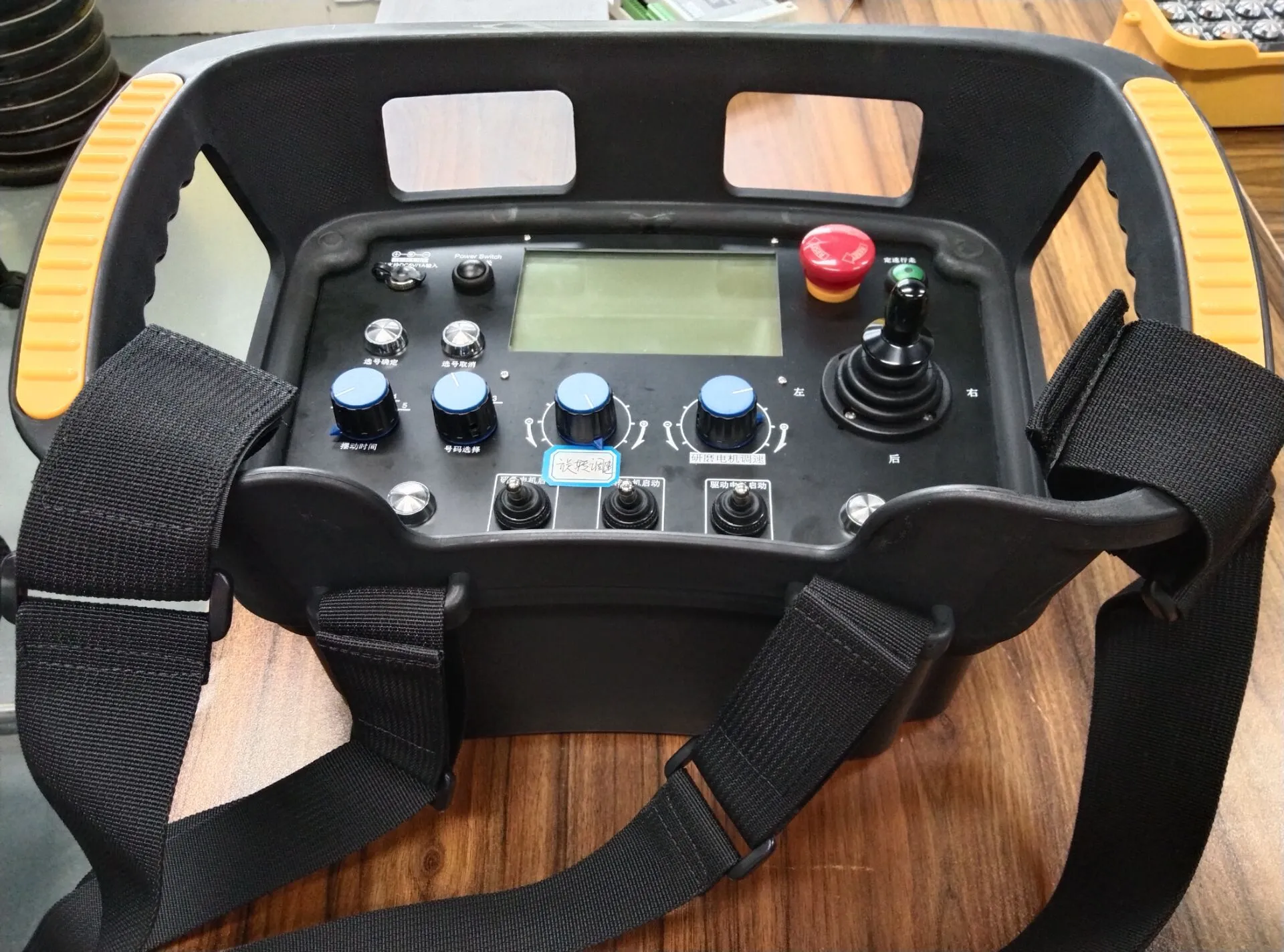
For applications requiring proportional hydraulic movement, an industrial joystick remote control may be more appropriate than a simple push-button system because the control architecture needs to transmit variable commands rather than only discrete on/off instructions.
For machines using electrohydraulic control, an industrial hydraulic remote control system can be configured around the machine’s existing hydraulic and electrical architecture.
The range requirement should then be evaluated together with the control functions, safety architecture, receiver installation, and machine environment.
A Practical Range Specification for Industrial Buyers
A useful RFQ should contain more than one number.
Instead of:
Wireless remote control, range 500 m.
Use something closer to:
Industrial wireless remote control, required operating distance 300 m, outdoor application, predominantly line-of-sight, proportional hydraulic control, 24 VDC machine, receiver mounted on machine, reliable communication required throughout the specified operating area.
This allows the manufacturer to assess whether the requested range is appropriate.
For a more demanding application, also provide:
- Maximum distance between operator and machine.
- Minimum distance.
- Typical operating distance.
- Indoor or outdoor environment.
- Major steel or concrete obstructions.
- Approximate machine dimensions.
- Receiver installation position.
- Whether an external antenna is possible.
- Whether communication feedback is required.
- Whether the operator must maintain visual contact.
- Required control functions.
- Machine operating voltage.
The more accurately the operating environment is described, the more meaningful the range recommendation becomes.
Common Mistakes When Comparing Wireless Remote Control Range
Mistake 1: Comparing maximum numbers only
A 1,000 m specification may look better than a 300 m specification, but the two numbers may have been obtained under completely different conditions.
Always ask what the published range represents.
Mistake 2: Assuming frequency determines range
Frequency affects radio propagation, but frequency alone does not determine the usable range.
The complete RF design matters.
Mistake 3: Ignoring antenna installation
A receiver mounted inside or behind a large metal structure may produce very different results from a receiver with a properly positioned external antenna.
Mistake 4: Treating open-field testing as factory testing
An open field has very different radio conditions from a steel processing plant, warehouse, construction site, or mining environment.
Mistake 5: Specifying an unnecessarily long range
If the operator normally works within 100 m, specifying a 1 km range may not provide any practical benefit.
The system should be designed around the actual operating area.
Mistake 6: Forgetting communication reliability
The important question is not simply whether a command can reach the receiver once.
Industrial control requires predictable communication and an appropriate response to communication loss.
Therefore, buyers should ask suppliers about the system’s behavior when the radio link is interrupted, rather than focusing only on maximum distance.
How to Test Industrial Wireless Remote Control Range
For an important installation, range should ideally be verified under representative operating conditions.
A practical range test can include:
Step 1: Establish the required operating boundary
Identify the farthest locations from which the operator is expected to control the machine.
Step 2: Test typical positions
Do not test only the best-case position.
Test locations that represent normal machine operation.
Step 3: Test difficult positions
If the machine operates around buildings, steel structures, containers, or other equipment, include these positions in the test.
Step 4: Test antenna orientation and installation
Confirm that the receiver antenna is installed in its intended final position.
Step 5: Check communication behavior
Do not only test whether a command is received.
Check whether communication remains stable and whether the machine responds as expected throughout the operating area.
Step 6: Test the communication-loss response
The system should have an appropriate response if the radio link is lost.
This is particularly important for safety-related machine control.
Step 7: Repeat after final installation
A range test performed before the receiver and antenna are installed in their final positions may not represent the finished machine.
Range Is Only One Part of an Industrial Wireless Remote Control
For hydraulic and heavy machinery, selecting a remote control based solely on distance is incomplete.
The system also needs to match:
- Control type
- Hydraulic valve interface
- Proportional resolution
- Number of channels
- Receiver outputs
- Machine voltage
- Communication protocol
- Emergency-stop architecture
- Feedback requirements
- Environmental protection
- Antenna configuration
- Operating temperature
- Machine integration requirements
For example, an excavator requiring proportional hydraulic control has different requirements from a simple hoist requiring several discrete commands.
Similarly, a concrete pump truck may require a different control architecture from a construction crane.
Nomi’s product range includes construction crane remote controls, concrete pump truck remotes, joystick remote controls, and push-button remote controls, reflecting these different application requirements.
The range specification should therefore be considered together with the machine’s complete control architecture.
What Should You Ask an Industrial Remote Control Supplier?
Before purchasing, ask the supplier these questions:
| Question | Why it matters |
|---|---|
| What is the typical operating range? | More useful than maximum range alone |
| Is the stated range line of sight? | Identifies test conditions |
| How was the range tested? | Allows meaningful comparison |
| What antenna is used? | Antenna affects communication performance |
| Can an external antenna be installed? | Useful for difficult machine installations |
| What frequency or frequency bands are available? | Helps evaluate the radio architecture |
| How does the system handle interference? | Important in industrial environments |
| What happens when communication is lost? | Important for machine safety |
| Is feedback communication required? | Two-way communication can change system requirements |
| Can the operating range be limited? | Useful when the machine has a defined operating zone |
| Can the system be tested on the actual machine? | Provides more representative results |
| What environmental conditions apply to the specification? | Prevents misleading range comparisons |
A supplier who can answer these questions clearly gives the buyer much more useful information than a supplier who only provides a single distance number.
Final Takeaway: Focus on Reliable Range, Not the Biggest Number
Industrial wireless remote controls can operate over very different distances. Published specifications from manufacturers range from around 100 m to several hundred meters and, for some systems, approximately 1 km or more under specified conditions.
But there is no universal “industrial wireless remote control range.”
The actual usable distance depends on the complete communication system and its environment.
The most important factors are:
- Line of sight
- Antenna location and configuration
- Physical obstructions
- Radio interference
- Frequency and radio architecture
- Receiver installation
- Environmental conditions.
For buyers, the best approach is to define the actual operating area first and then ask the supplier to confirm whether the proposed system can provide reliable communication throughout that area.
For hydraulic machinery, range should also be evaluated together with proportional control, receiver integration, machine voltage, hydraulic interface, feedback, and safety requirements.
A remote control that provides a slightly lower published maximum range but reliable communication throughout the actual working area can be more appropriate than a system advertised with a much larger distance under ideal conditions.
The useful specification is not “How far can the signal travel?” It is “How far can the machine be controlled reliably under the conditions in which it will actually operate?”
FAQs
1. How far can an industrial wireless remote control work?
There is no universal distance. Published industrial systems range from around 100 m to several hundred meters, while some specialized systems specify approximately 1 km or longer under particular conditions. Actual range depends on the radio system, antenna, obstacles, interference, and operating environment.
2. Does 433 MHz have a longer range than 2.4 GHz?
Not necessarily. Frequency influences propagation characteristics, but usable range also depends on transmitter power, receiver sensitivity, antenna design, modulation, interference, installation, and regulatory requirements. Frequency alone should not be used to predict range.
3. Does line of sight improve wireless remote-control range?
Generally, a clearer radio path reduces the number of physical obstructions affecting communication. Industrial structures, machinery, concrete walls, and steel equipment can reduce practical range.
4. Can an industrial wireless remote control work through steel?
It can communicate in environments containing steel, but large steel structures can affect radio propagation and create difficult communication conditions. Antenna placement and system design become particularly important in steel-intensive industrial environments.
5. Why is the actual range shorter than the manufacturer’s specification?
The manufacturer’s specification may be based on a particular test condition, such as line of sight or a defined installation. The actual application may contain obstacles, interference, unfavorable antenna placement, or other environmental factors that reduce effective range.
6. Is a 1 km industrial remote control always better than a 100 m system?
No. The required range depends on the application. If the operator normally works within 100 m, a longer theoretical range may not provide a practical benefit. Range should be matched to the required operating area and safety requirements.
7. Can an external antenna increase operating range?
An external antenna can allow the antenna to be positioned more appropriately relative to the machine and surrounding structures. Some industrial remote-control systems provide external antenna configurations.
8. What range should I specify when requesting a quotation?
Provide the maximum required operator-to-machine distance together with the application, indoor/outdoor environment, line-of-sight conditions, major obstacles, machine type, receiver location, and control requirements. This gives the supplier enough information to evaluate the requested range properly.
9. How should industrial remote-control range be tested?
The test should include the actual machine, final receiver and antenna installation, normal operating positions, difficult positions, and the maximum required operating distance. Communication behavior should also be checked when the link becomes weak or is interrupted.
10. What is more important than maximum range?
For industrial machine control, reliable communication throughout the required operating area is more important than the largest possible range number. A range specification should therefore always be considered together with the installation environment and machine-control requirements.
