

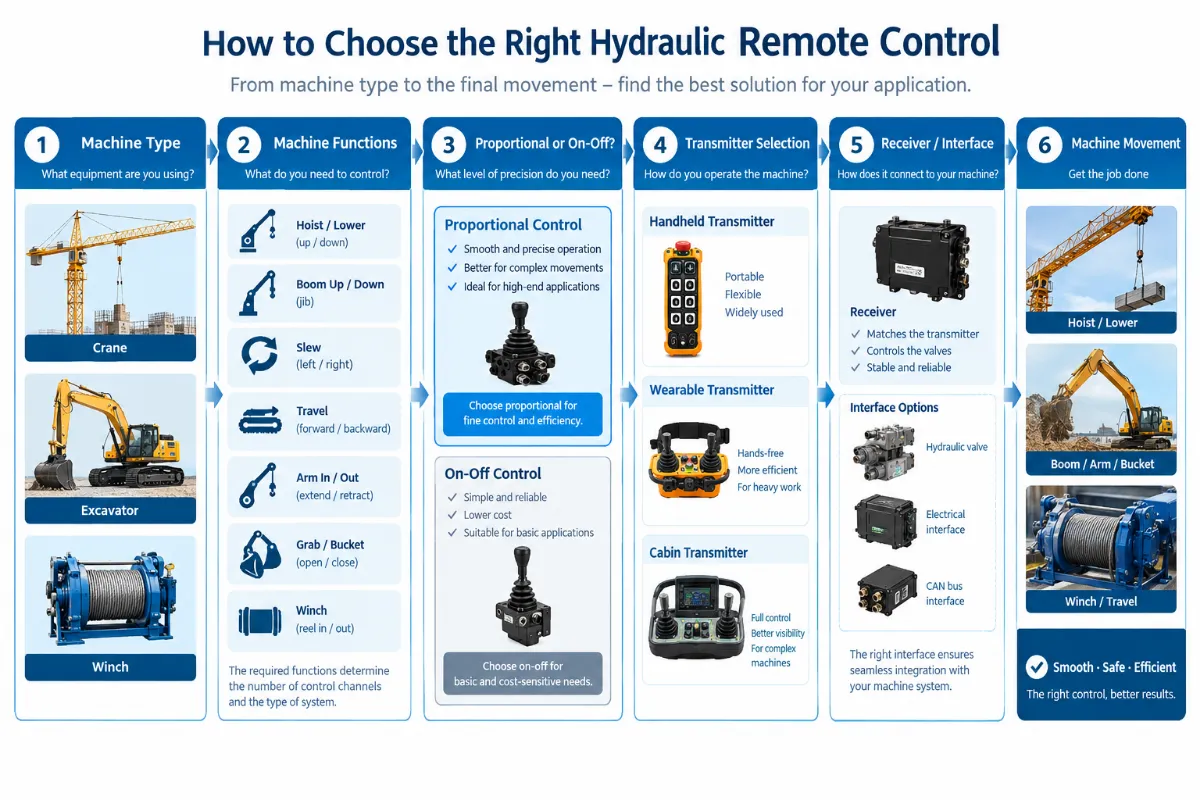
Selecting a joystick remote control for a crane, excavator, or winch should start with the machine, not the handheld transmitter. The correct system depends on the machine’s movements, whether those movements require proportional or on/off control, the hydraulic or electrical interface, the number of control functions, operating environment, communication range, and required safety functions.
A remote with more joysticks, more buttons, or a longer advertised range is not automatically the right choice. The receiver and machine interface are equally important. For hydraulic equipment, the system may need to convert joystick movement into proportional valve commands or pilot pressure rather than simply switching a relay on and off.
Nomi provides industrial wireless remote control systems for applications including cranes, excavators, hydraulic equipment and other construction machinery. Its product range includes hydraulic proportional systems, joystick industrial radio remote controls and push-button industrial radio remote controls.
1. Start With the Machine, Not the Remote Control
The first question should not be “Which remote control should I buy?”
It should be:
What exactly does the machine need the operator to control?
List every independent machine function before selecting the transmitter.
For a typical crane, this may include:
- Hoisting up and down
- Slewing left and right
- Boom raising and lowering
- Boom extension and retraction
- Trolley travel
- Bridge travel
- Auxiliary functions
- Emergency stop
- Engine or power control
An excavator may require:
- Boom
- Arm
- Bucket
- Swing
- Left travel
- Right travel
- Auxiliary hydraulic functions
- Blade
- Engine speed
- Attachment functions
A winch may need considerably fewer functions:
- Winch in
- Winch out
- Start/stop
- Speed control
- Clutch or auxiliary function
- Emergency stop
This first step determines the required number of control axes, switches, proportional channels and digital outputs.
For crane applications, control arrangement also deserves attention. ISO 7752 establishes principles for crane control layout and characteristics, while different parts address specific crane types. ISO 7752-1 covers general principles, and ISO 7752-2:2025 addresses the basic arrangement and movement of controls for mobile cranes.
The important point for remote-control selection is that the wireless transmitter should reproduce an understandable and appropriate control interface for the machine. A remote system should not be selected independently of the machine’s existing control philosophy.
2. Decide Whether You Need Proportional or On/Off Control
This is one of the most important decisions.
There are two basic control approaches.
| Control type | How it works | Typical use | Main limitation |
|---|---|---|---|
| On/off | Command is essentially on or off | Simple auxiliary functions, basic winches, simple equipment | Limited speed and positioning control |
| Multi-step | Several fixed speed levels | Some hoists and cranes | Less precise than continuous control |
| Proportional | Output changes according to joystick position | Excavators, hydraulic cranes, precision lifting | More complex integration |
| Mixed | Proportional axes plus on/off functions | Many hydraulic machines | Requires correct channel and interface configuration |
When is proportional control useful?
Proportional control becomes important when the operator needs to regulate movement rather than simply start or stop it.
Consider lowering a suspended load.
With a simple on/off command, the operator may have only a fixed lowering speed. The operator has to repeatedly start and stop the movement to position the load.
With proportional control, joystick displacement can determine the commanded output. Small joystick movement can produce a low-speed command, while greater displacement produces a higher command.
The same principle is useful for:
- Fine load positioning
- Boom movement.
- Excavator attachment control.
- Winch speed control.
- Swing control.
- Coordinated hydraulic movements.
For a hydraulic machine, however, proportional control requires more than a proportional joystick. The receiver output must be compatible with the machine’s valve or control system.
A proportional hydraulic remote-control system may involve the transmitter, receiver, proportional output stage, valve amplifier and hydraulic valve interface.
This is why buyers should not specify only “wireless joystick remote control” when requesting a quotation.
They should also specify how the machine is currently controlled.
3. Understand the Difference Between a Joystick and a Hydraulic Proportional System
The terms “joystick remote control” and “hydraulic proportional remote control” are sometimes used interchangeably, but they describe different aspects of the system.
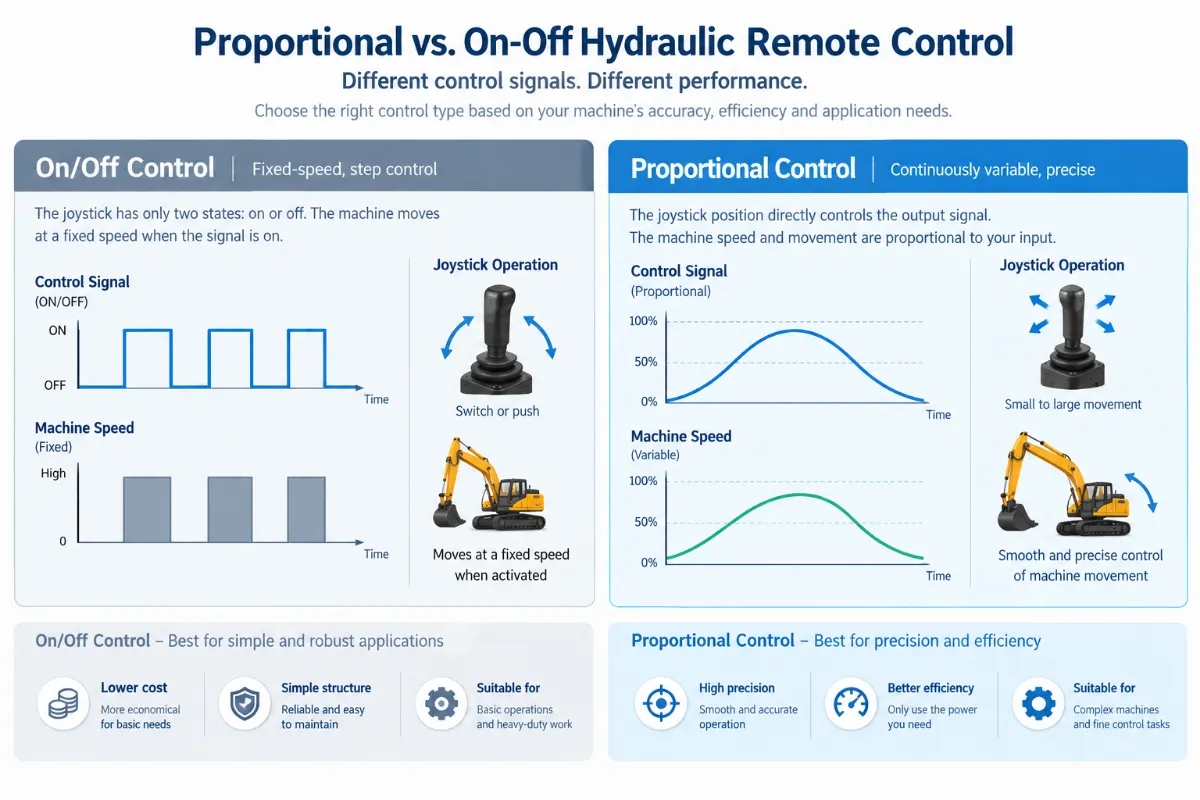
A joystick describes the operator input device.
A proportional hydraulic system describes how that command is converted into a variable hydraulic output.
The signal path can be simplified as:
Operator joystick → transmitter → wireless link → receiver → control output → valve/actuator → machine movement
If the machine uses a hydraulic pilot-control system, the receiver may need to interface with proportional pressure-reducing valves or another compatible hydraulic control architecture.
For example, an excavator retrofit may require separate control channels for boom, arm, bucket, swing, travel and auxiliary functions. The exact configuration depends on the excavator and its existing control system.
This means a technically suitable selection requires information about the machine’s existing valves, pilot circuit, electrical supply and control interface.
Nomi’s hydraulic industrial radio remote control systems are designed for applications such as cranes, excavators, hydraulic valves, loaders and other hydraulic equipment, with configurable control functions depending on the application.
4. Choose the Number of Joysticks and Control Axes
The physical layout of the transmitter should follow the operator’s required movements.
A common mistake is choosing the transmitter based on the number of buttons shown in a product photograph.
Instead, map the machine functions first.
For example:
| Machine requirement | Possible remote input |
|---|---|
| Hoist up/down | 1 proportional axis |
| Crane left/right slew | 1 proportional axis |
| Boom up/down | 1 proportional axis |
| Forward/reverse travel | 1 proportional axis |
| Auxiliary function | Mini joystick, knob or switch |
| Start/stop | Push button |
| Emergency stop | Dedicated emergency-stop device |
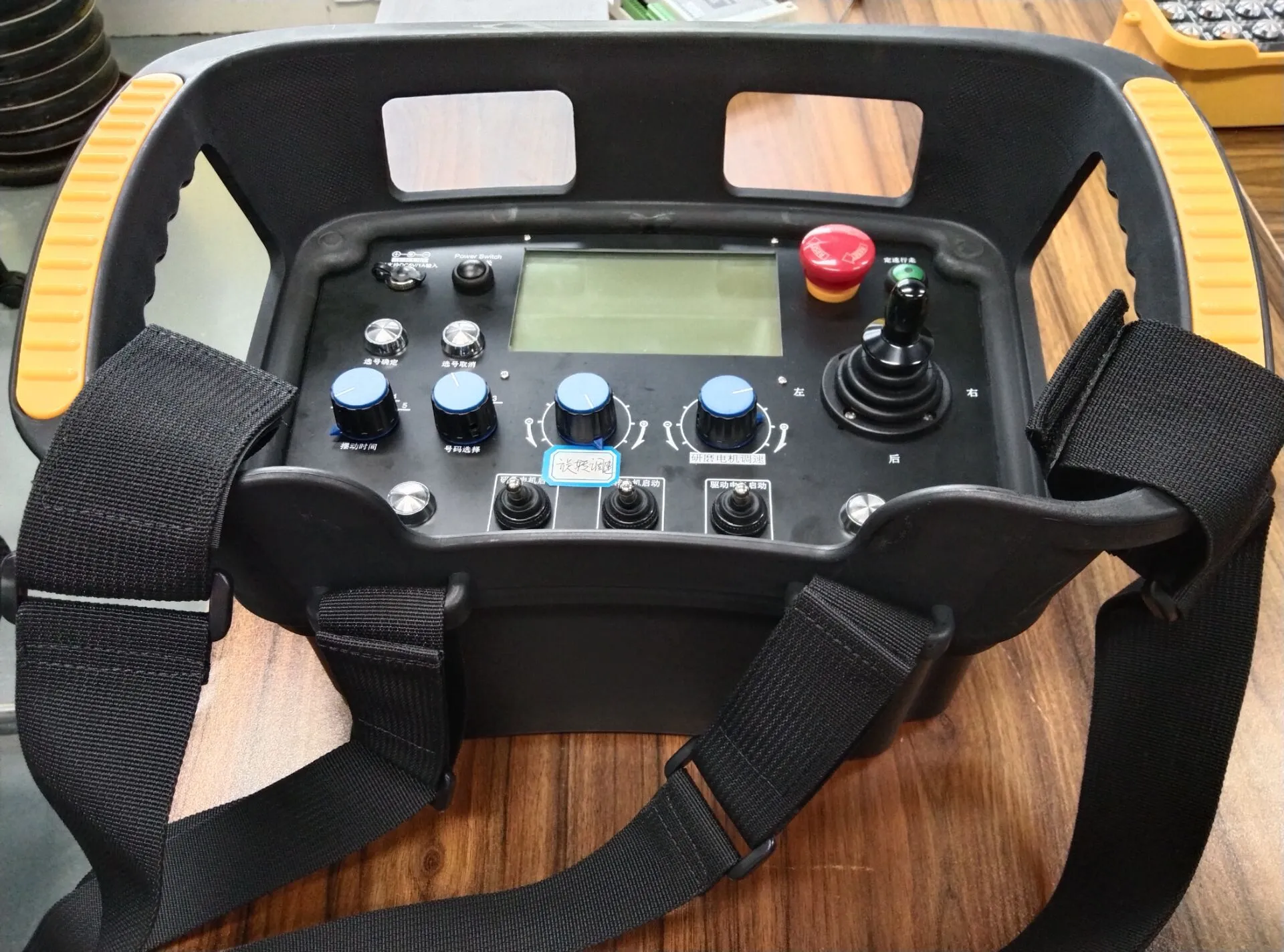
A two-axis joystick can provide two directions of movement, depending on the configuration. Multiple joysticks can therefore control several independent machine movements while keeping the operator’s hands on a familiar interface.
For excavators, the control pattern deserves particular attention.
The remote operator should not have to relearn a completely different control arrangement simply because the machine has been converted to wireless control.
For retrofit projects, provide the supplier with the machine model, existing joystick/control pattern and hydraulic schematic whenever possible.
5. Check the Hydraulic and Electrical Interface Before Ordering
This is where many remote-control projects become more complicated than expected.
The transmitter is only one part of the system.
Before selecting a remote control, identify:
- Machine supply voltage
- Existing control voltage
- Hydraulic pilot pressure, if applicable.
- Valve type
- Number of hydraulic functions.
- Proportional or switching valves.
- Solenoid specifications.
- Existing PLC or controller.
- Analog input/output requirements.
- Digital input/output requirements.
- CAN bus or other communication interfaces, if applicable.
- Connector and wiring requirements.
- Existing emergency-stop circuit.
For example, a system using proportional hydraulic valves may require an analog output such as 0 to 10 V, ±10 V or 4 to 20 mA, depending on the valve amplifier and machine architecture.
That specification should never be assumed simply because a remote control is described as “proportional.”
A useful supplier question
Instead of asking:
“Can this remote control operate my excavator?”
provide:
“The machine is a [machine type/model]. It currently uses [hydraulic/electrical control method]. The machine supply is [voltage]. It has [number] control functions. The proportional valve/solenoid information is [details]. Can your transmitter and receiver interface directly with this system?”
That gives the supplier enough technical information to evaluate compatibility.
6. Select the Operating Range Based on the Real Working Environment
Advertised radio range and usable working range are not necessarily the same.
A manufacturer may specify a maximum range under favorable conditions. Actual range can be affected by:
- Steel structures
- Buildings
- Containers
- Trees
- Terrain
- Electrical equipment.
- Radio interference.
- Antenna position.
- Receiver installation.
- Machine orientation.
- Frequency regulations in the target country.
Nomi’s published product information includes remote-control distances such as 225 meters for some industrial remote-control models, with customized distances available for certain systems. Its hydraulic proportional product information also describes longer-range configurations for specific applications.
These figures should be treated as product specifications for the particular system, not as a universal guarantee that every installation will achieve the same distance.
For an RFQ, specify the actual required operating distance.
For example:
Required operating distance: approximately 100 m in an outdoor industrial environment.
That is more useful than simply asking for a “long-range remote control.”
7. Consider IP Protection and the Installation Environment
A remote control used inside a clean workshop does not necessarily require the same environmental protection as one used around construction equipment, hydraulic machinery, ports or outdoor cranes.
Consider:
- Rain
- Dust
- Mud
- Hydraulic oil
- Cleaning water
- Humidity
- Salt exposure
- Temperature
- Mechanical impact.
- Vibration.
Nomi’s published industrial remote-control information includes waterproof and dustproof configurations and protection options such as IP65, IP66, IP67 and IP68 depending on the product and application.
Do not select an IP rating only because the number is higher.
First determine the actual exposure.
A remote used outdoors may need substantially different protection from a transmitter used inside a control room. The receiver also needs appropriate protection because it is installed on the machine and may be exposed to vibration, water, dust or hydraulic contamination.
8. Match the Remote Control to the Crane Application
Cranes can have very different control requirements.
Mobile cranes
Mobile cranes may require control of:
- Hoisting
- Slewing
- Boom luffing
- Boom telescoping
- Traveling
- Auxiliary functions.
ISO 7752-2:2025 specifically addresses control arrangement and direction of movement for mobile cranes.
For this application, the transmitter layout should make the major crane movements intuitive and consistent with the intended control arrangement.
Construction and hydraulic cranes
Hydraulic cranes often benefit from proportional joystick control because boom and lifting movements may need continuous speed adjustment.
Nomi offers wireless hydraulic proportional remote-control systems for construction and engineering crane applications.
Overhead cranes and hoists
An overhead crane may require:
- Hoist up/down.
- Trolley left/right.
- Bridge forward/backward.
- Auxiliary functions.
The appropriate control architecture depends on whether the machine uses single-speed, two-speed or variable-speed drives.
Tower and other specialized cranes
Specialized cranes should be evaluated according to their actual movement axes and the applicable control requirements rather than selecting a generic remote based only on the word “crane.”
ISO 7752 contains different parts covering general crane control principles and specific crane categories.
9. Match the Remote Control to the Excavator
Excavators are particularly demanding because several hydraulic movements may need to be coordinated simultaneously.
A typical configuration can involve:
- Boom
- Arm
- Bucket
- Swing
- Left travel
- Right travel
- Auxiliary hydraulics
- Blade
- Engine speed
A basic push-button remote is generally not an appropriate substitute for proportional joystick control when the operator needs smooth simultaneous hydraulic movement.
For an excavator retrofit, the supplier should understand:
- Machine manufacturer and model.
- Machine production year.
- Hydraulic control architecture.
- Pilot pressure system.
- Main control valve.
- Electrical supply.
- Engine throttle arrangement.
- Existing emergency-stop circuit.
- Required auxiliary functions.
- Required operator control pattern.
Nomi’s published excavator retrofit information describes architectures using proportional pilot-pressure control and electronic or electromechanical interfaces, depending on the machine.
The exact retrofit method should be confirmed against the individual excavator rather than assumed from the machine’s tonnage or model name alone.
10. Match the Remote Control to the Winch
Winches can have relatively simple control requirements, but the application can still determine whether proportional control is worthwhile.
A basic winch may only need:
- Winch in
- Winch out
- Stop
A more demanding application may require:
- Variable speed
- Smooth acceleration
- Controlled deceleration
- Auxiliary functions
- Clutch control
- Emergency stop
For a basic utility winch, a push-button remote may be sufficient.
For a hydraulic winch used for controlled load positioning, a proportional joystick can provide more precise speed control.
The key question is therefore not “Is a joystick remote better?”
It is: Does the winch application require continuous control of speed or hydraulic output?
11. Do Not Ignore the Receiver
The transmitter gets most of the attention because it is the part the operator holds.
Technically, however, the receiver is just as important.
The receiver must translate wireless commands into signals that the machine can understand.
Before purchasing, confirm:
- Receiver supply voltage
- Number of outputs
- Digital outputs
- Analog/proportional outputs
- Output current
- Communication protocol
- Connector type
- Mounting method
- Protection level
- Emergency-stop interface
- Signal-loss behavior
- Antenna arrangement
- Configuration options.
A transmitter with the correct joystick arrangement cannot compensate for an incompatible receiver-side interface.
This is particularly important when replacing an existing remote control. If the old transmitter and receiver use a proprietary communication architecture, replacing only the transmitter may not be practical.
12. Treat Safety Functions as a System Requirement
A remote control for industrial machinery should not be evaluated only by radio distance and joystick sensitivity.
Safety functions should be considered at the machine-system level.
Depending on the application, the specification may include:
- Emergency stop
- Fail-safe behavior
- Signal-loss response
- Unauthorized transmitter prevention.
- Receiver watchdog
- Command validation.
- Redundant safety circuits.
- Safe startup.
- Controlled restart.
- Battery monitoring.
- Status indication.
The exact safety architecture should be determined according to the machine, applicable regulations, risk assessment and required performance level.
For crane control layout, ISO 7752 provides relevant control-layout requirements. For machinery safety, other standards may also apply depending on the machine and market.
A supplier should therefore be asked to identify which safety-related functions are implemented in the remote-control system and which remain part of the machine’s existing safety system.
13. Check Temperature, Battery and Operator Ergonomics
A technically compatible remote can still be inconvenient if the operator cannot use it comfortably for an entire shift.
Check:
- Operating temperature
- Transmitter weight
- Battery capacity
- Charging time.
- Battery replacement.
- Joystick travel
- Joystick return-to-center behavior.
- Button spacing
- Emergency-stop accessibility.
- Display requirements
- Strap or harness options.
- Visibility of status indicators.
Nomi’s published joystick remote-control information lists an operating temperature range of -25°C to +85°C for certain models, a response time of up to 20 ms, and a configurable remote-control distance of 225 meters for the referenced product.
Those specifications belong to the stated product configuration and should not automatically be applied to every Nomi remote-control model.
14. How to Compare Supplier Quotations
When several suppliers quote different systems, avoid comparing only the price.
Use a specification table.
| Item | Supplier A | Supplier B | Supplier C |
|---|---|---|---|
| Machine compatibility | |||
| Transmitter type | |||
| Number of joysticks | |||
| Proportional axes | |||
| Digital channels | |||
| Receiver type | |||
| Supply voltage | |||
| Hydraulic interface | |||
| Operating range | |||
| IP rating | |||
| Operating temperature | |||
| Emergency stop | |||
| Signal-loss behavior | |||
| Battery operating time | |||
| Certifications | |||
| Warranty | |||
| Spare parts | |||
| Technical support | |||
| Price |
This prevents a low quotation from appearing attractive simply because important components or functions have been omitted.
15. Common Mistakes When Selecting a Joystick Remote Control
Mistake 1: Choosing the remote before analyzing the machine
The correct process is machine first, remote second.
Mistake 2: Assuming every joystick is proportional
A joystick’s physical movement does not automatically mean the machine receives a proportional hydraulic command.
Verify the receiver output and valve interface.
Mistake 3: Comparing advertised range without considering the environment
A published open-area range is not necessarily the usable range around steel structures, buildings or other sources of interference.
The number of controls matters, but so does how those controls map to machine functions.
Mistake 5: Ignoring the receiver
The transmitter and receiver should be evaluated as one control system.
Mistake 6: Assuming a generic excavator configuration will fit every machine
Hydraulic circuits, valve arrangements, control patterns and electrical systems vary by manufacturer, model and production year.
Mistake 7: Treating a certification as proof of machine compatibility
A product certification and compatibility with a particular hydraulic machine are different questions.
Ask for both the applicable certifications and the technical compatibility information.
Mistake 8: Focusing only on purchase price
Installation, commissioning, spare parts, battery replacement, technical support and future maintenance can all affect the actual cost of ownership.
16. What Information Should You Send a Supplier?
If you want an accurate quotation, prepare as much of the following information as possible:
Machine information
- Machine type
- Manufacturer
- Model
- Production year
- Application
Control information
- Existing control method
- Number of control functions.
- Number of simultaneous movements.
- Proportional or on/off requirements.
- Existing joystick/control pattern.
Hydraulic information
- Hydraulic schematic
- Main control valve model
- Pilot valve information
- Solenoid information.
- Hydraulic pressure information where relevant.
Electrical information
- Supply voltage
- Existing controller
- Wiring diagram
- Connector information.
- Analog/digital interface requirements.
Wireless requirements
- Required operating distance.
- Indoor/outdoor use
- Frequency requirements where applicable.
- Expected interference environment.
Environmental requirements
- Operating temperature
- Rain/dust exposure
- Washdown requirements
- Vibration
- Marine or corrosive environment.
Safety requirements
- Emergency stop
- Signal-loss behavior
- Applicable machinery standards.
- Required certification or market-entry requirements.
The more complete this information is, the less likely the quotation will be based on assumptions.
17. A Practical Selection Workflow
A useful selection process can be reduced to eight steps:
Step 1: Identify the machine.
Determine the exact equipment type, model and application.
Step 2: List every required movement.
Map each independent function and direction.
Step 3: Decide the control type.
Determine which functions need proportional control and which only need on/off control.
Step 4: Check the machine interface.
Identify hydraulic valves, pilot circuits, solenoids, electrical inputs and communication interfaces.
Step 5: Select the transmitter layout.
Choose the appropriate number of joysticks, switches, knobs and emergency-stop controls.
Step 6: Define the operating environment.
Specify range, temperature, IP protection and expected interference.
Step 7: Confirm safety and compliance requirements.
Separate machine safety requirements from remote-control product certifications.
Step 8: Compare complete systems.
Evaluate the transmitter, receiver, interface hardware, installation requirements, documentation, warranty and technical support together.
This process is more reliable than choosing a remote control from a product photograph or a single specification such as transmission distance.
18. When Should You Choose a Proportional Joystick Remote?
A proportional joystick remote may be appropriate when the machine requires:
- Smooth variable-speed movement.
- Fine positioning
- Controlled acceleration and deceleration.
- Simultaneous hydraulic functions.
- Precise boom or attachment control.
- Variable winch speed.
- Reduced dependence on fixed speed steps.
A simpler push-button remote may be adequate when:
- Functions are strictly on/off
- Precise speed adjustment is unnecessary.
- The machine already handles speed control elsewhere.
- The application has relatively simple operating requirements.
The correct choice depends on the machine and task, not on which control architecture appears more advanced.
19. Nomi Remote Control Options
Nomi’s published product range includes three broad categories relevant to industrial machinery:
- Hydraulic industrial radio remote controls, designed for hydraulic machinery and proportional control applications.
- Joystick industrial radio remote controls, intended for multi-function equipment requiring joystick-based operator input.
- Push-button industrial radio remote controls, suited to applications where discrete commands are sufficient.
Nomi also publishes application-specific solutions for cranes, excavators, hoists and other construction machinery.
For a customized system, the useful starting point is not simply selecting a catalog model. Provide the machine model, control functions, existing interface and operating environment so the transmitter and receiver configuration can be evaluated together.
FAQ
1. How do I choose a joystick remote control for a crane?
Start by listing every crane movement, including hoisting, slewing, boom movement, trolley or bridge travel, and auxiliary functions. Then determine which movements require proportional control and identify the crane’s electrical or hydraulic interface.
Neither is universally better. Push-button control can be sufficient for simple on/off functions, while joystick control is more suitable when the operator needs continuous control of movement or speed.
3. Do excavators need proportional remote control?
For applications requiring smooth simultaneous control of boom, arm, bucket, swing and travel functions, proportional control can be important. The exact system must also be compatible with the excavator’s hydraulic control architecture.
4. How far can an industrial wireless remote control work?
The specified range depends on the particular system and configuration. Actual range can be affected by machine structures, buildings, terrain, antenna placement and electromagnetic interference. Always distinguish manufacturer-rated range from the required range in the real operating environment.
5. What IP rating should an industrial remote control have?
The required IP rating depends on exposure to water, dust, cleaning processes and the installation environment. Outdoor and washdown applications generally require greater environmental protection than clean indoor installations. The transmitter and receiver should both be evaluated.
6. What information does a supplier need to select a remote control?
At minimum, provide the machine type and model, required functions, existing control method, supply voltage, required operating distance and operating environment. For hydraulic machinery, hydraulic schematics, valve information and pilot-control details can significantly improve compatibility assessment.
7. Can one remote control operate both proportional and on/off functions?
Yes, a properly configured system can combine proportional control axes with discrete switches or buttons. This is useful when a machine requires variable hydraulic movement together with simple auxiliary functions.
8. Does a longer radio range mean a better remote control?
Not necessarily. Range is only one specification. Machine compatibility, control response, receiver outputs, safety functions, environmental protection and operator ergonomics can be more important depending on the application.
9. Can a wireless remote control be retrofitted to an existing excavator?
It can be possible, but compatibility must be evaluated against the excavator’s hydraulic and electrical architecture. The retrofit may require proportional valve interfaces, a receiver/control module, wiring and machine-specific configuration.
10. What should I ask before buying an industrial joystick remote control?
Ask the supplier to confirm machine compatibility, transmitter and receiver configuration, proportional outputs, digital channels, power supply, operating range, IP rating, operating temperature, emergency-stop behavior, signal-loss behavior, applicable certifications, warranty and technical support.
Conclusion
The right joystick remote control is the one that matches the machine’s control architecture and the operator’s actual working requirements.
For cranes, focus on movement axes, control layout, proportional requirements, load positioning and the machine’s safety architecture. For excavators, hydraulic and electrical compatibility becomes particularly important because several functions may need simultaneous proportional control. For winches, the key decision is often whether simple in/out control is sufficient or whether variable speed and controlled movement are required.
Before requesting a quotation, provide the supplier with the machine model, control functions, hydraulic or electrical interface, required range, environmental conditions and safety requirements.
That information allows the supplier to evaluate the complete transmitter-receiver-machine interface, rather than simply recommending a remote based on its appearance or advertised range.
