

Industrial wireless remote control OEM projects are rarely just a matter of changing the buttons or adding a company logo. A successful system has to match the machine’s control architecture, operator interface, hydraulic or electrical functions, wireless environment, safety requirements, and production workflow.
For hydraulic machinery, the integration chain typically looks like this:
Operator → Wireless Transmitter → RF Communication → Receiver → Machine Control Interface → Hydraulic Valve / Electronic Controller → Actuator
The transmitter may use joysticks, switches, push buttons, potentiometers, or other controls. The receiver then converts the wireless commands into the electrical or control signals required by the machine. For proportional hydraulic applications, the control system must preserve the relationship between operator input and the required valve command rather than treating every function as a simple on/off signal. Nomi’s hydraulic proportional remote-control architecture follows this general control principle.
For OEM manufacturers, the most important question is therefore not simply “Can the remote be customized?” It is:
Can the supplier integrate the wireless control system into the machine’s actual control architecture and validate the resulting system?
That is the starting point for an effective OEM project.
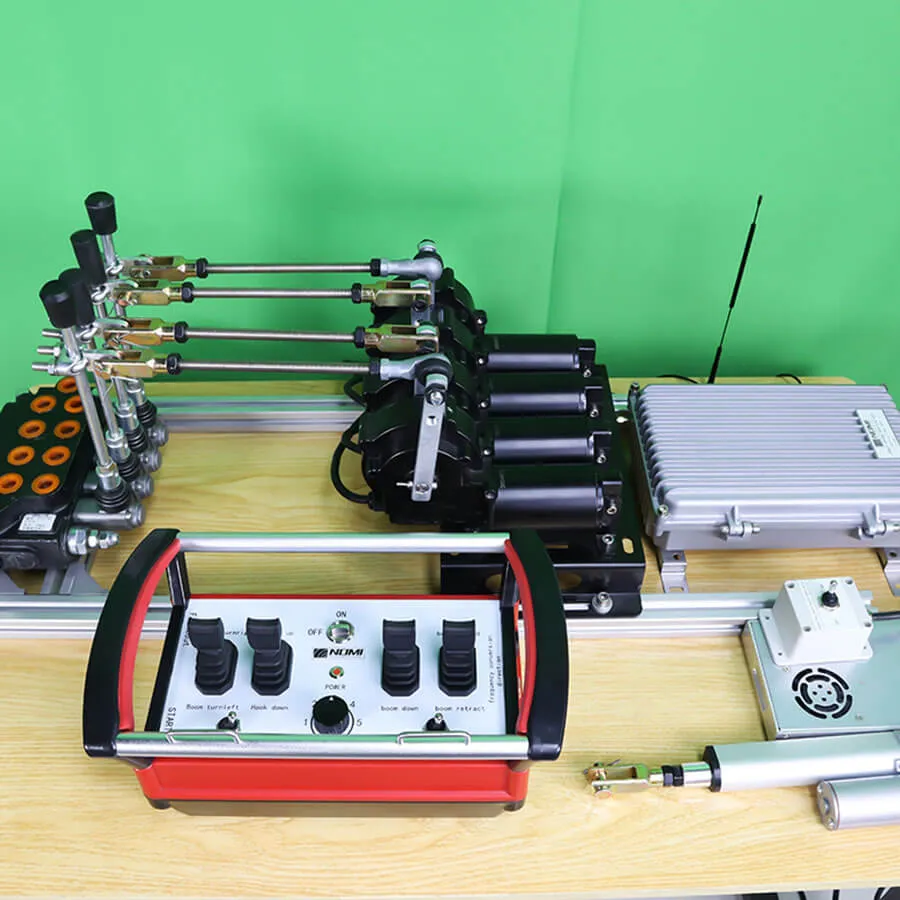
What Does OEM Integration Mean for an Industrial Wireless Remote Control?
OEM integration means adapting the remote-control system to a particular machine, product family, or control architecture.
The customization may involve the physical transmitter, electrical interface, wireless communication, receiver outputs, operator controls, safety functions, labeling, software configuration, or several of these areas at the same time.
A simple customization might only require a different button layout or company logo. A more complex project may require the receiver to interface with proportional hydraulic valves, machine controllers, relays, analog inputs, digital inputs, or other control equipment.
A useful way to classify OEM customization is:
| Customization level | Typical changes | Engineering impact |
|---|---|---|
| Branding | Logo, labels, colors, icons | Low |
| Operator interface | Buttons, joysticks, switches, layout | Low to medium |
| Functional configuration | Channel count, function mapping, interlocks | Medium |
| Receiver interface | Digital, analog, relay or other outputs | Medium to high |
| Hydraulic integration | Proportional valve control, scaling, ramping | High |
| Safety integration | Emergency stop, signal-loss behavior, safety functions | High |
| Complete OEM platform | Housing, electronics, communication, control logic and validation | High |
The distinction matters because two suppliers may both advertise “OEM customization” while offering very different levels of engineering support.
Why Standard Remote Controls Are Not Always Enough
A standard industrial remote control can work well when the machine already matches the supplier’s existing control architecture.
However, OEM machinery often has application-specific requirements.
A manufacturer may need:
- A specific number of hydraulic functions.
- Multiple proportional joystick axes.
- Dedicated auxiliary functions.
- Custom button combinations.
- A particular receiver output configuration.
- Integration with an existing PLC.
- A specific valve driver interface.
- Customized emergency-stop behavior.
- Machine-specific labels and symbols.
- A particular transmitter enclosure.
- One transmitter controlling one receiver.
- One transmitter controlling multiple machines under controlled conditions.
- A defined response to communication loss.
This is why OEM integration should begin with the machine, not the remote.
A common procurement mistake is to select a transmitter first and then attempt to make the machine conform to it. For a new OEM machine, the more practical approach is normally to define the machine’s required functions first and then determine the appropriate remote-control architecture.
The First Step: Map the Machine Functions
Before asking a supplier for a quotation, create a complete list of functions that the operator must control.
For a hydraulic machine, this might include:
| Machine function | Control type | Example requirement |
|---|---|---|
| Boom up/down | Proportional | Variable speed |
| Boom extension/retraction | Proportional | Variable speed |
| Slewing | Proportional | Forward/reverse |
| Winch up/down | Proportional | Variable speed |
| Horn | Digital | On/off |
| Work light | Digital | On/off |
| Engine start/stop | Digital | Controlled function |
| Auxiliary hydraulic function | Proportional or digital | Application dependent |
| Emergency stop | Safety function | Machine risk assessment required |
The exact control type depends on the machine.
A function that requires precise movement should not automatically be assigned to an on/off button simply because that is easier to configure.
Similarly, not every function needs proportional control. Using proportional hardware where the machine only needs a discrete command may increase complexity without providing a useful benefit.
The objective is to create a function map that connects the operator’s control to the machine’s required response.
Proportional Control Requires More Than a Joystick
For hydraulic machinery, proportional control is one of the most important areas of OEM integration.
A basic push button may produce a discrete command:
OFF → ON
A proportional joystick instead provides a variable command:
0% → 20% → 50% → 80% → 100%
The receiver or control electronics then translate this command into the appropriate machine-side output.
The complete sequence may be represented as:
Joystick displacement → transmitter signal → wireless communication → receiver → signal processing → valve control → hydraulic actuator
Nomi describes this type of proportional architecture as a system in which joystick input is converted into a wireless command and then into a proportional hydraulic control signal.
However, proportional control is not necessarily a simple linear relationship.
Depending on the machine, the control system may require:
- Deadband
- Scaling
- Gain
- Output limitation
- Direction reversal
- Ramp control
- Neutral position calibration.
- Different forward and reverse behavior.
- Minimum activation output.
- Maximum output limitation.
For example, an excavator or crane that responds aggressively to a small joystick movement may require a different control curve from a machine where fine positioning is more important.
Therefore, when requesting an OEM quotation, buyers should provide the supplier with the actual valve and control requirements rather than simply stating:
“We need proportional control.”
What Information Should an OEM Provide to the Remote-Control Supplier?
A detailed technical specification can significantly reduce quotation errors and integration problems.
At minimum, an OEM project should normally define the following.
1. Machine Information
Provide:
- Machine type
- Machine model
- New machine or retrofit
- Hydraulic or electrical architecture
- Existing control system
- Machine operating environment
- Intended market or country
2. Function List
Provide every function that must be controlled.
For each function, identify:
- Digital or proportional
- Forward/reverse requirement
- Momentary or maintained operation
- Required interlock
- Priority
- Simultaneous operation requirements
3. Hydraulic Information
For hydraulic machinery, provide relevant information about:
- Valve manufacturer and model
- Valve type
- Solenoid or proportional actuator
- Required input signal
- Voltage or current interface
- Number of valve sections
- Hydraulic functions
- Existing controller or driver
The supplier should not be expected to guess the valve interface from the machine name alone.
4. Electrical Information
Useful information includes:
- Machine supply voltage
- Receiver supply voltage
- Available current
- Digital input/output requirements
- Analog input/output requirements
- Relay requirements
- Controller interface
- Connector type
- Wiring requirements
5. Operator Interface
Specify:
- Number of joysticks
- Number of axes
- Push buttons
- Toggle switches
- Rotary controls
- Indicator LEDs
- Display requirements
- Emergency-stop arrangement
- Labeling
- Preferred transmitter shape
6. Wireless Requirements
Define:
- Target operating distance
- Operating environment
- Country or region
- Potential RF interference
- Required frequency configuration
- One-to-one or other communication architecture
- Required feedback or two-way communication
Radio requirements should be evaluated according to the target market and applicable regulations. For example, ETSI EN 300 220 covers certain short-range radio equipment operating from 25 MHz to 1,000 MHz, with its current published work including revisions relevant to the European regulatory environment.
Customization Is Not Only About the Transmitter
One of the most common misunderstandings about OEM remote controls is that customization means changing the handheld unit.
In reality, the receiver can be equally important.
A complete OEM solution may require customization of:
Transmitter
- Joystick position
- Number of controls
- Button arrangement
- Switch type
- Housing
- Labels
- Icons
- Color
- Logo
- Display
- Emergency-stop location
Receiver
- Output type
- Output quantity
- Analog outputs
- Digital outputs
- Relay outputs
- Connector arrangement
- Machine wiring
- Communication interface
- Mounting method
Control Logic
- Function mapping
- Interlocking
- Direction logic
- Proportional scaling
- Ramping
- Neutral behavior
- Signal-loss behavior
- Startup behavior
Nomi’s industrial radio remote-control materials describe OEM/ODM customization including functions, controls, colors, logo and transmitter-receiver configurations.
This distinction is important when comparing quotations. A supplier offering a custom enclosure is not necessarily offering the same engineering scope as a supplier capable of modifying the complete transmitter-receiver control architecture.
Safety Should Be Designed Into the Integration
Wireless control introduces an additional communication layer between the operator and machine.
That means OEM engineering should consider what happens when:
- The transmitter loses power.
- The receiver loses power.
- Radio communication is interrupted.
- The operator releases a control.
- A joystick remains displaced during startup.
- The emergency stop is activated.
- A machine-side controller reports a fault.
- The communication environment becomes unstable.
A wireless remote should not be treated as an independent safety solution simply because it has an emergency-stop button.
The machine’s overall safety architecture needs to be assessed.
ISO 12100 provides principles and methodology for machinery risk assessment and risk reduction. It is currently the published ISO standard for this purpose, although ISO notes that a replacement is under development.
For safety-related parts of control systems, ISO 13849-1:2023 provides methodology and requirements for designing and integrating safety-related control-system parts, including electrical, hydraulic, pneumatic and mechanical technologies.
For machine electrical equipment, IEC 60204-1:2016 with Amendment 1:2021 addresses electrical, electronic and programmable electronic equipment and systems for machinery and includes requirements relating to areas such as emergency stop, control circuits and technical documentation.
These standards do not mean that every remote-control project automatically requires the same safety architecture. The appropriate requirements depend on the machine, application, jurisdiction and risk assessment.
The important OEM principle is:
Do not treat transmitter safety functions, receiver safety functions and machine-level safety functions as interchangeable concepts.
They need to be evaluated as part of the complete machine-control system.
RF Performance Is a System Requirement
Another common mistake is to select a wireless remote primarily according to its advertised maximum distance.
A stated operating range does not guarantee the same performance in every industrial environment.
Actual wireless performance can be affected by:
- Buildings
- Steel structures
- Electrical equipment
- Other RF sources
- Antenna position
- Receiver installation
- Machine orientation
- Environmental conditions
- Frequency regulations
- Installation quality
For OEM applications, the relevant question is therefore not:
“How many meters can the remote reach?”
A better question is:
“What operating distance and communication reliability are required in the actual machine environment?”
Nomi’s published materials describe different industrial remote-control configurations and customizable operating distances, while its product range includes joystick and push-button systems for industrial applications.
The final configuration should be evaluated against the machine’s intended operating environment rather than relying solely on a headline range number.
OEM Integration Should Include a Validation Stage
A custom remote-control project should not move directly from a quotation to mass production.
A practical development process is:
Requirement definition → Technical review → Configuration → Prototype → Machine integration → Functional testing → Safety validation → Documentation → Pilot production → Mass production
Each stage has a different purpose.
Requirement definition
Confirm what the machine must do.
Technical review
Confirm whether the transmitter, receiver and machine interfaces are compatible.
Prototype
Build the configured system before committing to large production quantities.
Machine integration
Install the system on the actual machine or an appropriate representative test platform.
Functional testing
Check every control function individually and in the combinations expected during operation.
Safety validation
Verify the defined emergency-stop and fault-response behavior against the machine’s safety requirements.
Documentation
Record the final configuration so future production units use the same technical definition.
Pilot production
A small production batch can identify assembly, wiring, labeling and operator-interface issues before larger quantities are produced.
What Should Be Tested Before Mass Production?
An OEM acceptance test should be based on the actual application.
A practical test list can include:
| Test area | What to verify |
|---|---|
| Control mapping | Every transmitter control operates the intended machine function |
| Proportional response | Output changes correctly with joystick displacement |
| Neutral position | Machine remains in the required state when controls are released |
| Direction | Forward/reverse functions are correct |
| Simultaneous commands | Required combined movements behave correctly |
| Communication loss | Machine enters the defined safe state |
| Emergency stop | Required emergency-stop behavior occurs |
| Startup | Machine does not unexpectedly activate during startup |
| Range | Required operating area is covered |
| RF environment | Communication remains appropriate under representative conditions |
| Environmental protection | Enclosure and connectors suit the application |
| Battery | Required operating duration and charging behavior are achieved |
| Labels | Operator controls are clearly identified |
| Receiver outputs | Electrical signals match machine requirements |
The exact acceptance criteria should be agreed between the OEM and supplier before production.
How to Compare Industrial Wireless Remote Control OEM Suppliers
Price alone is usually insufficient for comparing custom industrial remote-control suppliers.
A more useful comparison considers the complete engineering scope.
| Evaluation area | Questions to ask |
|---|---|
| Product architecture | Is the solution based on an existing platform or a new design? |
| Transmitter | Can controls and layout be customized? |
| Receiver | Can outputs and interfaces be configured? |
| Hydraulic integration | Can the system match the required valve interface? |
| Proportional control | Can scaling and control behavior be configured? |
| Safety | How are emergency stop and communication loss handled? |
| RF | Is the configuration suitable for the target market? |
| Environmental protection | What enclosure and environmental requirements are supported? |
| Documentation | Are wiring diagrams, configuration information and test records available? |
| Prototype | Can the supplier provide an engineering sample? |
| Production | Can the supplier maintain the approved configuration? |
| Support | Is technical support available during machine integration? |
| Customization | Which changes are standard configuration and which require engineering? |
This approach helps distinguish a customizable product from a customizable control system.
Common OEM Mistakes
Mistake 1: Asking for a quotation with only the machine name
“Wireless remote control for excavator” is not enough information for a reliable technical quotation.
The supplier needs to know what the remote must actually control.
Mistake 2: Specifying only the transmitter
The receiver and machine-side interface can determine whether the system can actually be integrated.
Mistake 3: Treating every function as proportional
Not every machine function needs variable control.
The control method should follow the machine function.
Mistake 4: Choosing based only on wireless distance
Maximum range does not describe complete system performance in a real industrial environment.
Mistake 5: Treating certification as machine-level safety approval
A product certification and a complete machine safety assessment are not the same thing.
Mistake 6: Skipping prototype testing
A remote may work correctly on a workbench but behave differently when connected to the actual machine.
Mistake 7: Changing the design after approval without configuration control
OEM production requires a controlled final configuration. Changes to button mapping, receiver outputs or control logic should be documented and approved.
Mistake 8: Comparing only unit price
A lower remote-control price may not represent a lower project cost if additional engineering, wiring modification, commissioning or troubleshooting is required.
When Does OEM Customization Make Sense?
OEM customization is particularly relevant when:
- The machine manufacturer wants a standardized operator interface
- Existing standard remotes do not match the machine
- The machine requires proportional hydraulic control
- Several machine functions must be combined into one transmitter
- The receiver needs a specific output configuration
- The OEM wants its own labeling and operating symbols
- The remote must be integrated into a new machine platform
- A retrofit requires compatibility with an existing hydraulic system
- The machine is produced repeatedly and the remote configuration needs to remain consistent
Nomi’s product and application information identifies hydraulic equipment, construction machinery, lifting machinery, cranes, port machinery, agricultural and forestry equipment, special vehicles and other industrial applications among the fields where its industrial radio remote controls are used.
For applications where continuous operator input is important, a joystick remote control can provide proportional control rather than the discrete commands associated with a conventional push-button system.
For simpler discrete functions, a push button remote control may be more appropriate.
For hydraulic machines that need wireless control of existing hydraulic functions, an industrial hydraulic remote control can be evaluated as part of the overall machine-control architecture.
Crane OEMs can also evaluate construction crane remote controls according to the specific crane control architecture and application requirements.
For lifting applications, overhead crane and hoist control systems address a different control architecture from hydraulic mobile machinery, so the system should be selected according to the actual machine configuration.
What Does Nomi Offer for OEM Projects?
Nomi’s public company information describes its business as industrial wireless remote-control development, manufacturing and supply, with applications covering lifting machinery, construction machinery, port machinery, hydraulic equipment, special vehicles and other industrial equipment. Its materials also state that OEM and ODM customization is available.
For an OEM project, Nomi can therefore be considered when the requirement involves more than simply purchasing an off-the-shelf transmitter.
Potential customization areas include:
- Transmitter configuration
- Joystick arrangement
- Button functions
- Function mapping
- Logo customization
- Control colors
- Transmitter-receiver configuration
- Application-specific control requirements
The exact scope should be confirmed against the machine specification before an OEM project is approved.
For manufacturers evaluating a custom wireless control system, the most useful starting point is to provide the machine model, control functions, hydraulic or electrical interface, required operator controls, power supply, target market, operating environment and any existing wiring or control diagrams.
That information allows the supplier to determine whether an existing configuration can be adapted or whether additional engineering is required.
A Practical OEM RFQ Checklist
Before contacting a supplier, an OEM can prepare the following information:
Machine
- Machine type
- Machine model
- New development or retrofit
- Application
- Target market
Functions
- Complete function list
- Digital functions
- Proportional functions
- Simultaneous operation requirements
- Interlocks
Hydraulic system
- Valve manufacturer
- Valve model
- Valve type
- Solenoid/proportional interface
- Required voltage/current
- Hydraulic circuit information
Electrical system
- Supply voltage
- Digital I/O
- Analog I/O
- Relay requirements
- Controller interface
- Connector requirements
Remote
- Number of joysticks
- Number of buttons
- Switches
- Display
- Emergency stop
- Housing preference
- Logo and labeling
Wireless
- Required operating area
- Target country
- Expected RF environment
- Required communication architecture
Safety
- Required emergency-stop behavior
- Required signal-loss behavior
- Machine risk assessment
- Applicable machine standards
- Required documentation
Commercial
- Prototype quantity
- Estimated annual quantity
- Target production date
- Packaging requirements
- Spare-parts requirements
- After-sales support requirements
This checklist can substantially improve the quality of the first technical discussion.
FAQ
Can an industrial wireless remote control be fully customized for an OEM machine?
Yes, depending on the supplier and project scope. Customization can range from buttons, labels and housing to transmitter configuration, receiver outputs, function mapping and machine-interface requirements. Nomi’s public materials specifically describe OEM/ODM customization services.
Can a wireless remote control operate proportional hydraulic valves?
It can, provided the transmitter, receiver and machine-side interface are designed for the required proportional control architecture. The required signal type and valve interface should be confirmed before selection.
What information should I send when requesting an OEM quotation?
At minimum, provide the machine type, complete control-function list, hydraulic valve information, electrical supply, required controls, desired operating range, target market and any existing wiring or control diagrams.
Is a customized housing enough for an OEM project?
Not necessarily. A customized housing changes the physical product, but it does not automatically solve receiver outputs, hydraulic integration, control logic, safety functions or machine compatibility.
Can the same transmitter control multiple machines?
Some systems can support different communication architectures, but the exact one-to-many behavior depends on the system design and application. The required operating logic and safeguards should be defined during engineering review.
How should proportional joystick control be specified?
Do not specify only “proportional joystick.” Identify the required axes, direction, neutral behavior, output type, scaling requirements, minimum and maximum commands, and the hydraulic valve or electronic controller being operated.
Does CE or FCC certification mean the complete machine is certified?
No. Product-level radio or electrical conformity and machine-level safety compliance are different matters. The complete machine must be evaluated according to the applicable regulations, standards and risk assessment.
How important is the wireless operating distance?
It is important, but it should not be considered in isolation. The required operating area, industrial environment, antenna installation and local radio requirements all affect the appropriate system configuration.
Should an OEM test a prototype before mass production?
Yes. A prototype or engineering sample allows the remote control to be tested with the actual machine interface before committing to production quantities.
What is the difference between OEM and ODM customization?
The terminology varies between suppliers. In practical terms, OEM work often involves adapting a supplier’s existing technology or product to a customer’s machine and branding, while ODM can involve a greater degree of product design responsibility. The exact scope should be defined in the project agreement rather than assumed from the label alone.
