

For hydraulic machinery, neither a joystick nor a push-button remote control is universally better. The appropriate choice depends mainly on whether the machine requires continuous proportional movement or discrete on/off commands.
A joystick is generally appropriate when the operator needs variable speed, smooth acceleration, fine positioning, or simultaneous control of multiple hydraulic functions. A push-button transmitter can be suitable when machine functions are primarily discrete, such as start/stop, extend/retract, raise/lower, mode selection, lighting, or auxiliary functions.
Many machines fall between these two categories. In that case, a hybrid remote control with proportional joysticks and push buttons can provide a more practical interface.
For buyers specifying an industrial wireless system, the important question is therefore not simply “joystick or push button?” It is what type of command does each machine function require?
What Is the Difference Between a Joystick and a Push-Button Remote?
The fundamental difference is the type of command sent to the machine.
A push-button remote normally provides a discrete command. The operator presses a button associated with a specific function, and the receiver sends the corresponding electrical or communication signal to the machine.
A joystick provides a variable command. The amount and direction of joystick movement can be translated into a proportional control signal.
| Characteristic | Push-Button Remote | Joystick Remote |
|---|---|---|
| Basic command type | Discrete | Proportional |
| Operator input | Button press | Variable stick movement |
| Typical control | On/off or predefined steps | Variable movement |
| Fine speed adjustment | Limited | Available when the machine supports proportional control |
| Multi-axis control | Possible with multiple buttons | Natural with multi-axis joysticks |
| Interface complexity | Generally simpler | Generally more complex |
| Typical applications | Discrete machine functions | Variable-speed hydraulic movements |
| Auxiliary functions | Very suitable | Usually supplemented with buttons |
| Operator skill requirement | Usually straightforward | Requires understanding of proportional movement |
The distinction is particularly important for hydraulic equipment because hydraulic valves and controllers may require different types of input.
A professional radio remote control system can connect to hydraulic equipment through different interfaces, depending on the machine architecture. Commercial systems are available with analog, PWM, current-regulated and CAN-based outputs, among others. For example, Anderson Controls describes systems combining proportional joystick inputs with analog, PWM and CAN outputs.
Why Proportional Control Matters in Hydraulic Machinery
Hydraulic machinery does not always need to operate at only full speed or zero speed.
Consider a crane lowering a load.
The operator may want:
- Fast movement when the load is far from the target.
- Reduced speed when approaching the target.
- Very small movements during final positioning.
A simple on/off command cannot provide the same degree of control as a proportional command.
With proportional control, the operator’s input can be translated into a corresponding variable output. The exact relationship depends on the transmitter, receiver, controller, hydraulic valve and configuration.
This is why proportional joysticks are commonly found on hydraulic machinery where variable movement is important. Industrial radio remote control systems for hydraulic cranes and mobile machinery commonly use proportional joystick interfaces.
However, there is an important qualification:
A proportional joystick alone does not make a hydraulic machine proportional.
The complete control chain must support proportional operation.
A simplified architecture looks like this:
Joystick → Wireless Transmitter → Radio Link → Receiver → Controller / Valve Interface → Hydraulic Valve → Actuator → Machine Movement
If one part of this chain only supports discrete commands, the machine cannot obtain the full benefit of proportional joystick input.
This is one of the most important points to verify before purchasing a remote control system.
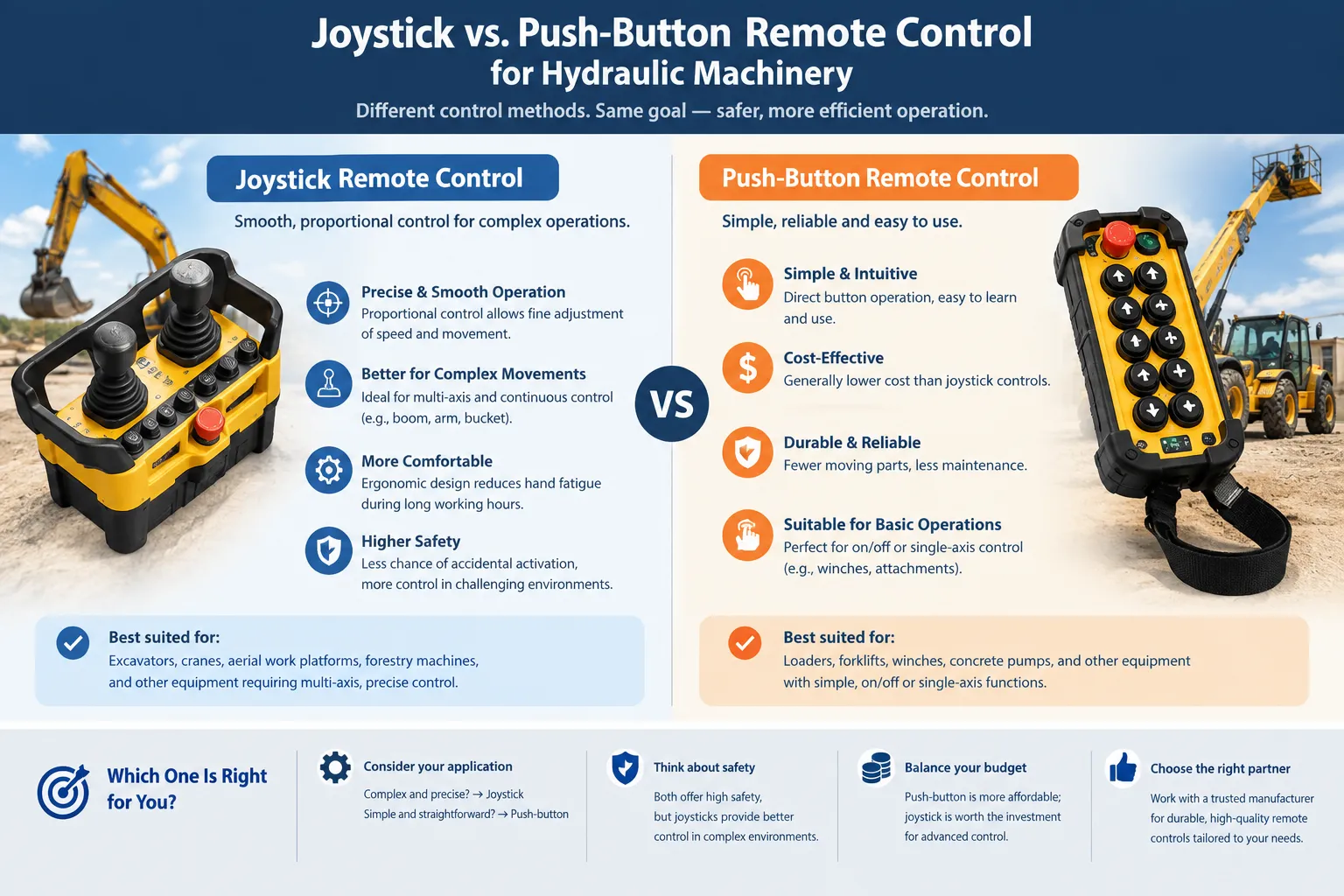
Joystick vs. Push-Button: How Do They Affect Machine Operation?
The difference becomes clearer when looking at actual machine functions.
Smooth variable-speed movement
Joystick control allows the operator to vary the command according to stick position.
For example:
- Small joystick movement → low-speed command
- Medium joystick movement → medium-speed command
- Full joystick movement → higher-speed command
The actual machine response depends on the hydraulic system and its configured control curve.
Push-button systems may instead use predefined operating states.
For example:
- Button released → stop
- First-stage command → slow
- Second-stage command → fast
This approach can work well when the machine only needs a limited number of operating speeds.
Fine positioning
Fine positioning is one of the strongest reasons to consider proportional control.
A machine moving a load into a precise position may require small changes in speed rather than repeated full-speed starts and stops.
This is particularly relevant to:
- Hydraulic cranes
- Material-handling machinery
- Certain construction equipment
- Forestry machinery
- Specialized lifting equipment
- Machines with multiple hydraulic movements
Professional radio remote control manufacturers commonly offer proportional joystick systems specifically for hydraulic mobile machinery and cranes.
Operator interface
Push buttons have a straightforward relationship between the physical control and the machine function.
A button can be labeled:
UP
DOWN
LEFT
RIGHT
START
STOP
This can make the interface easy to understand.
A joystick requires the operator to understand both direction and degree of movement.
For machines with several proportional axes, this distinction becomes increasingly important during operator training and commissioning.
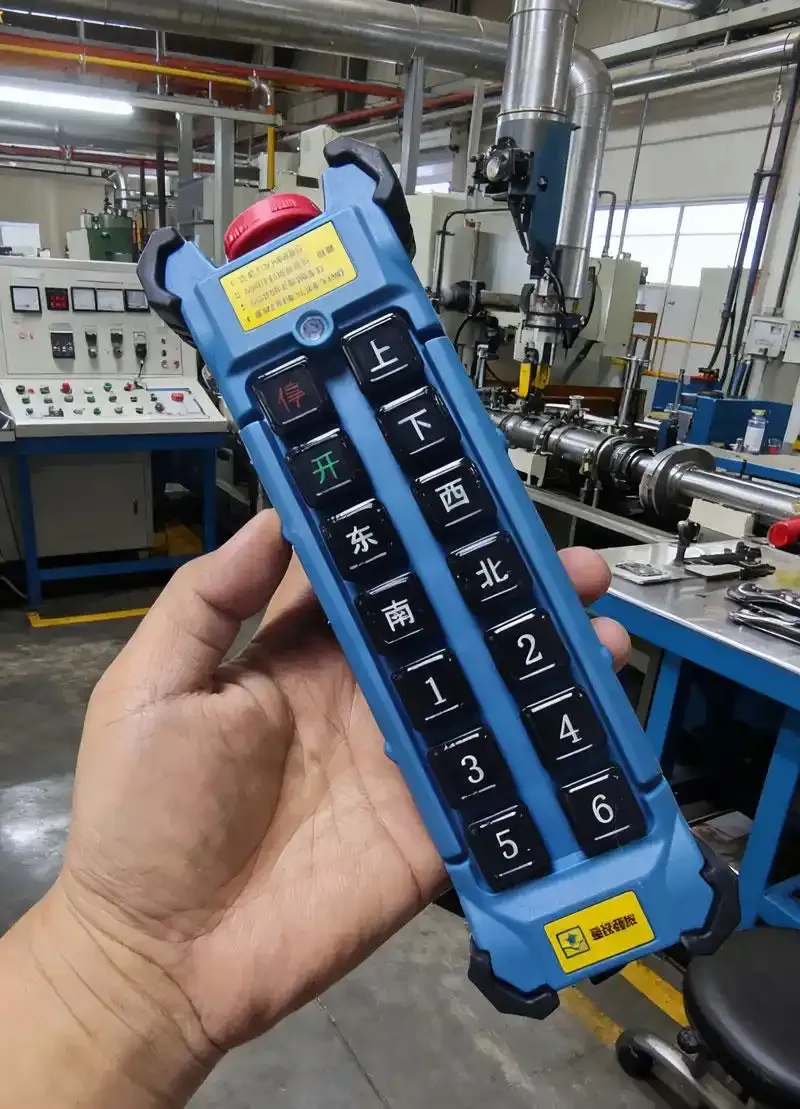
When Is a Push-Button Remote Control a Practical Choice?
Push-button control should not be regarded simply as a lower-level alternative to a joystick.
It can be a technically appropriate solution when machine functions are fundamentally discrete.
Examples include:
- Start/stop commands
- Horn
- Lights
- Pump activation
- Mode selection
- Auxiliary equipment
- Simple raise/lower functions
- Functions that only require predefined speeds
- Equipment where proportional movement is not required
Industrial push-button transmitters are commonly configured with multiple buttons so one transmitter can control numerous discrete functions. HBC-radiomatic, for example, maintains separate push-button and joystick transmitter ranges and notes that application requirements determine the appropriate transmitter concept.
Nomi also offers a dedicated range of push-button remote controls for industrial applications.
A push-button interface may therefore make sense when:
- The hydraulic function is essentially on/off.
- Only a small number of speed stages are required.
- Positioning accuracy is not a major requirement.
- The operator mainly activates predefined machine functions.
- Many auxiliary functions need to be controlled from one transmitter.
The important point is to specify the required control behavior rather than selecting a transmitter based only on its physical design.
When Is a Joystick Remote Control More Appropriate?
A joystick becomes more relevant when the operator needs continuous control of machine movement.
Typical requirements include:
Variable hydraulic speed
If the machine must operate at different speeds depending on the operator’s input, proportional control is worth considering.
Fine positioning
If the machine regularly needs to approach a target slowly and accurately, proportional control can provide a more suitable operator interface.
Multiple hydraulic axes
Mobile hydraulic machinery may have several functions that need independent variable control.
For example, a machine could require simultaneous control of:
- Boom
- Slewing
- Extension
- Winch
- Auxiliary hydraulic functions
Multi-axis joystick configurations are designed specifically for this type of control. Tokyo Keiki’s RAC2 system, for example, uses multiple joysticks for proportional control of construction machinery.
Variable machine behavior
Some hydraulic operations are not simply “move” or “stop.” The operator may need to control how aggressively the machine moves.
In those cases, proportional input can provide more control than a fixed command.
Nomi’s joystick remote controls are positioned for proportional control applications involving hydraulic machinery and other industrial equipment.
Joystick vs. Push-Button: The Real Comparison
The following comparison is more useful than simply describing one technology as “better.”
| Requirement | Push Button | Joystick |
|---|---|---|
| Basic on/off control | Excellent fit | Possible but unnecessary for many functions |
| Predefined speed stages | Suitable | Suitable |
| Continuous speed control | Limited | Suitable |
| Fine positioning | More limited | More suitable |
| Multiple proportional axes | Less intuitive | Well suited |
| Large number of auxiliary functions | Very suitable | Usually needs additional buttons |
| Simple operator interface | Suitable | Depends on configuration |
| Complex hydraulic movement | May be limiting | Often more suitable |
| Simple discrete machinery | Suitable | May add unnecessary complexity |
| Mixed machine functions | Suitable with additional controls | Hybrid design is often practical |
The correct decision should therefore be made function by function.
A machine does not necessarily need one control technology for every operation.
Why Hybrid Remote Controls Are Often Practical
One of the most useful design options is a combination of joysticks and push buttons.
A typical hybrid transmitter might contain:
- Two or more proportional joysticks
- Emergency stop
- Start/stop
- Horn
- Lighting control
- Mode selection
- Auxiliary switches
- Engine or pump functions
This arrangement reflects how many machines actually work.
The main hydraulic movements may require proportional control, while secondary functions only require discrete commands.
For example:
| Machine Function | Suitable Control |
|---|---|
| Boom movement | Joystick |
| Slewing | Joystick |
| Winch speed | Joystick |
| Auxiliary hydraulic function | Joystick or proportional switch |
| Horn | Push button |
| Lights | Push button |
| Engine start | Push button |
| Operating mode | Push button |
| Emergency stop | Dedicated safety control |
Commercial hydraulic radio systems demonstrate this mixed architecture. Anderson Controls, for example, offers systems combining proportional joysticks with additional switches for auxiliary functions.
For many hydraulic machines, this is more realistic than trying to make every function proportional.
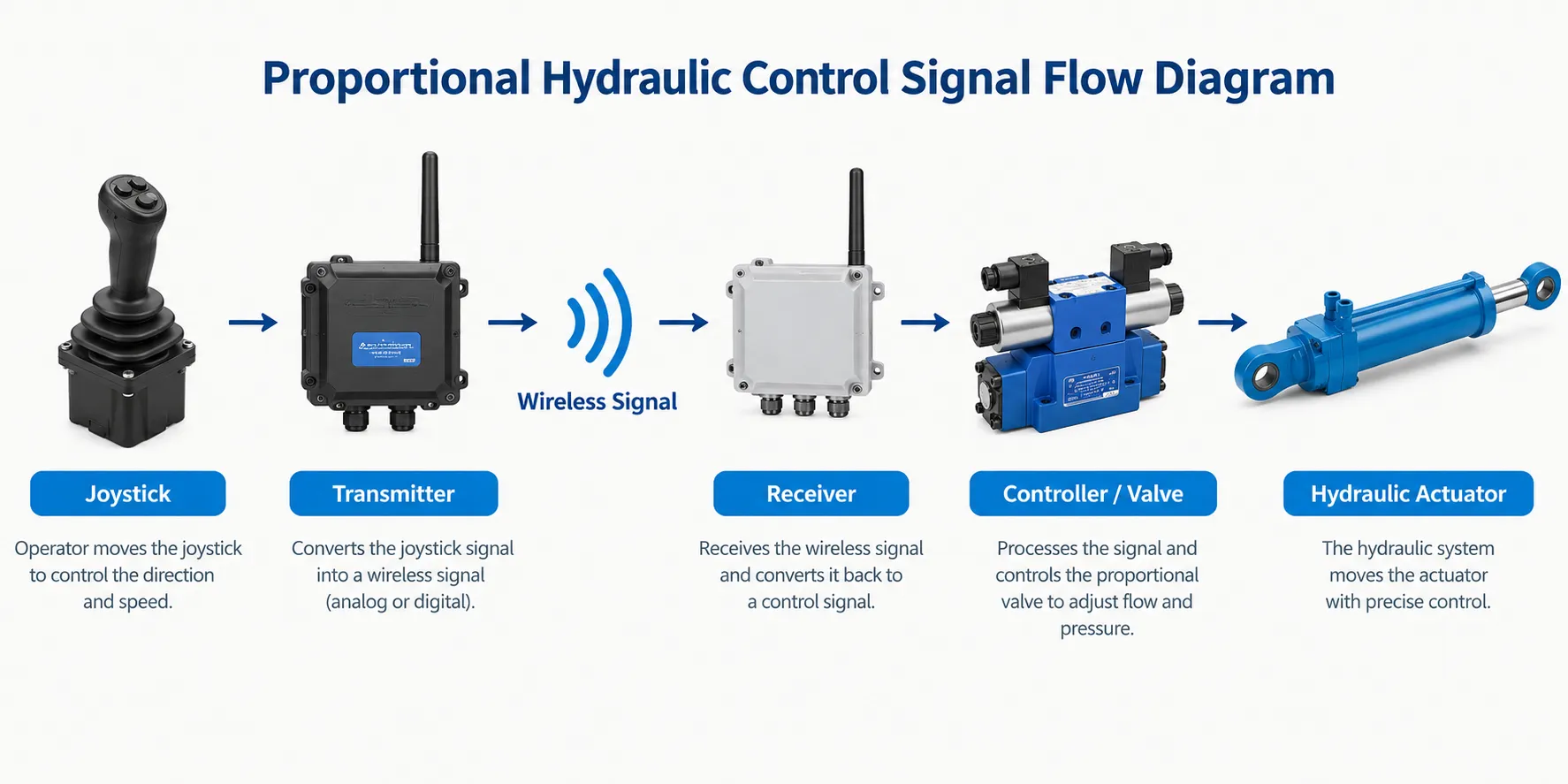
The Most Important Point: Match the Remote to the Machine Interface
Before ordering a wireless hydraulic remote control, buyers should identify how the existing machine receives commands.
Important information may include:
- Existing joystick type
- Hydraulic valve manufacturer and model.
- Valve control method.
- Analog input
- PWM input
- Current-controlled proportional output.
- CAN bus
- Digital input/output.
- Existing controller or ECU.
- Number of hydraulic functions.
- Number of proportional channels.
- Number of on/off channels.
- Supply voltage
- Emergency-stop architecture.
- Required operating distance.
- Required environmental protection.
A joystick transmitter cannot simply be connected to every hydraulic valve.
The receiver output must be compatible with the downstream control system.
For example, a proportional hydraulic valve may require a particular voltage, current or PWM control method. The receiver therefore needs to generate an appropriate signal or communicate with an intermediate controller.
This is why specifying only:
“We need a wireless joystick remote.”
is usually not enough information for a supplier to select the correct system.
What Should Buyers Tell a Remote Control Supplier?
A detailed RFQ can significantly reduce the risk of receiving an incompatible quotation.
At minimum, provide the following information.
1. Machine type
Examples:
- Hydraulic crane
- Excavator
- Concrete pump truck
- Forestry machine
- Skid loader
- Winch
- Construction machinery
- Agricultural machinery
2. Number of proportional functions
For example:
- 2 proportional axes
- 4 proportional axes
- 6 proportional functions
3. Number of on/off functions
List additional functions such as:
- Horn
- Light
- Pump
- Engine
- Mode selection
- Auxiliary valve
4. Existing control interface
Provide the available information about:
- Valve
- Controller
- PLC
- ECU
- CAN bus
- Analog input
- PWM
- Voltage
- Current
5. Power supply
Specify the machine’s electrical supply voltage, such as the actual system voltage used by the equipment.
6. Required operating distance
Do not simply request “long range.”
Specify the approximate distance required between operator and machine and whether there are obstacles, buildings, steel structures or other sources of radio interference.
7. Working environment
Consider:
- Indoor or outdoor use
- Dust
- Water
- Rain
- Temperature
- Vibration
- Impact
- Hazardous area requirements
8. Safety requirements
The emergency stop and other safety functions should be considered as part of the complete machine safety architecture.
ISO 13849-1:2023 provides a methodology for designing and integrating safety-related parts of machinery control systems, including electrical, hydraulic, pneumatic and mechanical technologies. Importantly, the standard does not itself determine the required performance level for every machine.
Read more: ISO 13849-1:2023 official standard page
IEC 62061 addresses the design, integration and validation of safety-related control systems for machinery. The current IEC publication has also been amended in 2026, so buyers should verify the edition applicable to their project rather than relying on an old specification.
Read more: IEC 62061 official standard page
Don’t Confuse Proportional Joystick Resolution With Machine Precision
Another common purchasing mistake is focusing too heavily on the joystick itself.
A system may have a high-resolution joystick, but that does not automatically mean the machine will achieve equally high practical positioning precision.
The complete signal chain matters.
Consider:
Joystick → Transmitter → Radio Link → Receiver → Output → Controller → Valve → Hydraulic Actuator → Mechanical Load
Each stage can affect the final response.
Other factors include:
- Joystick calibration
- Deadband
- Output scaling
- Ramp settings
- Hydraulic valve characteristics.
- Hydraulic pressure
- Flow rate
- Mechanical backlash.
- Machine load
- Operator technique.
Therefore, buyers should avoid selecting a system based only on a single specification such as joystick resolution.
The more useful question is:
What machine behavior does the complete control system need to achieve?
Safety Is Not Determined by Joystick or Push Button Alone
A joystick transmitter is not automatically safer than a push-button transmitter.
Likewise, a push-button transmitter is not automatically unsafe.
Safety depends on the complete machine control system and its safety functions.
Relevant considerations can include:
- Emergency stop
- Loss-of-signal behavior
- Receiver watchdog
- Safe state after communication failure.
- Unintended activation prevention.
- Machine-level safety functions.
- Control-system architecture.
- Risk assessment
- Applicable machinery standards.
ISO 13849-1:2023 specifically addresses safety-related parts of control systems and emphasizes that required performance levels must be determined for the particular application rather than assumed from the control interface alone.
This distinction matters when comparing supplier quotations.
A quotation stating “industrial joystick remote” tells you very little about the actual safety architecture.
Ask the supplier what safety functions are implemented and what documentation is available for the complete system.
Radio Performance Is Another Separate Specification
Joystick versus push button determines the operator interface. It does not by itself determine radio performance.
When comparing wireless systems, consider:
- Frequency band
- Radio protocol
- Communication range.
- Antenna configuration.
- Communication reliability.
- Environmental interference.
- Receiver location
- Required response behavior
- Applicable regional radio requirements.
For example, industrial systems are available in different frequency ranges and with different communication architectures. Tokyo Keiki’s RAC2 system uses a specified low-power radio system and communicates receiver outputs through a serial interface, with an optional control unit for hydraulic solenoid valves.
For European applications, radio equipment may also need to meet applicable requirements under the relevant regulatory framework. ETSI EN 300 220 covers short-range devices in the 25 MHz to 1,000 MHz range, with the applicable edition and part depending on the equipment and regulatory context.
Therefore, the RF specification should be evaluated separately from the joystick or button layout.
Common Mistakes When Choosing a Hydraulic Remote Control
Mistake 1: Assuming joystick is always better
A joystick provides proportional control, but proportional control is not required for every machine function.
If the machine only requires discrete commands, adding proportional hardware may introduce unnecessary complexity.
Simplicity is useful only when it matches the machine’s operating requirements.
If the operator needs continuously variable hydraulic movement, a basic push-button interface may not provide the desired control behavior.
Mistake 3: Specifying only the transmitter
The transmitter is only one part of the system.
The receiver and its output interface must also match the machine.
Mistake 4: Ignoring the hydraulic valve
A buyer may specify the machine model but omit the hydraulic valve information.
That can make it difficult to determine the appropriate receiver output and interface.
Mistake 5: Requesting “long range” without defining the environment
Radio range depends on the system and operating environment.
A range figure from an open-area test should not automatically be treated as the guaranteed range inside a steel plant, warehouse or construction site.
Mistake 6: Treating safety certification as a product feature independent of the machine
A remote-control component’s certification or declared conformity does not automatically mean that the complete machine installation meets every applicable safety requirement.
The machine-level risk assessment and control architecture still matter.
A Practical Selection Process
If you are purchasing a wireless remote control for hydraulic machinery, use this sequence.
Step 1: List every machine function
Separate the functions into:
Proportional functions
and
On/off functions
This immediately tells you whether a pure push-button, pure joystick, or hybrid interface is worth considering.
Step 2: Identify the existing control interface
Find the valve, controller, PLC, ECU or other interface receiving the operator commands.
Step 3: Determine the required output signals
Ask the equipment manufacturer or control-system engineer whether the machine requires:
- Analog voltage
- Current-controlled output
- PWM
- Digital output
- CAN
- Serial communication
- Another proprietary interface
Step 4: Define the safety functions
Identify the required emergency-stop behavior, communication-loss behavior and other machine-specific safety functions.
Step 5: Define the radio environment
Specify:
- Required distance
- Indoor/outdoor
- Obstacles
- Temperature
- Dust
- Water
- Potential interference
Step 6: Choose the transmitter layout
Only after the functional requirements are clear should you decide:
Joystick
Push button
or
Joystick + push button
Nomi’s hydraulic remote control systems cover hydraulic machinery applications, while separate joystick and push-button product categories allow the transmitter interface to be matched to the control requirement.
For construction crane applications, Nomi also provides construction crane remote controls.
Joystick or Push Button: A Simple Decision Framework
Use the following as an initial screening tool rather than a substitute for machine-level engineering.
| If the machine requires… | Start by considering… |
|---|---|
| Simple on/off commands | Push button |
| A few predefined speed stages | Push button |
| Continuous hydraulic speed control | Joystick |
| Fine movement and positioning | Joystick |
| Multiple proportional hydraulic axes | Multi-axis joystick |
| Many auxiliary functions | Push buttons |
| Proportional primary movements + many auxiliary functions | Hybrid |
| Remote control of a simple hydraulic pump | Push button or hybrid |
| Complex mobile hydraulic machinery | Joystick or hybrid |
| Existing proportional valve system | Proportional joystick or compatible proportional input |
This framework should then be checked against the actual hydraulic and electrical architecture.
Frequently Asked Questions
Not in every application. A joystick provides proportional input and can be more appropriate when variable movement and fine control are required. Push buttons can be appropriate for discrete commands and predefined operating functions.
Yes. Hybrid transmitters can combine proportional joysticks with push buttons for auxiliary functions. Commercial systems use this type of mixed architecture.
Does a joystick automatically provide proportional hydraulic control?
No. The complete control chain must support proportional operation, including the transmitter, receiver, output interface, controller and hydraulic valve.
What is a proportional hydraulic remote control?
It is a wireless control system capable of transmitting variable commands rather than only discrete on/off commands. The actual proportional behavior depends on the complete machine control architecture.
It can be suitable when the hydraulic functions only require discrete commands or predefined speed levels and do not require continuous operator adjustment.
When should I choose a joystick remote?
Consider a joystick when the machine requires variable hydraulic speed, fine positioning, multiple proportional axes or smooth operator control.
What information should I send to a remote-control supplier?
Provide the machine model, number of functions, proportional and on/off channels, valve/controller information, electrical voltage, required radio range, working environment and safety requirements.
Can an existing hydraulic machine be converted to wireless control?
In some applications, yes. The feasibility depends on the existing control architecture, valve interface, available space, power supply and safety requirements. Nomi provides hydraulic remote-control and retrofit-oriented solutions for various machinery applications.
Does a longer radio range always mean a better remote control?
No. Range is only one specification. The appropriate system also needs to provide compatible machine interfaces, reliable communication, appropriate safety functions and suitable environmental protection.
What is the most important specification when buying a hydraulic remote control?
There is no single specification that applies to every machine. The first priority is to match the remote-control system with the machine’s required functions and existing control interface. After that, evaluate safety, radio performance, environmental requirements, ergonomics and service support.
