

If a hydraulic machine only needs simple commands such as start, stop, raise, lower, extend, or retract, an on-off hydraulic remote control may be sufficient. If the operator needs to vary hydraulic movement speed, make precise positioning adjustments, or control acceleration and deceleration smoothly, proportional control is usually the better choice.
The important point is that this decision should not be made by looking at the remote transmitter alone. The existing hydraulic valve, actuator, electrical interface, machine functions, operating environment, and required level of motion control all affect the correct solution.
For many industrial machines, the most practical solution is not necessarily full proportional control or full on-off control. A hybrid system can use proportional joysticks for functions that require variable movement while retaining push buttons or switches for simple auxiliary functions.
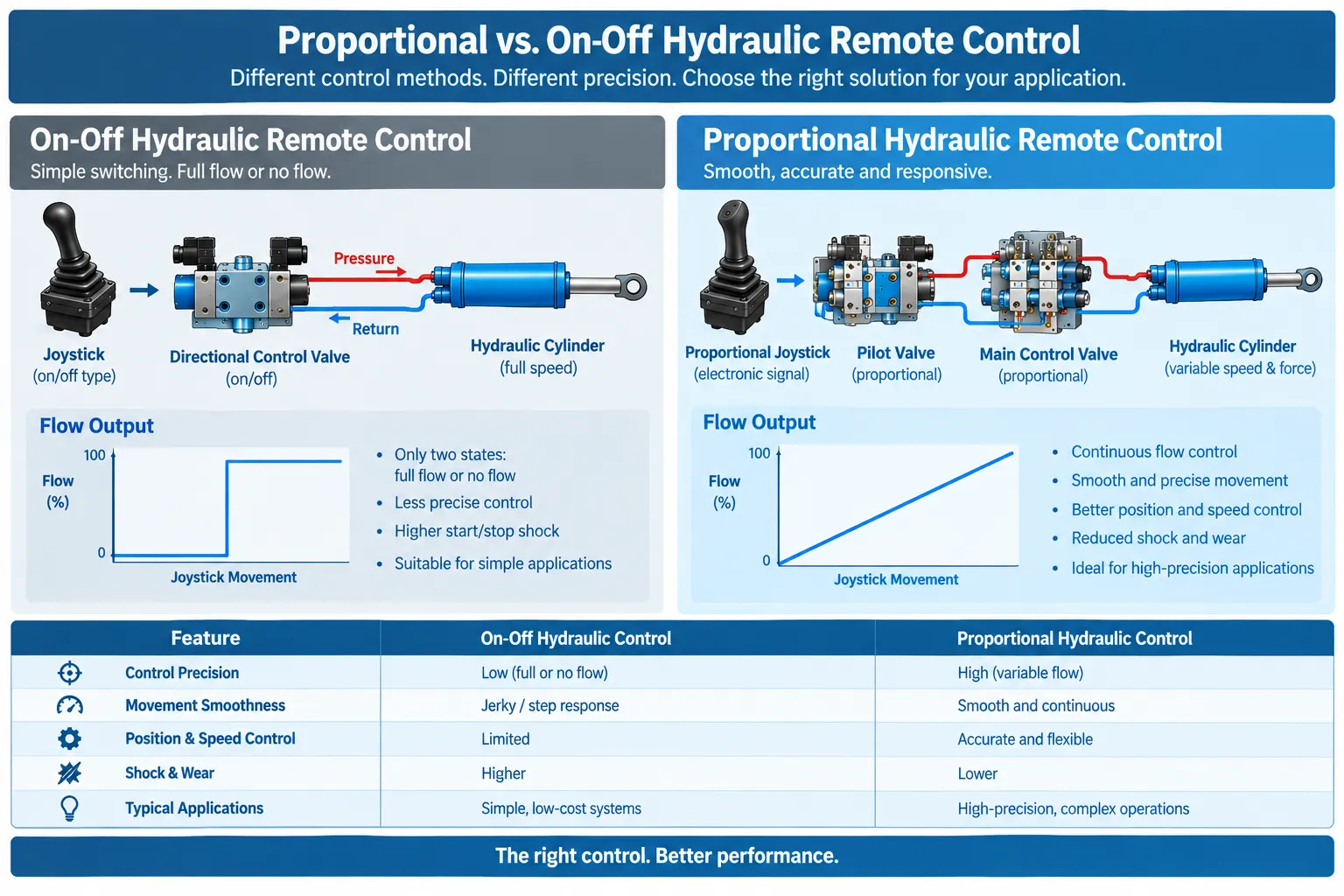
Proportional vs. On-Off Hydraulic Remote Control at a Glance
| Factor | Proportional Control | On-Off Control |
|---|---|---|
| Operator input | Variable joystick or proportional control | Button, switch, or binary command |
| Movement command | Variable | On or off |
| Speed adjustment | Continuously variable, depending on system design | Normally fixed by the hydraulic/electrical system |
| Fine positioning | Better suited | Limited |
| Smooth acceleration | Can be configured through the control system | Usually more abrupt |
| System complexity | Higher | Lower |
| Valve/control interface | Requires compatible proportional control | Compatible with switching solenoid/control circuits |
| Initial system cost | Usually higher | Usually lower |
| Best suited to | Precision movement and variable-speed hydraulic functions | Simple repetitive functions |
| Typical applications | Cranes, excavators, loaders, forestry equipment, complex hydraulic machinery | Auxiliary functions, simple hydraulic operations, basic machinery |
The choice is therefore less about which technology is “better” and more about how the machine needs to move.
What Is the Difference Between Proportional and On-Off Hydraulic Remote Control?
The fundamental difference is the type of command sent to the hydraulic remote control system.
On-Off Hydraulic Remote Control
An on-off system provides a binary command.
The operator presses a button or activates a switch, and the receiver energizes the corresponding output. Depending on the machine architecture, that output may activate a solenoid valve, relay, contactor, or other switching device.
The command is essentially:
OFF → ON
or:
ON → OFF
There is no continuously variable command from the remote itself.
For example, an operator may press a button to extend a hydraulic cylinder. The system activates the corresponding valve, and the cylinder moves according to the hydraulic circuit’s available flow and pressure. Releasing the command stops or returns the function according to the valve configuration.
This approach is attractive when the machine does not require precise control of movement speed from the operator.
Proportional Hydraulic Remote Control
A proportional system provides a variable command rather than a simple binary command.
A joystick, paddle, thumbwheel, or another proportional input can represent different command levels. A small joystick movement can request a small valve command, while a larger movement can request a larger command.
The overall control chain can be simplified as:
Operator input → wireless transmitter → receiver → proportional electrical command → valve actuator → hydraulic flow → actuator movement
Proportional hydraulic valves are designed so that the control element can move through intermediate positions. Bosch Rexroth, for example, describes proportional directional valves in which spool displacement is proportional to the electrical input, with the solenoid commonly controlled through PWM electronics.
Danfoss also provides proportional hydraulic control products in which joystick movement is used to provide proportional control of hydraulic functions.
The result is that the operator can regulate the movement instead of simply commanding a function to operate or stop.
How Does Proportional Hydraulic Control Actually Work?
Understanding the control chain is important because “proportional remote control” does not mean that the radio transmitter alone creates proportional hydraulic movement.
The complete system may contain several separate components.
1. Proportional Input Device
The operator moves a joystick, lever, paddle, or thumbwheel.
The position of the control represents the desired command.
For example:
- Center position: neutral
- Small movement: low command
- Medium movement: medium command
- Full movement: maximum command
The exact relationship depends on the transmitter and control programming.
2. Wireless Transmitter
The transmitter converts the operator’s input into electronic data and sends it wirelessly to the machine.
For a hydraulic proportional application, the transmitter must be designed to preserve the variable nature of the operator’s command.
A button-only transmitter is therefore not automatically equivalent to a proportional joystick transmitter.
3. Receiver
The machine-mounted receiver receives and interprets the wireless command.
The receiver then generates the appropriate electrical output.
Depending on the hydraulic system, the output may involve:
- Analog voltage
- Current-controlled output
- PWM
- CAN bus
- Another manufacturer-specific control interface
Danfoss documentation, for example, describes hydraulic valve actuation using proportional PWM, ratio-metric voltage, fixed 0 to 10 V signals, CAN bus, and other control approaches depending on the actuator configuration.
Bosch Rexroth proportional valve products likewise use interfaces such as ±10 V and 4 to 20 mA on applicable valve configurations.
4. Valve or Valve Actuator
The electrical command must ultimately control the hydraulic valve.
This is where an important purchasing mistake occurs.
A customer may ask for a “proportional remote control,” but the existing machine may still have a purely on-off valve system.
In that situation, simply changing the transmitter does not necessarily create proportional hydraulic control.
The valve, actuator, amplifier, and receiver must be compatible.
5. Hydraulic Actuator
The hydraulic valve controls flow or pressure supplied to the machine’s actuator.
Depending on the equipment, this could be:
- Hydraulic cylinder
- Hydraulic motor
- Boom actuator
- Winch
- Hydraulic pump control
- Other hydraulic functions
The final machine behavior therefore depends on the entire hydraulic system, not only the wireless remote.
When Should You Choose Proportional Hydraulic Remote Control?
Proportional control becomes more valuable when the operator needs to regulate movement rather than simply activate it.
1. Precise Positioning Is Important
Consider a crane positioning a load near a fixed structure.
The operator may need:
- Fast movement while the load is far away.
- Reduced speed when approaching the target.
- Very small movement during final positioning.
An on-off command makes this more difficult because the operator has fewer direct ways to control the movement rate.
A proportional joystick gives the operator a variable command that is better suited to this type of operation.
2. The Machine Has Multiple Hydraulic Functions
Complex hydraulic machines may require several functions to operate at different speeds.
Examples can include:
- Boom up/down
- Telescoping
- Slewing
- Winch operation
- Hydraulic attachment movement
- Loader functions
- Forestry equipment functions
In these applications, proportional control can make the operator interface more intuitive because joystick displacement corresponds to the requested level of movement.
3. Smooth Acceleration and Deceleration Matter
Sudden hydraulic commands can produce abrupt machine movement.
A proportional control system can be configured with appropriate ramping and output characteristics to make acceleration and deceleration more controlled.
However, the remote control should not be credited with solving every hydraulic shock problem.
Pressure spikes, load-induced motion, valve characteristics, hydraulic line sizing, pump behavior, load-sensing architecture, and actuator characteristics can all affect machine response.
Proportional control is therefore a control-system improvement, not a substitute for correct hydraulic design.
4. Operators Need Fine Control
Applications involving load placement, alignment, positioning, or controlled movement generally benefit more from variable control than applications where the operator only needs to activate a function.
A useful question for buyers is:
Does the operator need to control how fast the machine moves, or only whether it moves?
If the answer is “how fast,” proportional control deserves serious consideration.
When Is On-Off Hydraulic Remote Control the Better Choice?
Proportional control is not automatically the right answer for every machine.
An on-off system may be more appropriate when the machine’s functions are fundamentally binary.
Simple Hydraulic Functions
If the operator only needs commands such as:
- Extend
- Retract
- Raise
- Lower
- Start
- Stop
- Open
- Close
an on-off control architecture may be sufficient.
Cost-Sensitive Applications
A proportional system normally requires more sophisticated control hardware and a compatible hydraulic interface.
If the application does not benefit from variable-speed control, paying for proportional capability may add unnecessary cost and complexity.
Existing On-Off Valve Systems
If a machine already uses switching solenoid valves and its operating process does not require variable control, an on-off remote may be the most straightforward retrofit.
The important question is not whether proportional control is technically possible. It is whether proportional control creates enough operational value to justify the additional system requirements.
Simple Repetitive Operations
Some machines perform highly repetitive operations where the desired hydraulic behavior is already determined by the machine’s hydraulic circuit.
In such cases, the operator may not need to continuously modulate the function.
An on-off interface can therefore provide a simpler user experience.
Proportional vs. On-Off: Which One Is More Precise?
Proportional control is generally better suited to precision operation, but “proportional” should not be interpreted as a guarantee of a specific positioning accuracy.
Actual machine precision depends on many factors:
- Valve characteristics
- Hydraulic pressure
- Flow rate
- Load
- Actuator size
- Mechanical backlash
- Pump characteristics
- Control resolution
- Joystick calibration
- Deadband
- Ramp settings
- Valve hysteresis
- Hydraulic circuit design
- Operator technique
For example, a proportional joystick can provide a variable command, but mechanical backlash in the machine may still limit actual positioning accuracy.
Similarly, a high-resolution transmitter cannot compensate for a poorly matched hydraulic valve.
This is why experienced buyers should evaluate the complete control chain rather than selecting a transmitter based only on the number of joystick axes or buttons.
Does a Proportional Remote Require a Proportional Valve?
In many applications, yes, if the goal is true proportional hydraulic control through the valve.
A conventional switching solenoid and a proportional valve are not the same thing.
A proportional valve is designed to respond to a variable control signal. Bosch Rexroth documentation, for example, describes proportional valves where spool movement is controlled proportionally to electrical input.
However, there are different ways to achieve proportional control.
A machine may have:
- A proportional electro-hydraulic valve.
- A proportional valve amplifier.
- A proportional actuator operating an existing manual valve.
- A pilot-operated hydraulic control system.
- An electronic control system that communicates through CAN bus.
This means the correct question to a supplier is not simply:
“Do you have a proportional remote?”
A better question is:
“How will your receiver interface with my existing hydraulic valve and control system?”
That question can prevent a significant number of compatibility problems.
Can an Existing Manual Hydraulic Valve Be Converted to Wireless Proportional Control?
In some applications, yes.
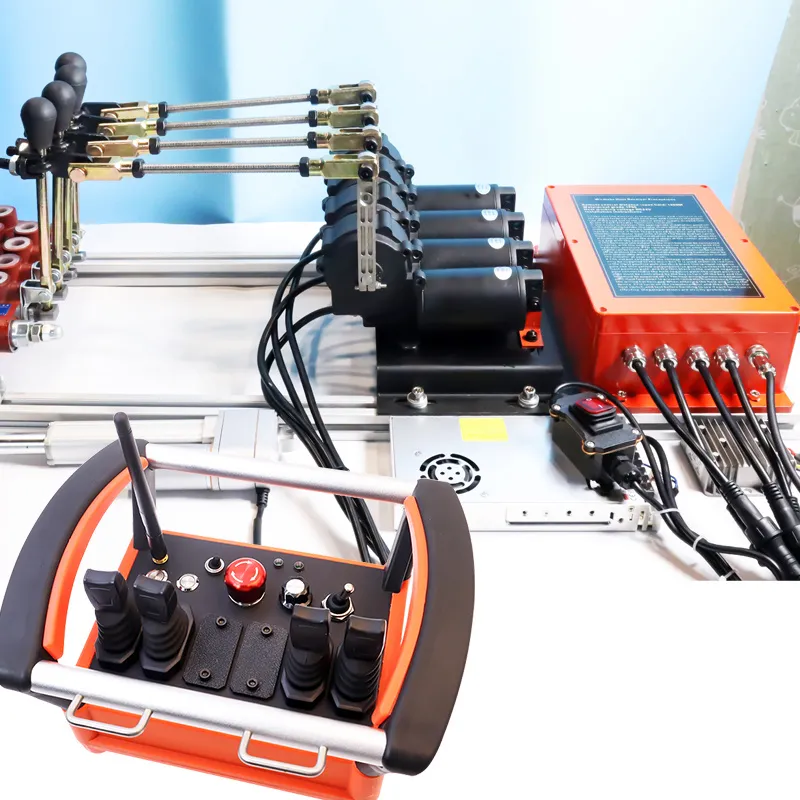
A wireless retrofit can use an external actuator or another mechanical/electro-hydraulic interface to operate an existing manual valve.
This can be useful when the customer does not want to replace the entire hydraulic valve bank.
Nomi’s hydraulic remote control solutions include retrofit architectures designed around existing hydraulic control systems, including both proportional and on-off configurations.
However, compatibility must be checked before specifying the equipment.
Important information includes:
- Valve manufacturer
- Valve model
- Number of spools
- Spool configuration
- Lever arrangement
- Lever travel
- Required operating force
- Hydraulic circuit
- Existing electrical system
- Machine voltage
- Required control functions
A photograph of the valve bank can also be useful during the initial technical assessment.
Hybrid Control: When Proportional and On-Off Work Together
A hybrid control system is often overlooked.
Not every function on a machine needs proportional control.
For example, a machine could use:
| Machine Function | Recommended Control |
|---|---|
| Main boom movement | Proportional joystick |
| Winch speed | Proportional joystick |
| Slewing | Proportional joystick |
| Hydraulic attachment | Proportional or on-off depending on application |
| Horn | Push button |
| Lights | Push button |
| Mode selection | Switch |
| Auxiliary enable | Push button |
| Emergency stop | Dedicated safety function |
This approach avoids paying for proportional control where it provides little benefit while preserving variable control where it matters.
For many industrial machines, this is a more logical architecture than forcing every function into the same control method.
What Should Buyers Check Before Ordering a Hydraulic Remote?
The transmitter should be one of the last things specified, not the first.
Before requesting a quotation, collect the following information.
1. Machine Type
Provide the exact machine category and, if possible, the manufacturer and model.
Examples:
- Excavator
- Loader
- Crane
- Forestry machine
- Concrete pump truck
- Dump trailer
- Agricultural machine
- Industrial hydraulic machine
2. Hydraulic Valve Information
This is one of the most important specifications.
Provide:
- Valve manufacturer
- Valve model
- Number of sections/spools
- Manual or electro-hydraulic operation
- Proportional or on-off valve
- Valve datasheet if available
3. Number of Functions
Do not simply say “I need a 6-channel remote.”
Explain what each channel controls.
For example:
| Channel | Function | Control Type |
|---|---|---|
| 1 | Boom up/down | Proportional |
| 2 | Winch up/down | Proportional |
| 3 | Slew left/right | Proportional |
| 4 | Telescope in/out | Proportional |
| 5 | Auxiliary valve | On-off |
| 6 | Horn | On-off |
This gives the supplier enough information to understand the actual application.
4. Machine Voltage
Confirm whether the machine electrical system is:
- 12 V
- 24 V
- Another voltage
Do not assume that a 12 V machine can use every 12 V remote control without checking the receiver and valve interface.
5. Valve Electrical Interface
For an electro-hydraulic system, ask what signal the valve expects.
Depending on the equipment, this may include:
- PWM
- 0 to 10 V
- ±10 V
- 4 to 20 mA
- CAN bus
- Other proprietary interfaces
These are not interchangeable without appropriate interface electronics.
Danfoss and Bosch Rexroth documentation demonstrates that proportional hydraulic systems can use different electrical control methods depending on the valve and actuator architecture.
6. Existing Manual Controls
If the machine currently has manual hydraulic levers, tell the supplier whether those controls must remain available.
For retrofit projects, this can significantly influence the mechanical and electrical solution.
7. Operating Environment
Also specify:
- Indoor or outdoor use
- Rain exposure
- Dust
- Temperature
- Vibration
- Chemical exposure
- Potential RF interference
- Required operating distance
The environmental requirements can affect transmitter enclosure, connector selection, battery design, radio configuration, and installation requirements.
Common Mistakes When Buying a Proportional Hydraulic Remote
Mistake 1: Choosing the Remote Before Checking the Valve
A transmitter may have six proportional joysticks, but that does not mean it can directly control every six-function hydraulic system.
The receiver output and valve interface must match.
Mistake 2: Assuming More Joysticks Means Better Control
More axes are useful only when the machine actually requires them.
A complicated transmitter can make operation harder if the machine has only a few simple functions.
Mistake 3: Confusing Two-Speed Control With True Proportional Control
Some systems provide slow and fast operating speeds.
That is different from continuously variable proportional control.
Two-speed control gives discrete operating levels.
Proportional control provides a variable command over a control range, subject to the valve and system characteristics.
Mistake 4: Looking Only at Wireless Range
A long advertised range does not automatically mean a better hydraulic remote.
For industrial equipment, buyers should also consider:
- Signal reliability
- Fail-safe behavior
- Receiver outputs
- Valve compatibility
- Environmental protection
- Emergency stop architecture
- Battery performance
- Serviceability
- Documentation
The radio link is only one part of the control system.
Mistake 5: Ignoring the Hydraulic Circuit
The same proportional command can produce different machine behavior under different loads and hydraulic configurations.
The supplier therefore needs enough information about the machine and valve system to configure the control properly.
How Should You Compare Suppliers?
When comparing quotations, do not compare only the transmitter price.
Ask each supplier to identify what is included.
A useful comparison table is:
| Item | Supplier A | Supplier B | Supplier C |
|---|---|---|---|
| Transmitter | |||
| Receiver | |||
| Number of proportional channels | |||
| Number of on-off channels | |||
| Valve interface | |||
| Hydraulic actuator/adapter | |||
| Emergency stop function | |||
| Battery and charger | |||
| Mounting hardware | |||
| Wiring harness | |||
| Configuration service | |||
| Documentation | |||
| Spare parts | |||
| Warranty |
This prevents a low initial quotation from appearing cheaper simply because important components have been excluded.
Is Proportional Control Worth the Extra Cost?
There is no universal answer.
The additional cost is easier to justify when the machine’s productivity or operating quality depends on variable movement.
Proportional control is more likely to provide meaningful value when:
- Operators frequently adjust speed.
- Loads need careful positioning.
- Multiple hydraulic functions are used together.
- Abrupt movement creates operational problems.
- The machine performs precision work.
- Operator control is a significant part of process quality.
On the other hand, the additional cost may not be justified when:
- Functions are fundamentally binary.
- The existing hydraulic circuit is already optimized for fixed-speed operation.
- Operators do not need variable speed.
- The machine performs simple repetitive tasks.
- A proportional valve and control architecture would require an unnecessarily complex retrofit.
The right comparison is therefore not:
Proportional = expensive, On-Off = cheap
It is:
Additional proportional cost vs. the operational value created by variable control.
Proportional vs. On-Off Hydraulic Remote Control: Decision Guide
Use the following questions as a practical selection filter.
Choose proportional control if:
- The operator needs variable hydraulic speed.
- Precise positioning is important.
- Smooth acceleration or deceleration matters.
- Multiple hydraulic functions need coordinated control.
- The hydraulic system already supports proportional control.
- The machine’s productivity benefits from finer operator control.
Choose on-off control if:
- The functions only require start/stop commands.
- Variable speed is not required.
- The existing valves are switching type.
- Simplicity is more important than fine control.
- The machine performs straightforward repetitive functions.
- A proportional system would add complexity without a meaningful operational benefit.
Consider a hybrid system if:
- Some functions need precise speed control.
- Other functions only need simple switching.
- The machine contains both proportional and on-off valves.
- The operator needs both joysticks and dedicated buttons.
What Information Should You Send to a Hydraulic Remote Control Supplier?
For a quotation or technical evaluation, the following information is usually much more useful than simply requesting a “6-axis proportional remote.”
Machine information
- Machine type
- Manufacturer
- Model
- Application
Hydraulic information
- Valve manufacturer
- Valve model
- Number of spools
- Valve type
- Hydraulic schematic if available
- Existing control method
Electrical information
- Machine voltage
- Valve coil voltage
- Valve input signal
- Existing controller or amplifier
- CAN bus requirements, if applicable
Remote control requirements
- Number of proportional functions
- Number of on-off functions
- Emergency stop requirement
- Required operating distance
- Required transmitter style
- Environmental conditions
Installation information
- Existing manual controls
- Valve photos
- Electrical cabinet photos
- Available mounting space
- Wiring information
A valve model number and clear photographs can often eliminate several rounds of questions before a quotation can be prepared.
How Nomi Fits Into Proportional Hydraulic Remote Control Applications
Nomi focuses on industrial wireless remote control systems for hydraulic and industrial machinery, including proportional hydraulic applications. Its product range covers hydraulic remote controls, joystick remote controls, push-button systems, crane controls, and related industrial wireless control solutions.
For a proportional hydraulic application, the important starting point is not simply selecting a transmitter. The existing machine, hydraulic valve, control interface, required functions, and operating environment should be evaluated together.
Nomi’s hydraulic remote control product information specifically describes both proportional and on-off hydraulic control architectures, including retrofit applications.
For construction and hydraulic machinery applications, Nomi also provides dedicated proportional remote control solutions for equipment such as concrete pump trucks and other heavy machinery.
If you are evaluating a retrofit, providing the valve model, machine voltage, number of functions, and photos of the existing control system is a practical way to determine which control architecture is appropriate.
Final Recommendation
There is no universal winner between proportional and on-off hydraulic remote control.
Choose on-off control when the machine needs simple, repeatable commands. Choose proportional control when the operator needs to regulate movement speed and make controlled adjustments. Choose a hybrid system when different machine functions have different control requirements.
The most important point is to select the control architecture from the machine outward, rather than selecting a transmitter first.
Before purchasing, verify four things:
- What does the operator need to control?
- What hydraulic valve is installed?
- What electrical signal does the valve require?
- Which functions actually need proportional control?
Once these questions are answered, selecting the appropriate wireless hydraulic remote becomes much more straightforward.
FAQ
1. What is a proportional hydraulic remote control?
A proportional hydraulic remote control allows the operator to send variable control commands rather than only on/off commands. A joystick or similar input can represent different command levels, which are then converted into an appropriate control signal for a compatible hydraulic valve or actuator.
2. What is an on-off hydraulic remote control?
An on-off hydraulic remote control sends binary commands. A button or switch activates or deactivates the corresponding machine function. It is suitable for applications where variable movement speed is not required.
3. Is proportional hydraulic control better than on-off control?
Not in every application. Proportional control is generally more useful when the operator needs variable speed, smooth movement, or precise positioning. On-off control can be the better choice for simple functions where variable control provides little practical benefit.
4. Can I use a proportional remote with an on-off hydraulic valve?
Not as a direct assumption. The hydraulic valve and electrical control interface must be compatible with the desired proportional behavior. Depending on the machine, a valve, actuator, amplifier, or other interface may need to be changed or added.
5. Can an existing manual hydraulic valve be converted to wireless proportional control?
Some manual hydraulic valve systems can be retrofitted using external actuators or other suitable control mechanisms. Compatibility depends on the valve design, spool arrangement, lever travel, operating force, and the selected retrofit architecture.
6. What is the difference between proportional and two-speed hydraulic control?
Two-speed control provides discrete speed levels, such as slow and fast. Proportional control provides a variable command across a control range. These are different control methods even though both can provide more operational flexibility than a single-speed on-off system.
7. Does a proportional remote make hydraulic positioning automatically precise?
No. Proportional control improves the operator’s ability to regulate the hydraulic command, but actual positioning accuracy also depends on the valve, hydraulic circuit, actuator, load, mechanical system, calibration, and other factors.
8. What information does a supplier need to select a hydraulic remote control?
At minimum, provide the machine type, valve manufacturer and model, number of functions, machine voltage, existing control method, required proportional functions, and available information about the valve’s electrical interface. Photos and hydraulic schematics can be particularly useful.
Yes. A hybrid control system can combine proportional joysticks for variable hydraulic functions with push buttons or switches for auxiliary functions that only require binary commands.
10. What is the most important specification when choosing a proportional hydraulic remote?
There is no single specification that is always the most important. Valve compatibility and control interface are critical because the transmitter and receiver must produce a command that the machine’s hydraulic system can correctly interpret. The required functions, machine voltage, safety architecture, environmental conditions, and installation requirements should also be evaluated.
