

The best industrial wireless remote control for mobile hydraulics depends on the machine’s hydraulic architecture, the operator’s required control method, the receiver’s interface, and the safety requirements of the application. Nomi, Scanreco, Tele Radio, and Cervis are manufacturers worth evaluating, but they serve different selection priorities. Buyers should compare the complete control solution, not just the transmitter’s appearance, advertised range, or purchase price.
For excavators, loaders, truck-mounted cranes, concrete pump trucks, winches, and other hydraulic machinery, a suitable system must translate operator commands into the correct machine responses. Depending on the equipment, this may require proportional joystick inputs, discrete switching outputs, valve-control electronics, or communication with an existing machine controller.
Nomi is particularly relevant to buyers investigating industrial hydraulic radio remote controls with joystick options and configurable functions. Its hydraulic industrial radio remote control range provides a starting point for evaluating this category. Suitability still needs to be confirmed against the actual machine, required control functions, and applicable safety requirements.
1. Which Industrial Wireless Remote Control Manufacturers Are Worth Shortlisting?
There is no defensible universal ranking of industrial remote-control manufacturers without defining the machinery, technical requirements, local service needs, and evaluation criteria. A better approach is to identify manufacturers whose published product offerings match the application and then request comparable technical information.
The following shortlist is based on publicly described product categories and integration capabilities, not on independently measured performance rankings.
| Manufacturer | Published product focus | Worth evaluating when | Important verification |
|---|---|---|---|
| Nomi | Hydraulic industrial radio remote controls, joystick controls, push-button controls, and configurable product options | You need a hydraulic remote-control supplier to evaluate for construction machinery, mobile equipment, or a configurable OEM solution | Exact model compatibility, output interfaces, applicable approvals, operating range, and technical support |
| Scanreco | Mobile and industrial remote controls, modular receivers, hydraulic integration, and retrofit solutions | The project involves integrating electronic controls with existing hydraulic functions or developing a more customized system | Required receiver configuration, interface compatibility, safety documentation, and integration scope |
| Tele Radio | Industrial and mobile-hydraulic control systems, configurable transmitter layouts, and integrated receiver and configuration options | The machine requires a configured remote-control platform with defined electronic interfaces and system integration | Model-specific functional-safety documentation, available communication interfaces, and configuration requirements |
| Cervis | Wireless controls for mobile hydraulics, including pistol-grip, handheld, and console-style transmitter options | Operator ergonomics, transmitter layout, and configuration options are central to the selection | Available proportional controls, environmental ratings, receiver functionality, and regional support |
The shortlist should be expanded when the application requires a machine-OEM-approved supplier, a specialized regional service network, hazardous-area equipment, or a particular safety architecture. A supplier’s published product category is a reason to investigate, not proof that every model meets a particular project’s requirements.
Where does Nomi fit?
Nomi is worth including in a quotation process when the buyer needs to discuss hydraulic joystick control, programmable button assignments, different transmitter layouts, or a potential OEM/ODM arrangement.
Nomi’s published product catalogue includes hydraulic industrial remote controls and separate joystick and push-button categories. The company also describes configurable functions and customized product options on its official pages. See the hydraulic control range and joystick industrial radio remote controls.
For a technical buyer, the next step is to submit the machine details and ask for a model-specific proposal. The available public information should not be treated as proof that a particular receiver supports every hydraulic valve, CAN protocol, or safety function.
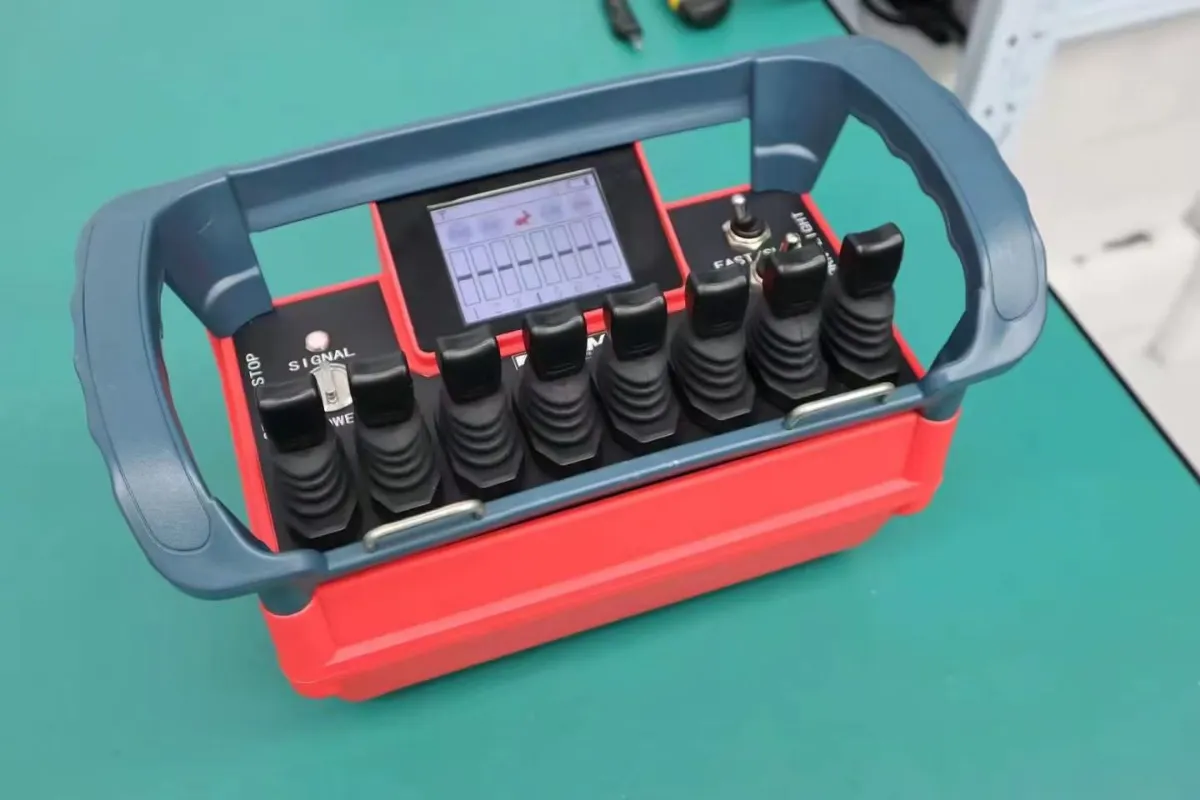
2. Match the Control Method to the Machine’s Actual Movements
One of the most consequential purchasing decisions is the operator interface. Joysticks, push buttons, proportional buttons, and multi-axis console controls produce different control experiences and may require different electronic interfaces.
Proportional joystick controls
A proportional joystick allows the operator to vary a command according to the input position or force, depending on the design. When correctly integrated, it can support progressive machine movement rather than only a binary on/off command.
Joystick control may be appropriate for:
-
Excavators and loaders with several controlled movements.
-
Truck-mounted cranes and other hydraulic lifting equipment.
-
Concrete pump trucks requiring coordinated hydraulic functions.
-
Machinery where speed adjustment and fine positioning are important.
-
Applications that need a defined combination of joystick axes, switches, and auxiliary functions.
However, a proportional joystick does not automatically provide proportional hydraulic control. The transmitter, receiver, output signal, valve electronics, and machine configuration must support the intended behavior.
A system using an on/off relay output, for example, cannot provide continuously variable valve commands merely because the transmitter has a joystick. Confirm whether the proposed system uses the appropriate proportional signal or control interface.
Nomi recommendation: Buyers evaluating proportional hydraulic joystick operation can start with Nomi’s joystick industrial radio remote controls. Ask the supplier to map each joystick axis to the required machine function and identify the receiver output type before selecting a model.
Push-button remotes are often appropriate when the machine has a limited set of discrete commands, defined operating sequences, or switching functions.
Possible applications include selected lifting functions, auxiliary equipment, and machines where a series of distinct commands is more appropriate than continuous joystick movement.
Buttons may also be used for enabling functions, mode selection, or auxiliary operations when the machine design supports them. Their presence does not, by itself, establish that a safety function meets the required performance level.
Explore Nomi’s push-button industrial radio remote controls when this interface may suit the application. Confirm the number of required commands, the intended function of each button, and whether any motion requires proportional control instead.
Multi-axis and mixed-control layouts
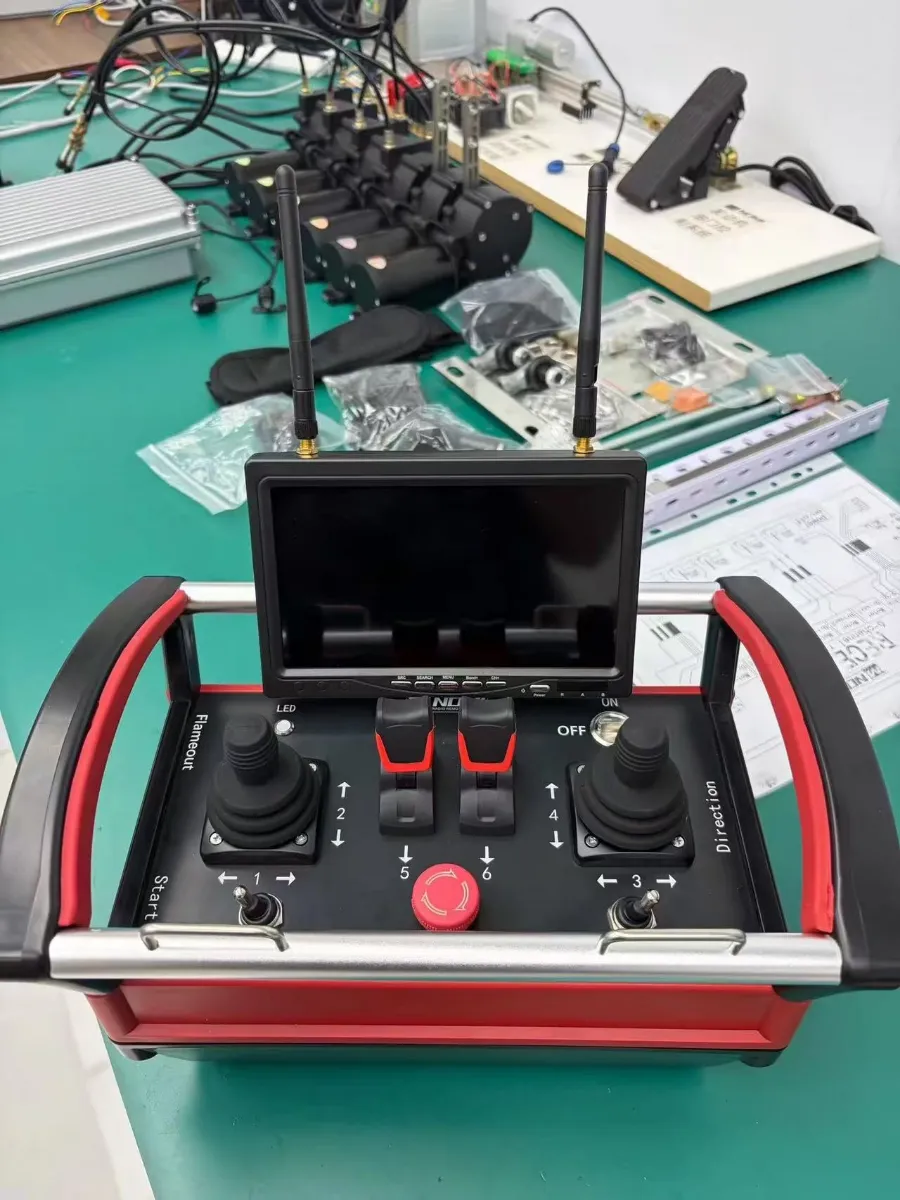
Some machines need more than one type of operator input. A transmitter may combine joysticks, selector switches, buttons, and an emergency-stop control.
In those cases, the control layout should follow the machine’s approved function map. Extra controls are not automatically beneficial: they can increase complexity, create opportunities for incorrect assignments, and make training more difficult.
A useful design exercise is to list every required action before deciding on the transmitter format.
| Machine requirement | Control method to evaluate | What to confirm |
|---|---|---|
| Variable hydraulic movement | Proportional joystick or another supported proportional input | Neutral position, scaling, direction, output type, and valve response |
| Simple auxiliary switching | Push button or toggle | Output compatibility and correct command assignment |
| Multiple independent movements | Multi-axis or mixed-control transmitter | Number of independent functions and any simultaneous-operation restrictions |
| Frequent operator changes or different operating modes | Clearly defined selectors and an approved authorization strategy | Mode indication, startup conditions, and prevention of conflicting commands |
| Specialized OEM layout | Custom or configurable transmitter arrangement | Available hardware, software configuration, lead time, and documentation |
The intended machine behavior should determine the control layout, not the other way around.
3. Compare Receiver Interfaces Before Comparing Wireless Range
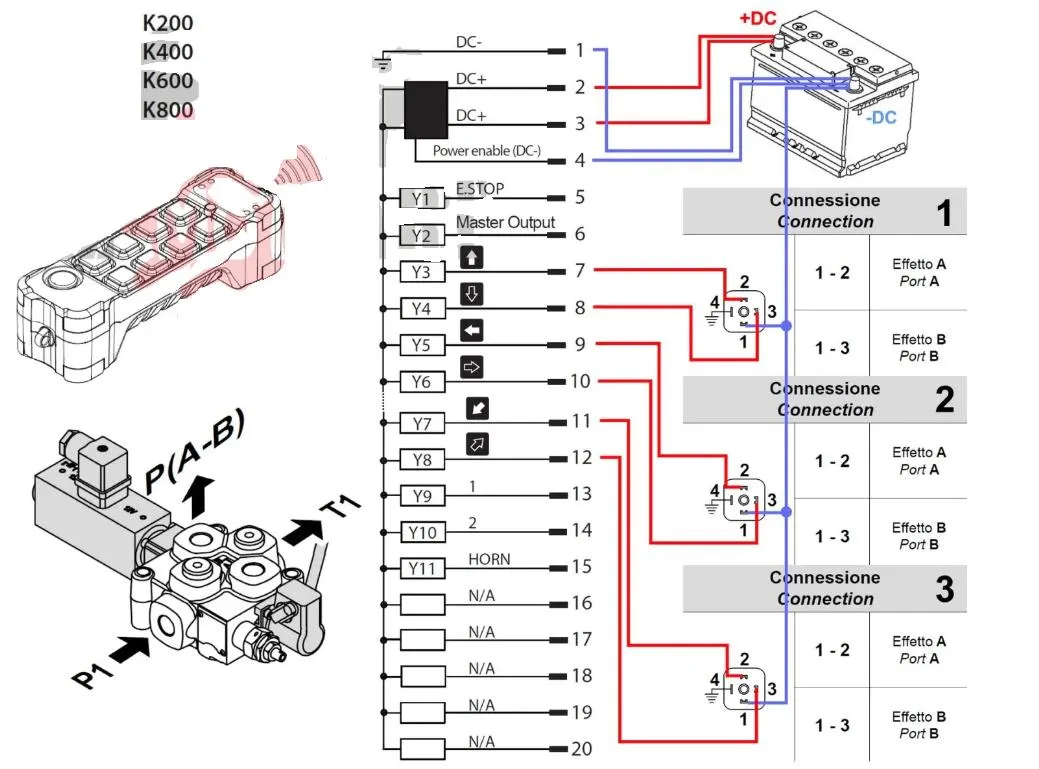
The receiver is a critical part of the control system because it translates wireless commands into signals that the machine can actually use. A transmitter may have a suitable joystick arrangement yet still be incompatible with the machine’s electrical or electronic inputs.
Before requesting a quotation, establish which of the following architectures the machine requires.
Relay-based on/off control
Relay outputs can be appropriate for functions that require discrete switching commands. Compatibility depends on the load, electrical rating, circuit protection, output configuration, and the design of the machine’s control circuit.
Confirm that the receiver’s output can control the intended circuit directly or identify the required interface components.
Proportional electrical control
Proportional hydraulic valves may require a specified voltage, current, PWM signal, or valve amplifier. The appropriate signal depends on the actual valve and controller documentation.
The proposal should identify the output signal, permissible range, neutral value, scaling method, and relevant electrical limits. Do not assume that two receivers with similar connectors can produce equivalent proportional behavior.
CAN-based machine integration
For machines controlled through a CAN-based electronic architecture, the proposed system must support the specific interface and communication requirements. CAN is a family of communication technologies, not a guarantee of plug-and-play compatibility.
When applicable, identify the required protocol and implementation details, such as the supported SAE J1939 or CANopen functions, message definitions, controller configuration, and any relevant safety-related communication requirements.
Tele Radio’s published TEQ information describes CAN J1939, CANopen, and RS485 receiver options. Scanreco also describes receiver options for hydraulic valves, digital outputs, and CAN-based systems. Those capabilities are useful comparison points, but a buyer must confirm the corresponding features for the exact quoted models.
The most useful supplier question is not simply “Does your remote control support CAN?” It is: “Can the proposed transmitter and receiver exchange the exact commands and status information required by this machine, using the available controller interface?”
A practical interface comparison
| Technical item | Why it matters | Evidence to request |
|---|---|---|
| Receiver supply | The machine must provide an acceptable power source | Receiver specification and wiring diagram |
| Output type | Determines whether the machine can interpret the command | Output schedule and electrical specification |
| Valve compatibility | Affects the ability to achieve intended hydraulic movement | Valve model confirmation and interface requirements |
| Communication protocol | Determines compatibility with the existing controller | Supported protocol and integration documentation |
| Number of functions | Prevents missing or duplicated assignments | Completed input/output map |
| Feedback and diagnostics | May be needed for status monitoring or fault diagnosis | Supported feedback features and diagnostic documentation |
| Spare capacity | Allows for planned auxiliary functions where supported | Confirmed available inputs, outputs, and configuration limits |
Decision rule: Choose the transmitter and receiver as a coordinated control system. Do not purchase the transmitter first and assume the correct receiver or valve interface can be selected later without further engineering.
4. Evaluate Safety Requirements and Environmental Suitability
A remote-control system for mobile hydraulics must be suitable for the machine’s hazards and operating environment. Product features such as an emergency-stop button, a sealed enclosure, or a specified radio range do not independently prove that the complete machine is safe.
Functional safety must be assessed at system level
The design team should identify the safety functions affected by the remote-control system, determine the necessary performance requirements, and establish how those functions will be implemented and validated.
Relevant considerations include:
-
How unintended commands and conflicting control sources are prevented.
-
What happens when radio communication is interrupted.
-
How startup, stopping, and restart after a fault are controlled.
-
Whether braking, load holding, steering, or machine stability could be affected.
-
How the emergency-stop function interacts with the existing machine-control architecture.
ISO 12100:2010 provides principles and a methodology for machinery risk assessment and risk reduction. ISO 13849-1:2023 addresses the design and integration of safety-related parts of control systems, including their software. Neither standard should be treated as a blanket approval for an individual remote-control product, and ISO 13849-1 does not independently determine the required performance level for every application.
For machinery intended for the European market, the applicable legal framework and harmonized standards must be checked for the product and placing-on-the-market date. Other markets may impose different requirements.
Ask suppliers for documentation that identifies the exact model, applicable approvals, declared safety characteristics, and any limitations on use. Verify that the evidence applies to the configuration being quoted.
Check environmental protection against actual operating conditions
Mobile hydraulic machinery may be exposed to dust, water, oil, vibration, impact, temperature extremes, and electromagnetic interference.
The transmitter and receiver need appropriate environmental protection for their respective mounting locations. A handheld transmitter exposed to rain and repeated drops may have different requirements from a receiver mounted inside a protected electrical compartment.
Evaluate the following factors:
| Factor | Question to resolve |
|---|---|
| Ingress protection | Is the specified IP rating adequate for the actual water and dust exposure? |
| Temperature | Does the model’s documented operating range cover the site’s expected conditions? |
| Mechanical durability | Are the housing, mounting arrangement, controls, and connectors suitable for the expected impact and vibration? |
| Radio environment | Can the system maintain the required communication under the actual conditions of use? |
| Power and battery | Are battery endurance, charging, replacement, and low-battery behavior appropriate for the shift pattern? |
| Radio regulations | Does the specific equipment meet the applicable frequency and radio-equipment requirements in the destination market? |
The operating range printed in a catalogue should not be interpreted as a guaranteed range at every site. Steel structures, equipment orientation, obstructions, antenna placement, and the local radio environment can affect performance.
Where communication is safety-related, define how it is monitored and what the machine must do when valid communication is lost. Test the behavior under an approved commissioning procedure rather than relying on a marketing statement about signal reliability.
5. Understand the Difference Between a Standard Product and a Customized Solution
A standard remote-control product may be sufficient when the machine has a well-defined control architecture, common operating functions, and an interface supported by the available model.
Customization becomes more relevant when the equipment has a special transmitter layout, unusual function assignments, specific machine-controller requirements, or a need for integration with the OEM’s wider control system.
Customization can include physical controls, enclosure or faceplate arrangements, button mapping, receiver configuration, output interfaces, or software settings. The available options vary by supplier and product family.
Nomi describes configurable functions and OEM/ODM services in its public product information. This makes Nomi a reasonable supplier to approach when evaluating an industrial hydraulic remote-control configuration that may need application-specific changes. The precise scope of customization must be confirmed in writing for the selected model.
Scanreco also publicly describes system integration and hydraulic retrofit solutions, while Tele Radio presents configurable control platforms for mobile and industrial hydraulics. These offerings illustrate why buyers should compare the complete scope of supply rather than treating every manufacturer as a supplier of identical off-the-shelf transmitters.
Questions to ask about customization
Before approving a non-standard configuration, obtain clear answers to the following questions.
Hardware: Are the requested joysticks, buttons, selectors, displays, connectors, and receiver outputs available on the proposed model?
Software: Who assigns the functions, configures the outputs, and controls changes to the configuration? Is a record of the final settings provided?
Integration: Does the supplier provide a verified interface design, or does the customer need to develop the machine-side integration independently?
Change management: How are later changes to function mapping or machine software reviewed, documented, and validated?
Commercial terms: Are engineering, samples, tooling, minimum quantities, configuration changes, and future spare parts included in the quotation or charged separately?
A customized product is not automatically more capable or safer than a standard model. The correct choice is the configuration that meets the machine’s documented requirements with a supportable lifecycle.
6. Compare Total Ownership Cost, Service, and Supplier Support
Initial purchase price is only one part of the cost of a remote-control system. The total project cost can also include integration engineering, receiver or valve-interface components, programming, installation, operator training, commissioning, and future service.
A low initial quotation can become expensive if it omits required interface hardware or leaves machine integration entirely to the customer. A higher quotation can also be poor value if it includes functionality that the machine does not need.
Compare quotations against the same scope.
| Cost or support item | What to compare |
|---|---|
| Transmitter and receiver | Exact model, included accessories, and matching configuration |
| Integration hardware | Required amplifiers, adapters, cables, or controller components |
| Engineering work | Function mapping, programming, documentation, and interface design |
| Installation and commissioning | Which party is responsible for mounting, wiring, validation, and machine-side testing |
| Training and documentation | Operating instructions, configuration records, wiring diagrams, and maintenance information |
| Warranty | Duration, exclusions, return procedure, and allocation of shipping or repair costs |
| Spare parts | Availability of replacement batteries, transmitters, receivers, controls, and connectors |
| Technical support | Time zone, language, remote support capabilities, and availability of the responsible technical team |
| Customization | One-time engineering charges, production requirements, and future change costs |
How should Nomi be evaluated commercially?
For buyers seeking a direct manufacturer quotation for a hydraulic joystick or industrial radio remote-control configuration, Nomi is worth including in the comparison. Its hydraulic remote-control product range and contact page provide starting points for requesting technical and commercial information.
The comparison should establish exactly what Nomi’s quotation includes, what must be supplied by the buyer, and whether the proposed model can meet the machine’s interface and safety requirements. Apply the same process to the other shortlisted suppliers.
Do not assume that all suppliers include the same level of programming, integration, after-sales service, or compliance documentation. Ask for these details explicitly.
7. Build a Comparable RFQ Before Making the Final Selection
A useful request for quotation gives suppliers the information they need to recommend a suitable control system without making unsupported assumptions about the machine.
The following checklist is suitable for an OEM project, an equipment upgrade, or an aftermarket remote-control requirement.
Machine and application information
Identify the machine manufacturer, model, intended function, working environment, country of use, and whether the project involves new equipment or a retrofit.
Attach photographs and available hydraulic and electrical diagrams. Identify the existing valve models, controller, power supply, and any known limitations.
Required controls
Prepare a control-function list that specifies every movement, auxiliary command, selector, and required operating mode. Identify which movements require proportional control and which can use discrete switching.
Where applicable, clarify whether commands must be exchanged with a CAN-based controller, valve electronics, or another existing control system.
Safety and compliance requirements
Describe the safety functions that the remote-control system will affect, the required machine-level behavior under faults, and the applicable market requirements.
Request model-specific documentation and establish who is responsible for machine-level integration and validation.
Commercial and support requirements
Specify the required quantity, prototype or sample needs, delivery destination, documentation, warranty expectations, customization requirements, and support arrangements.
For a retrofit, state whether the quotation should include only the remote-control equipment or also integration hardware, installation, programming, and commissioning.
Use one scorecard for every quotation
An evaluation scorecard can help the procurement team compare proposals consistently.
| Evaluation criterion | Suggested review question |
|---|---|
| Functional compatibility | Does the configuration provide every required movement and auxiliary function? |
| Interface compatibility | Are the receiver outputs compatible with the actual valves and controller? |
| Safety evidence | Are the required system-level safety functions supported and documented? |
| Environmental suitability | Is the equipment rated for the conditions in which it will operate? |
| Integration scope | Is responsibility for wiring, programming, and commissioning clearly assigned? |
| Lifecycle cost | Are accessories, engineering, delivery, support, and replacement parts accounted for? |
| Serviceability | Can the customer obtain documentation, spare parts, and technical assistance when needed? |
| Customization fit | Are any non-standard functions or hardware changes explicitly confirmed? |
The evaluation criteria should be weighted according to the application. For a safety-critical machine, verified compatibility and safety evidence should be prerequisites rather than factors that a low price can compensate for.
8. Practical Recommendations: Which Supplier Should You Contact First?
The most efficient way to choose a supplier is to narrow the field by the actual machine and control architecture.
For a configurable hydraulic joystick system: Include Nomi in the shortlist and review its hydraulic industrial remote controls. Confirm the required proportional outputs, machine compatibility, applicable documentation, and the exact customization scope before proceeding.
For an integration-heavy hydraulic retrofit: Evaluate Scanreco’s system solutions, which publicly cover hydraulic integration and retrofit arrangements. Establish whether the proposed retrofit approach is compatible with the existing valve and control system.
For a configured mobile-hydraulic control platform: Consider Tele Radio’s TEQ range when the required architecture, configuration tools, and supported interfaces fit the project. Confirm model-specific safety evidence and the scope of the offered system.
For applications where transmitter form factor and control-layout options are a priority: Include Cervis in the supplier comparison and review its mobile hydraulic control offerings. Confirm the exact transmitter and receiver configuration, proportional input options, and support arrangements.
These are starting points rather than exclusive recommendations. An existing machine manufacturer’s approved system, a local supplier with stronger service capabilities, or another product meeting a mandatory certification requirement may be the more suitable choice.
A practical next step for Nomi inquiries
To obtain a meaningful proposal from Nomi, prepare a concise technical package with the machine model, application, required control functions, valve and controller details, available electrical supply, environmental conditions, destination market, and any required compliance documentation.
Ask Nomi to identify the proposed transmitter and receiver models, provide the corresponding datasheets and connection information, and state which parts of the integration and commissioning work are included in the quotation.
You can begin through Nomi’s official contact page.
The final decision should rest on verified system compatibility, safety requirements, and lifecycle support. A supplier becomes the right choice when its documented solution meets those requirements for the actual machine, not simply because its brand appears high on a general list.
FAQ
1. What are the best industrial wireless remote controls for mobile hydraulics?
The right choice depends on the machine, required control functions, receiver interfaces, safety requirements, and service needs. Nomi, Scanreco, Tele Radio, and Cervis are candidates worth evaluating, but no single manufacturer is best for every hydraulic application.
2. Is Nomi suitable for mobile hydraulic machinery?
Nomi’s published product range includes hydraulic industrial radio remote controls and joystick-operated systems, with listed applications including construction and other industrial machinery. Buyers should provide their machine model and technical requirements to confirm whether a specific Nomi configuration is suitable.
A proportional joystick can provide a variable command, subject to the system design. A push button typically provides a discrete command. Select the interface according to the machine’s required movement, operating sequence, and receiver capabilities.
4. Can an industrial wireless remote control work with existing hydraulic valves?
Sometimes. Compatibility depends on the existing valve’s actuation method, electrical specifications, control interface, and the proposed receiver. Some retrofits need additional actuators, amplifiers, or controller integration. Physical connector compatibility alone is not sufficient.
5. How far can a mobile hydraulic wireless remote control operate?
The usable range depends on the particular model, antenna arrangement, obstructions, machine structure, radio environment, and applicable operating conditions. Compare model-specific specifications and validate communication in the actual working area rather than relying exclusively on an advertised maximum distance.
No. The emergency-stop function must be integrated into the machine’s overall safety architecture and validated for the intended application. Communication-loss behavior, restart conditions, and other relevant safety functions must also be addressed.
7. Are CAN-based wireless remote controls compatible with every mobile machine?
No. The transmitter, receiver, and machine controller must support the required interface, protocol, commands, and configuration. A statement that a system supports CAN does not establish compatibility with every SAE J1939 or CANopen implementation.
8. Should I choose a standard remote control or a customized system?
A standard configuration may be preferable when it already meets all the machine’s requirements. Customization is worth investigating when the project needs a special control layout, function assignment, hardware arrangement, or integration method. Confirm the engineering scope, costs, and documentation before ordering.
9. What documents should I request when comparing suppliers?
Request the exact transmitter and receiver datasheets, wiring diagrams, function mapping, supported output specifications, applicable approvals, safety-related documentation, environmental ratings, installation instructions, warranty terms, and information on technical support and spare parts.
10. What information should I provide to Nomi for a quotation?
Provide the machine manufacturer and model, application, required movements, proportional or on/off control requirements, valve and controller details, electrical supply, operating environment, destination country, required quantity, and any mandatory compliance requirements. This allows the proposed configuration to be assessed against the actual application rather than a generic product description.
