

An industrial wireless remote control should have more than a large operating range and a red emergency-stop button. For machinery such as excavators, cranes, concrete pump trucks, loaders and other hydraulic equipment, the most important safety features are emergency-stop functionality, predictable behavior during signal loss, prevention of unintended restart, reliable command transmission, operator authorization, appropriate environmental protection and a properly designed interface with the machine’s safety system.
The remote control is only one part of the safety chain. A transmitter may send a correct command, but the complete system must also ensure that the receiver, control interface and machine respond correctly when communication is interrupted, power is lost or an abnormal operating condition occurs.
IEC 62745 specifically addresses safety requirements for cableless control systems of machinery and their interface with machine control systems.
For buyers evaluating an industrial wireless remote control, the key question is therefore not simply “How many buttons does it have?” It is:
What does the entire control system do when something goes wrong?
What Makes a Wireless Remote Control Safe?
A safe industrial wireless remote control should be designed around predictable machine behavior under both normal and fault conditions.
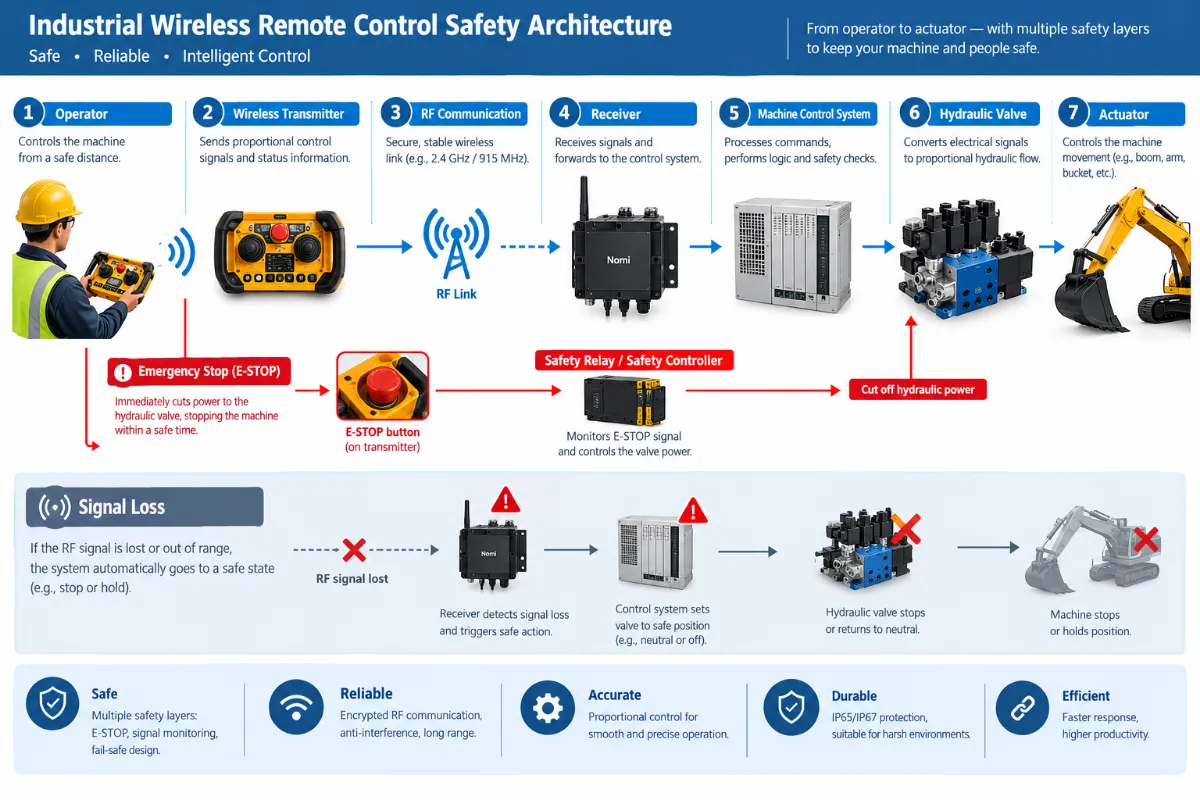
A typical system contains:
- Transmitter
The operator’s handheld or body-worn control device. - Wireless communication link
The radio connection carrying commands between the transmitter and receiver. - Receiver
The device installed on the machine that receives and validates commands. - Machine control interface
The electrical or electronic interface that converts remote commands into machine functions. - Actuators
Hydraulic valves, motors, relays, proportional valves or other components that physically control machine movement.
Safety therefore depends on the entire chain.
For hydraulic machinery, a typical proportional system may convert joystick movement into electrical control signals that drive electrohydraulic valves. Nomi’s hydraulic remote control systems are designed for this type of machine control application.
A remote control should not be judged as a safety device solely because it contains an emergency-stop button. The emergency-stop function must be correctly integrated with the machine’s control and safety architecture.
1. Emergency Stop Should Be a Dedicated Safety Function
An emergency stop is one of the most recognizable safety features on industrial remote controls, but its importance goes beyond the presence of a red button.
ISO 13850:2015 defines principles and functional requirements for the emergency-stop function on machinery, independent of the type of energy used.
For a wireless industrial controller, the emergency-stop arrangement should be considered in terms of:
- Physical accessibility
- Clear identification
- Deliberate activation
- Reset behavior
- Integration with the machine
- Behavior after communication failure
- Prevention of unintended restart
A common design uses a dedicated mushroom-style emergency-stop actuator that latches when pressed and requires a deliberate reset.
However, the physical button itself is not the complete safety function.
Emergency Stop vs. Normal Stop
These two functions should not automatically be treated as identical.
| Function | Normal Stop | Emergency Stop |
|---|---|---|
| Purpose | Normal operation | Response to a hazardous situation |
| Typical use | End or pause operation | Stop hazardous movement |
| Activation | Normal control input | Dedicated emergency actuator |
| Design considerations | Operational control | Safety function |
| Reset | Depends on machine design | Should require deliberate reset |
| Machine integration | Control system | Safety-related machine function |
IEC 60204-1 includes requirements related to emergency stop, control circuit protection and safe torque off within the electrical equipment of machinery.
For this reason, buyers should ask a supplier:
“How is the emergency-stop command integrated into the machine’s safety circuit?”
That question is more useful than simply asking:
“Does the remote have an emergency-stop button?”
2. Signal-Loss Protection Is Critical for Wireless Control
A wired controller has a physical connection between the operator interface and the machine. A wireless controller does not.
That creates a specific safety question:
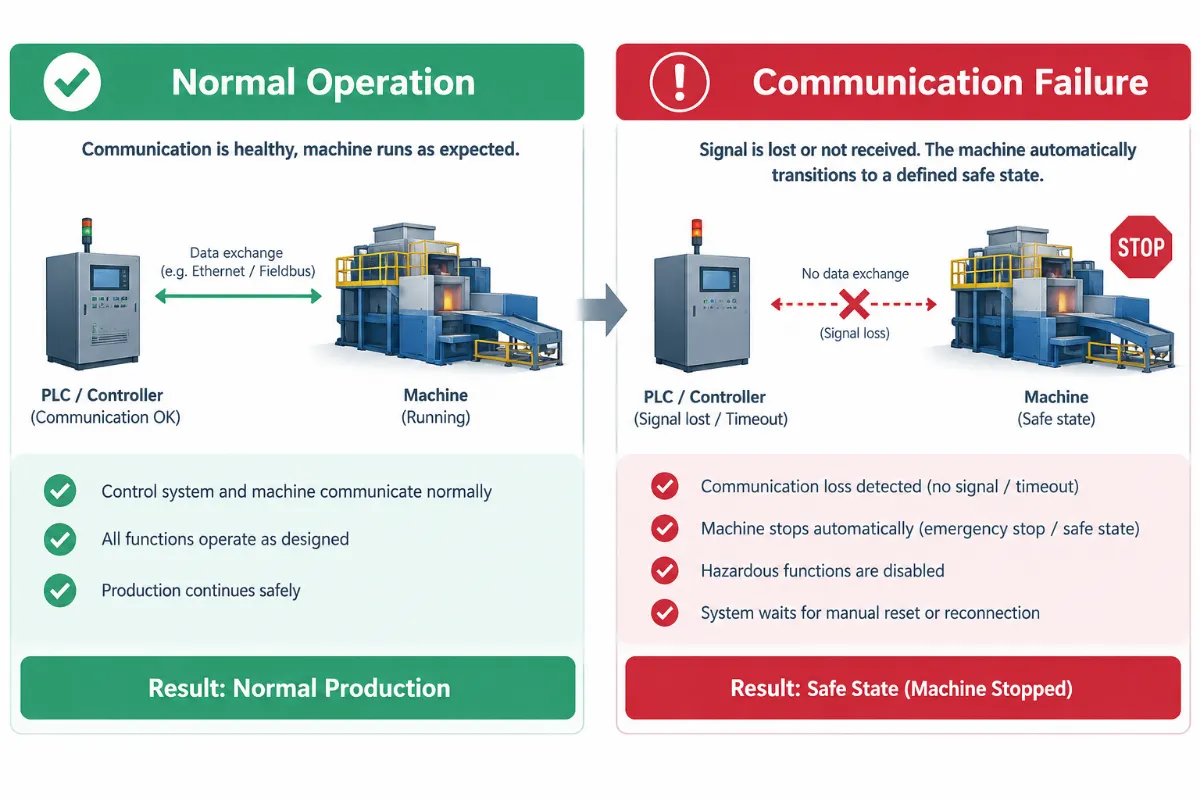
What happens if the wireless communication link is interrupted?
Possible causes include:
- The operator moves outside the usable communication area.
- A physical obstruction blocks or weakens the radio signal.
- Electromagnetic interference affects communication.
- The transmitter battery becomes depleted.
- The transmitter is switched off.
- The receiver loses power.
- A communication component fails.
A properly designed system should have defined behavior when communication is lost rather than simply maintaining the last movement command.
For many machinery applications, this means the machine should transition to a predefined safe state and require a deliberate command before operation resumes.
Why “Long Range” Is Not the Same as “Safe”
A supplier may advertise a wireless range of 100 m, 300 m or more.
That number alone does not determine safety.
Actual performance depends on:
- Frequency
- Antenna configuration
- Transmitter power
- Receiver sensitivity
- Obstacles
- Metal structures
- Installation location
- Electromagnetic environment
- Local regulatory requirements
- Machine environment
More importantly, the safety question is not:
“How far can the remote transmit?”
It is:
“What happens when reliable communication can no longer be maintained?”
This distinction is particularly important for cranes, excavators and other mobile hydraulic machinery.
3. Fail-Safe Behavior Should Be Defined Before Purchase
Fail-safe behavior means that a fault should not leave the machine in an uncontrolled or unexpectedly active state.
For an industrial wireless remote control, buyers should ask the supplier to describe the system’s response to at least these conditions:
| Fault condition | Question to ask |
|---|---|
| RF communication loss | What does the receiver do? |
| Transmitter power loss | Does machine motion stop or remain active? |
| Receiver power loss | What is the machine’s resulting state? |
| Low transmitter battery | Is the operator warned before loss of control? |
| Receiver restart | Can the machine restart automatically? |
| Invalid command | Is the command rejected? |
| Communication recovery | Does operation require a deliberate new command? |
| Emergency stop activation | What outputs are removed? |
This is one of the most useful parts of a technical RFQ because it forces the supplier to explain system behavior rather than marketing specifications.
A wireless controller should not simply assume that the last valid command remains valid indefinitely.
For example, if a joystick was commanding forward movement when communication was suddenly interrupted, the receiver should not continue treating that old command as an active operator instruction indefinitely.
The exact safe-state behavior, however, must be determined by the machine’s hazard analysis and control architecture rather than assumed to be identical for every application.
4. Prevent Unintended Machine Restart
Another important safety feature is controlled restart.
Consider a simple scenario:
- The operator is controlling a hydraulic machine.
- Wireless communication is interrupted.
- The machine enters a safe state.
- The radio connection becomes available again.
Should the machine immediately resume the previous movement?
For safety-critical machinery, automatic resumption can create an unexpected movement hazard.
A better approach is normally to require a deliberate new operating command after the relevant fault or stop condition has been cleared.
The exact restart logic depends on the machine and its applicable safety requirements.
Buyers should therefore ask:
“After communication is restored, does the machine require a new operator command before movement can resume?”
This question is particularly important for proportional hydraulic control because a joystick may have a defined position at the moment the communication link is restored.
5. Operator Authorization Helps Prevent Unintended Use
An industrial wireless remote may be physically capable of controlling a machine, but that does not mean every person should be able to operate it.
Depending on the application, useful authorization methods may include:
- Key switch
- Electronic authorization
- Pairing between transmitter and receiver
- PIN or password access
- Dedicated transmitter identification
- Controlled transmitter assignment
Operator authorization can help prevent situations where an unintended transmitter sends commands to the wrong machine.
This becomes particularly relevant when multiple machines operate within the same work area.
For example, on a construction site, warehouse or industrial facility, several wireless systems may operate simultaneously. The system should be designed so that the intended transmitter communicates with the intended receiver rather than relying on physical proximity alone.
Some industrial remote control manufacturers use electronic or physical keys and password-based authorization as part of their control architecture.
The appropriate method depends on the machine, operating environment and required safety architecture.
6. The Remote Should Prevent Accidental Commands
The physical design of the transmitter also matters.
A remote control may be technically reliable but still create operational risk if buttons and joysticks are too easy to activate accidentally.
Useful design considerations include:
Clearly separated controls
Controls for frequently used functions should be distinguishable from safety-critical controls.
Protected or appropriately positioned switches
A control that can be activated accidentally when the transmitter is placed on a surface should be evaluated carefully.
Emergency-stop accessibility
The emergency stop should be quickly accessible without requiring the operator to search through the control panel.
Center-return controls
For joystick-based proportional systems, spring-centered controls can help establish a defined neutral position when the operator releases the joystick, depending on the machine’s control architecture.
Ergonomics
The operator should be able to control the machine without excessive physical effort or awkward hand positions.
These considerations are especially relevant for hydraulic machinery where the operator may need to make repeated small proportional movements.
7. Proportional Control Can Matter for Safety and Precision
Not every machine requires proportional wireless control.
A simple machine may only need:
- Start
- Stop
- Forward
- Reverse
- Auxiliary ON/OFF
Other hydraulic machinery may require continuous control of:
- Boom movement
- Bucket movement
- Slewing
- Traveling
- Winching
- Hydraulic attachment functions
For these applications, proportional joysticks can provide finer control than simple on/off buttons.
Nomi’s website separates joystick remote controls and push button remote controls because the appropriate interface depends on the machine’s control requirements. Nomi also provides construction crane remote controls for crane applications.
The key point is that proportional control is not automatically a safety feature.
Its value depends on the machine.
For a machine requiring precise movement, proportional control may improve controllability. But the safety architecture still needs to define what happens when the joystick signal, radio link, transmitter power or receiver fails.
8. Environmental Protection Should Match the Application
Industrial remote controls may be used outdoors, around construction machinery, hydraulic equipment, dust, rain, mud and vibration.
The transmitter’s enclosure should therefore have an appropriate ingress protection rating.
Common ratings include:
| Rating | General protection concept |
|---|---|
| IP54 | Limited dust ingress protection and protection against water splashes |
| IP65 | Dust-tight and protected against water jets |
| IP66 | Dust-tight and protected against powerful water jets |
| IP67 | Dust-tight and protected against temporary immersion under specified test conditions |
The exact protection level required depends on the application.
For example, an indoor industrial machine may have very different environmental requirements from a remote control used beside an excavator in rain and mud.
It is also important not to confuse enclosure IP protection with overall machine safety.
IP rating answers an environmental protection question. It does not prove that the wireless control system is functionally safe.
9. Wireless Communication Must Be Reliable and Appropriate for the Environment
A wireless remote control should maintain predictable communication under its intended operating conditions.
Important considerations include:
- Operating frequency
- Radio protocol
- Communication architecture
- Receiver sensitivity
- Antenna arrangement
- Electromagnetic interference
- Communication monitoring
- Error detection
- Command validation
- Installation location
IEC 62745 is particularly relevant because it addresses cableless control systems used to communicate between operator control stations and machine control systems.
However, simply stating that a remote uses a particular frequency does not prove that the system is safe.
For example, 433 MHz, 868 MHz and 915 MHz may be used in different products and markets, but frequency selection must also account for applicable regional radio regulations and the actual operating environment.
The buyer should ask for the complete radio and safety architecture, not just the frequency.
10. EMC Performance Matters Around Industrial Machinery
Industrial environments can contain many sources of electromagnetic interference.
Examples include:
- Electric motors
- Variable-frequency drives
- Inverters
- Welding equipment
- High-current electrical systems
- Other radio equipment
- Switching power supplies
A wireless control system should therefore be evaluated for its intended electromagnetic environment.
IEC 60204-1 includes requirements concerning electromagnetic compatibility as part of the electrical equipment of machinery.
For procurement, useful questions include:
- What EMC requirements does the system meet?
- Under what test conditions?
- What radio environment was considered?
- How does the system respond to invalid or corrupted communication?
- Has the complete transmitter and receiver system been evaluated, or only individual components?
This is more meaningful than simply asking whether a supplier says the product is “anti-interference.”
11. Safety Standards Should Be Verified, Not Assumed
Safety standards are useful when they correspond to the actual application and are properly documented.
Three particularly relevant references are:
IEC 62745
Safety of machinery, requirements for cableless control systems of machinery.
IEC 60204-1
Safety of machinery, electrical equipment of machines, including requirements related to emergency stop and control circuits.
ISO 13850
Safety of machinery, emergency-stop function and design principles.
These standards should not automatically be interpreted as “the remote control is certified.”
There is an important difference between:
- Designed with reference to a standard
- Tested according to a standard
- A component meeting a particular requirement
- A complete system being assessed
- A product having a specific certification
Buyers should request the relevant technical documentation and determine exactly what product, configuration, test and requirement the claim applies to.
12. A Safe Remote Control Is a System, Not Just a Handheld Device
One of the most common purchasing mistakes is evaluating only the transmitter.
For hydraulic machinery, the actual safety chain may look like this:
Operator → Transmitter → Radio Link → Receiver → Control Interface → Hydraulic Valve → Actuator → Machine Movement
A failure anywhere in this chain can affect the final result.
For example:
- A transmitter may function correctly.
- The radio link may be interrupted.
- The receiver may still have power.
- The machine interface may retain a previous output.
- The hydraulic valve may remain energized.
Therefore, the buyer needs to understand how the complete system behaves under faults.
This is especially important when retrofitting wireless controls to existing machinery.
A wireless remote control retrofit should be evaluated together with:
- Existing machine controls
- Hydraulic valves
- Electrical control circuits
- Safety relays
- Emergency-stop circuit
- Receiver outputs
- Power supply
- Machine PLC or controller
- Operator interface
Nomi’s construction crane remote control systems and concrete pump truck remotes illustrate how wireless control applications can differ according to machine type.
13. What Should Buyers Ask an Industrial Wireless Remote Control Supplier?
Before approving a supplier, buyers should request specific technical information instead of relying on general claims such as “safe,” “industrial grade” or “long range.”
A practical supplier questionnaire can include:
| Question | Why it matters |
|---|---|
| What happens when RF communication is lost? | Defines fault behavior |
| What happens if transmitter power is lost? | Checks power-failure behavior |
| Is there a dedicated emergency stop? | Identifies emergency-stop architecture |
| How is the emergency stop connected to the machine? | Checks system integration |
| Does the machine restart automatically after communication recovery? | Identifies unintended restart risk |
| How is transmitter-receiver pairing handled? | Prevents incorrect machine control |
| Is operator authorization available? | Controls unauthorized operation |
| What IP rating applies to the transmitter? | Determines environmental suitability |
| What are the operating temperature limits? | Checks environmental compatibility |
| What radio frequency is used? | Supports regional and application assessment |
| What EMC requirements are addressed? | Evaluates industrial interference conditions |
| What standards are referenced or tested against? | Allows technical verification |
| What documents are available? | Supports engineering approval |
| What receiver outputs are available? | Determines machine compatibility |
| What proportional signal formats are supported? | Important for hydraulic control |
This information is usually much more useful for procurement than a simple product brochure.
14. Common Mistakes When Choosing a Wireless Remote Control
Mistake 1: Choosing based only on wireless range
A longer advertised range does not automatically mean better safety.
The actual requirement is reliable control within the intended operating area and predictable behavior when communication is lost.
The button is only one component.
The complete emergency-stop function must be integrated into the machine’s safety architecture.
Mistake 3: Ignoring signal-loss behavior
This is one of the most important differences between wireless and wired control.
Always ask what the receiver does when communication disappears.
Mistake 4: Treating IP rating as a safety rating
IP65 or IP67 describes enclosure protection against specified environmental conditions. It does not demonstrate functional safety.
Mistake 5: Selecting the transmitter before understanding the machine
The correct sequence should normally be:
Machine requirements → control functions → safety functions → interface requirements → transmitter configuration
not:
Choose a remote → try to make it work with the machine.
Mistake 6: Assuming every joystick system is interchangeable
Hydraulic proportional systems can use different signal types and interfaces.
Before purchasing, confirm:
- Voltage signals
- Current signals
- PWM
- CAN
- Digital outputs
- Proprietary interfaces
- Output resolution
- Neutral position requirements
- Receiver output capability
Nomi’s recent guidance on joystick versus push-button remote controls similarly emphasizes defining the required machine signals and safety functions before choosing the transmitter layout.
15. How to Choose the Right Safety Configuration
There is no single safety configuration that is appropriate for every machine.
A practical selection process is:
Step 1: Identify the machine
Examples include:
- Excavator
- Loader
- Crane
- Concrete pump truck
- Drilling rig
- Road machinery
- Industrial hydraulic equipment
Step 2: Identify the hazards
Determine which movements or functions could create hazardous conditions.
Step 3: Define the required safety functions
At minimum, consider:
- Emergency stop
- Normal stop
- Communication-loss behavior
- Power-loss behavior
- Restart behavior
- Operator authorization
Step 4: Define the control interface
Determine whether the machine requires:
- Joystick
- Push buttons
- Proportional controls
- Toggle switches
- Auxiliary controls
- Mixed interfaces
Step 5: Define the machine interface
Confirm:
- Voltage
- Current
- PWM
- CAN
- Digital outputs
- Hydraulic valve requirements
- Existing control system
Step 6: Define the operating environment
Specify:
- Indoor or outdoor use
- Rain
- Dust
- Mud
- Temperature
- Vibration
- Electromagnetic environment
- Required operating distance
Step 7: Verify documentation
Request:
- Technical datasheet
- Wiring diagram
- Receiver specifications
- Safety-function description
- Applicable test reports
- Applicable declarations or certificates
- Installation instructions
- Operating instructions
Only after these requirements are clear should the final remote-control configuration be selected.
16. What Safety Features Matter Most for Hydraulic Machinery?
For an industrial hydraulic machine, the priorities can be summarized as follows:
| Safety consideration | Why it matters |
|---|---|
| Emergency stop | Provides a dedicated means of initiating an emergency stop |
| Signal-loss response | Prevents uncontrolled behavior when communication fails |
| Controlled restart | Helps prevent unexpected machine movement |
| Operator authorization | Reduces unintended or unauthorized control |
| Reliable command validation | Helps prevent invalid commands from reaching the machine |
| Appropriate control interface | Supports predictable operator control |
| Proportional control where required | Enables controlled hydraulic movement |
| Environmental protection | Protects the controller in the intended environment |
| EMC considerations | Supports reliable operation around industrial equipment |
| Machine-side safety integration | Connects remote control functions with the actual machine safety system |
The most important point is that these features should be considered together.
A remote control with excellent IP protection but poor signal-loss behavior is not necessarily appropriate for a safety-critical application.
Likewise, a controller with a sophisticated joystick does not automatically provide a safe emergency-stop system.
17. How Nomi’s Industrial Hydraulic Remote Controls Fit Into This Selection Process
Nomi focuses on industrial hydraulic proportional wireless remote controllers for machinery applications.
The product range on the Nomi website includes hydraulic remote controls, joystick remote controls, push-button remote controls and application-specific solutions such as construction crane and concrete pump truck remote controls.
For a machine retrofit or new control system, the appropriate configuration should be determined from the machine’s actual control and safety requirements.
For example:
- A machine requiring continuous hydraulic movement may need proportional joystick control.
- A machine with simple auxiliary functions may use push-button control.
- A crane application may require a dedicated control layout for lifting and positioning.
- A concrete pump truck may require a different combination of proportional and auxiliary functions.
- A retrofit project may need to interface with existing hydraulic valves and electrical controls.
The most useful approach is therefore to provide the supplier with the machine model, hydraulic valve information, control functions, required output signals, operating environment and required safety behavior rather than simply asking for “a wireless remote.”
18. Final Buyer Checklist
Before purchasing an industrial wireless remote control, verify these points:
Safety
- Is there a dedicated emergency-stop function?
- How is the emergency stop integrated with the machine?
- What happens when communication is lost?
- What happens when the transmitter battery fails?
- What happens when the receiver loses power?
- Does the machine require a new command before restarting?
Control
- Joystick or push button?
- Proportional or on/off?
- How many functions?
- What output signals are required?
- What hydraulic valves are being controlled?
Wireless
- What frequency is used?
- What communication method is used?
- What is the intended operating range?
- How does the system behave outside the reliable communication area?
- How is transmitter-receiver pairing handled?
Environment
- Required IP rating?
- Operating temperature?
- Vibration?
- Dust?
- Rain?
- Electromagnetic interference?
Documentation
- Technical datasheet
- Wiring diagram
- Receiver specifications
- Safety-function description
- Applicable standards
- Test documentation
- Installation instructions
- Operating instructions
If these questions cannot be answered clearly, the buyer does not yet have enough information to evaluate the wireless remote control properly.
FAQ
1. What are the most important safety features of an industrial wireless remote control?
The most important features generally include a properly integrated emergency-stop function, predictable behavior during wireless communication loss, controlled restart, reliable command handling, appropriate operator authorization and compatibility with the machine’s safety architecture.
No. An emergency-stop actuator is only one part of the safety system. The emergency-stop function must be correctly integrated with the machine and its control architecture.
3. What should happen if the wireless signal is lost?
The machine should transition to a defined safe state appropriate to its hazard analysis and control design. The exact behavior depends on the machine and applicable safety requirements.
4. What is the difference between a normal stop and an emergency stop?
A normal stop is part of ordinary machine operation. An emergency stop is a safety function intended to respond to a hazardous situation. ISO 13850 provides principles for emergency-stop functions on machinery.
5. Does a longer wireless range make a remote control safer?
Not necessarily. Range is a performance parameter, not a complete safety measure. More important is predictable control behavior within the intended operating area and safe behavior when communication becomes unreliable.
6. Is IP67 better than IP65 for every industrial remote control?
Not automatically. IP67 provides protection against temporary immersion under specified test conditions, while IP65 and IP66 address different water-exposure conditions. The correct rating depends on the actual environment.
7. Which standards are relevant to wireless machine remote controls?
IEC 62745 is specifically concerned with cableless control systems for machinery. IEC 60204-1 addresses electrical equipment of machines, including emergency-stop and control-circuit considerations. ISO 13850 addresses emergency-stop function design principles.
It depends on the machine. Joysticks are generally more appropriate where proportional movement is required, while push buttons may be suitable for simpler on/off functions. The required hydraulic and electrical interface should be determined before selecting the transmitter.
9. What should I ask a supplier before buying a wireless hydraulic remote control?
Ask about emergency-stop integration, signal-loss behavior, restart behavior, transmitter-receiver pairing, output signals, hydraulic valve compatibility, IP rating, operating environment, applicable standards and technical documentation.
10. Can an industrial wireless remote control be added to an existing hydraulic machine?
In many cases, a wireless control system can be integrated or retrofitted, but compatibility must be assessed at the machine-control level. The hydraulic valves, electrical interface, safety circuit, receiver outputs and existing controls all need to be considered.
