

A wireless remote control for an excavator allows an operator to command selected machine functions from a handheld transmitter or another remote operating station instead of using the conventional cab controls directly. On a hydraulic excavator, the commands must pass through a compatible receiver and machine-control interface before they can operate the hydraulic valves, cylinders, and motors. The functions available depend on the excavator’s control architecture and the remote-control configuration.
For equipment owners, the key question is not simply whether a remote can operate an excavator. It is whether the proposed system can control the required movements, interface correctly with the existing machine, and provide an appropriate level of safety and operator feedback for the intended work.
This distinction matters because a basic wireless joystick, a hydraulic remote-control conversion kit, and a camera-assisted teleoperation system are not interchangeable products.
What Is a Wireless Remote Control for an Excavator?
An excavator wireless remote control is an operator interface that sends commands to a receiver installed on or connected to the machine. Depending on the design, those commands may be translated into relay outputs, proportional electrical signals, controller communications, or signals that operate an electro-hydraulic interface.
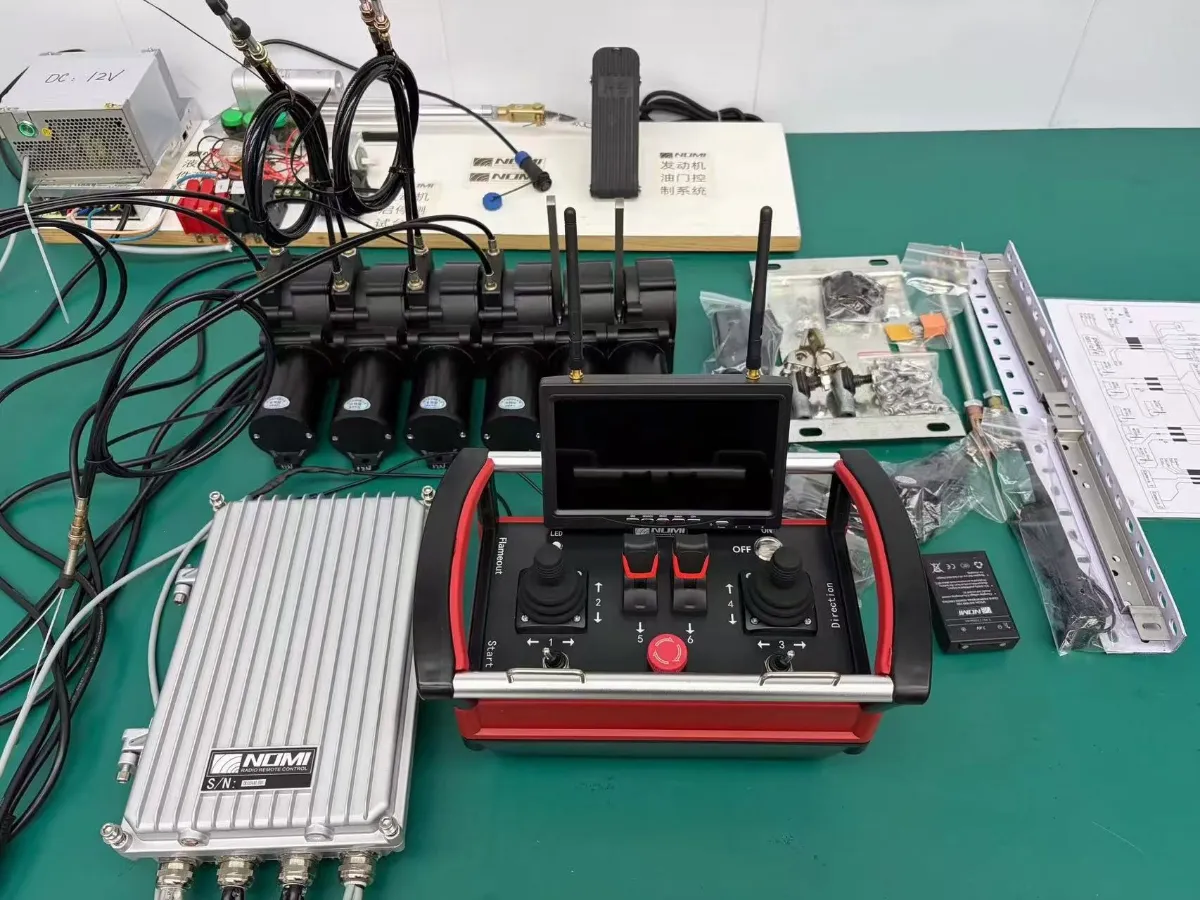
The remote controller does not generate the excavator’s digging force. The engine, hydraulic pump, valves, cylinders, and hydraulic motors continue to perform the physical work. The remote system changes how the operator’s commands reach those machine components.
A typical arrangement contains several elements:
- Wireless transmitter: The handheld controller contains joysticks, switches, buttons, or other operator controls.
- Radio communication link: The transmitter sends coded commands to the machine-side receiver.
- Receiver and control interface: The receiver processes valid commands and produces the configured electrical or electronic outputs.
- Hydraulic or electronic actuation: Compatible valves, actuators, or the excavator’s existing electronic controls convert the commands into machine movement.
- Machine response: The boom, arm, bucket, upper structure, tracks, or approved auxiliary equipment move according to the functions enabled by the system.
The exact architecture varies. A wireless controller designed to operate an existing solenoid valve is not automatically suitable for replacing an excavator’s original pilot joystick. A complete retrofit may require additional electro-hydraulic components, control logic, machine-side wiring, and safety validation.
For an overview of the product category, see Nomi’s industrial hydraulic remote control systems.
Which Excavator Functions Can Be Controlled Remotely?
The number and type of functions depend on the transmitter layout, available control axes, receiver outputs, hydraulic interfaces, and the scope of the conversion. A remote-control system should therefore be specified by required machine functions rather than by the number of buttons or joysticks alone.
| Excavator function | What the operator commands | What must be verified |
|---|---|---|
| Boom | Raise and lower the boom | Compatible control channel and valve interface |
| Arm or stick | Extend or retract the arm movement | Required direction and proportional response |
| Bucket | Curl and dump the bucket | Both operating directions and any task-specific speed requirements |
| Upper structure swing | Rotate the upper structure left or right | Swing control compatibility and work-area hazards |
| Left and right travel | Move the corresponding tracks forward or backward | Independent track control, direction mapping, and safe stopping behavior |
| Engine speed | Increase or reduce engine speed | Whether the engine controller or throttle mechanism supports remote commands |
| Auxiliary hydraulics | Operate an approved attachment, such as a breaker or grapple | Auxiliary valve capacity, flow requirements, and electrical interface |
| Other machine functions | Operate approved blade, lighting, horn, or attachment functions | Whether the function is included in the proposed configuration |
The table describes possible functions, not a guarantee that every remote controller supports all of them.
Main hydraulic movements
Boom, arm, and bucket movements are central to excavator work. These functions frequently require more than simple activation and deactivation because operators must approach a digging position, regulate movement, and coordinate several axes.
The swing function adds another consideration. Rotating the upper structure changes the machine’s working envelope and can create collision or crushing hazards even when the tracks remain stationary.
Track travel can require a separate control arrangement for the left and right tracks. Before selecting a transmitter, confirm whether it can generate all required travel commands and whether simultaneous commands are supported.
The exact joystick assignment must also match the machine and operator training. Excavator control patterns and existing electronic controls differ, so a supplier should not assume that every machine follows the same joystick layout.
Auxiliary functions and attachments
Some excavators operate hydraulic breakers, shears, grapples, augers, or other attachments. Adding remote operation for an attachment requires confirmation of its control method and hydraulic requirements.
For example, a breaker may require a dedicated auxiliary hydraulic command. A grapple may require opening and closing functions, while an attachment with rotation may need additional independent control. A quick coupler can introduce separate engagement and locking considerations.
The remote transmitter must have sufficient controls, but that is only one part of the solution. The receiver outputs, valves, machine controller, interlocks, and attachment specifications must also support the required operation.
Before specifying attachment control, identify the attachment model and the exact functions that must be available remotely.
Proportional Control or On/Off Control: Which Is Appropriate?
One of the most important choices is whether the excavator requires proportional control, on/off control, or a combination of both.
On/off control provides a discrete command. A function is activated or deactivated, or a direction is selected, according to the system design. It may be suitable for simple auxiliary operations that do not require continuously variable movement.
Proportional control allows the operator to vary the command according to joystick displacement or another proportional input. It is often useful when regulating movement speed, positioning the bucket, coordinating multiple hydraulic axes, or approaching a work area gradually.
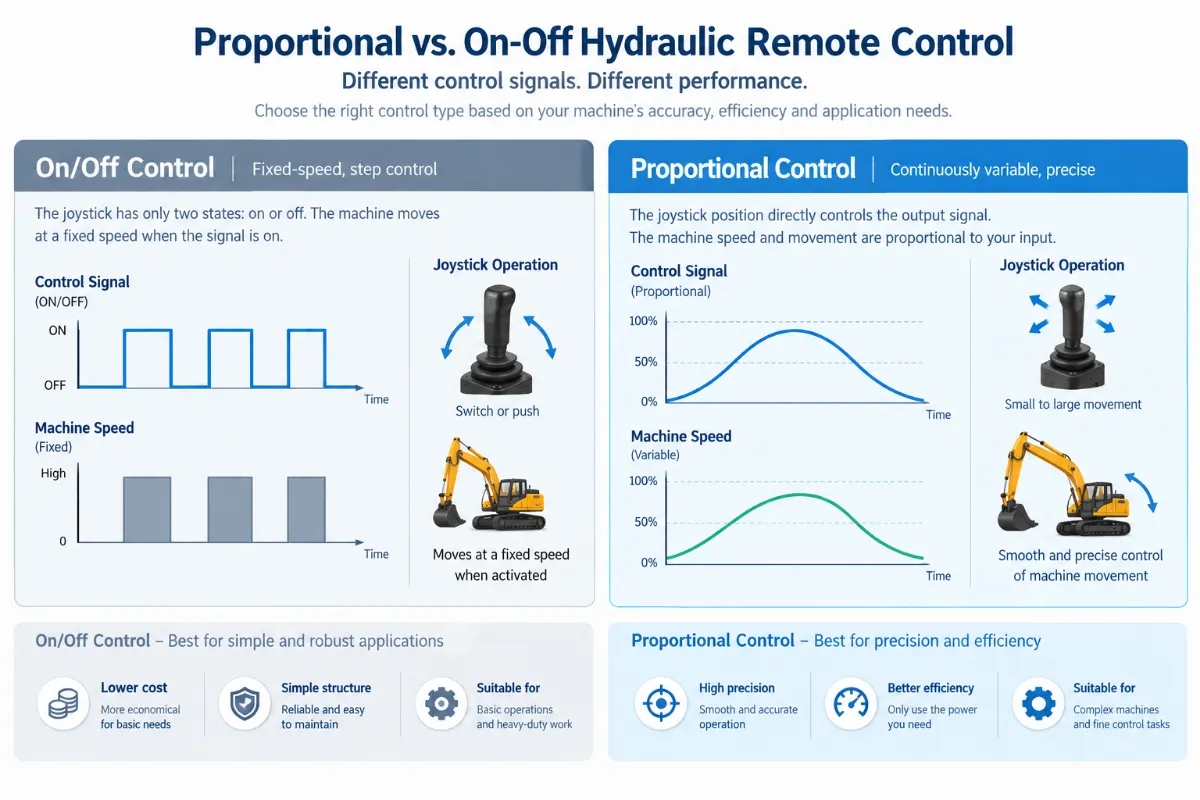
A hybrid arrangement uses proportional joysticks for main movements and buttons or switches for auxiliary functions.
| Requirement | On/off control | Proportional control | Hybrid arrangement |
|---|---|---|---|
| Simple discrete command | Often suitable | Possible if configured | Suitable |
| Variable boom or bucket movement | Limited | Often preferred | Suitable |
| Gradual positioning | Limited | More control flexibility | Suitable |
| Auxiliary functions requiring only activation or direction selection | Often suitable | May be unnecessary | Suitable |
| Several coordinated hydraulic movements | Depends on the architecture | Often appropriate | Often appropriate |
| Simple installation and control logic | May be simpler | Requires compatible proportional interfaces | Depends on the selected functions |
Proportional control offers more command flexibility, but it does not guarantee that the machine will move at a fixed percentage of maximum speed for the same percentage of joystick displacement. Hydraulic load, valve characteristics, control calibration, and machine response all affect actual movement.
A proportional joystick also cannot make an on/off receiver output behave like a true proportional hydraulic control system. The whole signal path must support the required control method.
Nomi’s industrial joystick remote controls are relevant when evaluating joystick-based operation. The configuration should be matched to the target excavator and the functions needed on site.
Handheld Remote, Hydraulic Conversion Kit, or Full Teleoperation System?
The term “excavator remote control” can refer to several different system configurations. Understanding the differences helps buyers avoid requesting a transmitter when the project actually requires a complete machine conversion.
1. Handheld wireless controller
A handheld controller sends commands to a compatible receiver or machine interface. This may be sufficient when the machine-side controls and safety functions are already designed to accept the required signals.
The operator may remain close enough to see the excavator and the work area directly. The controller does not necessarily include cameras, machine-status displays, or all the components required to convert a conventional cab-operated excavator.
2. Hydraulic remote-control conversion kit
A conversion kit adds the hardware and control logic needed to operate selected excavator functions remotely. Depending on the existing machine, this may involve electro-hydraulic valves, actuators, controller modules, wiring, a radio link, and changes to the control interface.
The engineering scope depends heavily on the excavator. Some machines expose suitable electronic interfaces, while others may require a different method of connecting the remote system to the existing controls.
Nomi’s excavator hydraulic remote control product page and industrial excavator remote-control kits provide starting points for reviewing the product categories. Buyers should confirm the actual bill of materials and compatibility for their machine rather than assume that every kit includes the same components.
3. Camera-assisted teleoperation
A teleoperation system adds video or other machine-status feedback to support operation when direct visual contact is insufficient or the operator must work from a protected control station.
The camera arrangement, viewing angles, lighting, network or radio link, image latency, and display layout all affect usability. A command-only wireless link does not provide the same information as a system that returns live video and machine status.
Caterpillar documents line-of-sight and non-line-of-sight remote-operation options for selected excavators. These examples demonstrate that remote control may range from a portable console used near the machine to a more integrated control station with video feedback. They should not be interpreted as evidence that every aftermarket remote controller offers the same capabilities. See Caterpillar Command technology.
4. Assisted or autonomous operation
Assisted systems and autonomous machines introduce additional sensing, software, machine-control integration, and operating logic. They are distinct from simply replacing the operator’s physical joystick with a wireless one.
A buyer who needs a standard wireless command interface should not automatically pay for features that are unnecessary for the task. Conversely, a project involving remote operation without a reliable view of the machine may require more than a handheld transmitter and receiver.
Where Can Wireless Excavator Remote Controls Be Useful?
The value of remote operation depends on the work environment and how far the proposed system can reduce a specific operational limitation or exposure.
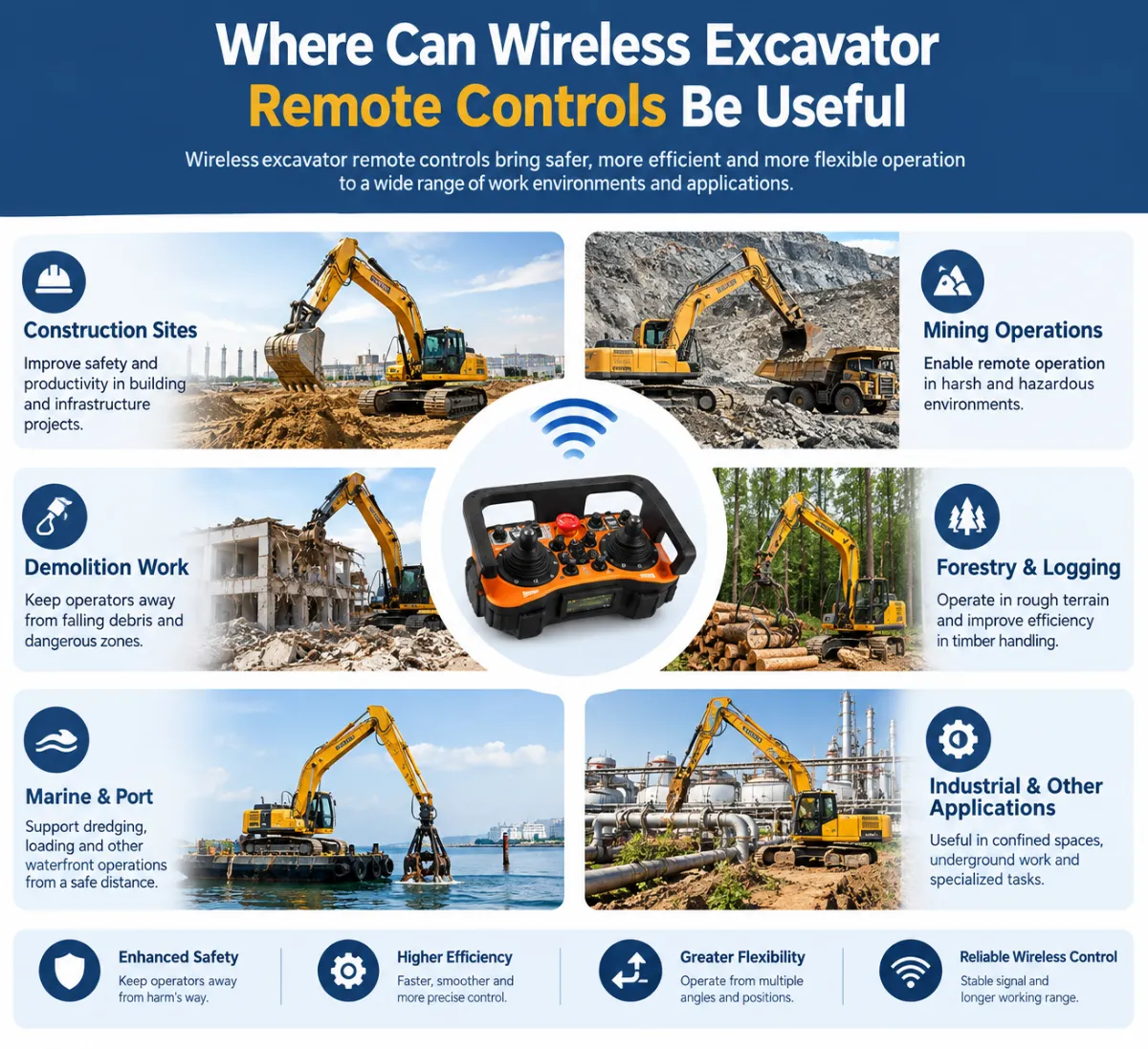
Demolition and unstable structures
Remote operation can allow the operator to remain outside a selected hazardous area while operating the machine. Suitability depends on the hazard boundary, available visibility, machine protection, and the level of remote feedback.
Remote control does not eliminate structural collapse, falling debris, or machine stability risks. The site still requires task-specific risk assessment and work-area controls.
A remote system may allow the operator to avoid occupying the excavator cab during particular tasks on unstable ground or in other hazardous conditions. However, the operator must still understand machine position, track movement, boom reach, and the possibility of slipping, tipping, or becoming immobilized.
If direct visibility is blocked, camera-assisted operation may be needed. The required feedback should be established before choosing the communication system.
Quarrying and post-blasting operations
Remote operation may be useful when personnel need to remain away from an area that cannot be occupied safely immediately after a disruptive process. The suitability and timing of operations depend on the site’s procedures, hazard assessment, and applicable regulations.
Caterpillar describes remote excavator operation for applications including blasting-related work, demolition, and unstable operating conditions in its Command for Excavating announcement.
Repetitive work and controlled operating areas
A remote control system can also be considered for repetitive tasks where the operator’s location, visibility, or working conditions make a remote interface practical. The expected operational value should be assessed against the time required to position the operator, maintain visibility, manage attachments, and respond to interruptions.
Remote control does not automatically improve productivity. Additional setup, camera feedback, communication limitations, and operator training can affect cycle times.
How to Check Excavator Compatibility Before Purchasing
Compatibility is one of the most important technical questions in an excavator remote-control project. The machine brand or operating weight alone does not determine which system will work.
Identify the existing control architecture
Establish whether the excavator uses mechanical or hydraulic pilot controls, electro-hydraulic controls, electronic joysticks, or an electronic machine-control interface.
The answer determines how remote commands can be introduced into the system. A controller intended for solenoid-operated valves may not be suitable for a machine whose controls require a different signal type or communication protocol.
Whenever possible, provide the supplier with the machine model, serial number, production year, hydraulic schematic, electrical wiring diagram, and information about any previous modifications.
Define the required functions and control behavior
Prepare a complete function list before requesting a quotation. Include boom, arm, bucket, swing, travel, engine speed, auxiliary hydraulics, and other functions that must be available remotely.
For each function, clarify whether it needs proportional movement, discrete direction control, an interlock, or simultaneous operation with another axis.
Also identify whether the remote must include a deadman or enabling device, a dedicated emergency-stop control, status indicators, or a means of switching between cab operation and remote operation.
Confirm the receiver and valve interface
The receiver must provide outputs that the machine-side equipment can accept. Depending on the configuration, relevant details may include:
- Supply voltage and allowable operating range.
- Output type, current, voltage, and connector arrangement.
- Hydraulic valve manufacturer and model, if applicable.
- Solenoid coil ratings and required control signals.
- Number of independent outputs and proportional channels.
- Any required controller communication or interface electronics.
Do not select a receiver solely because its voltage matches the machine. Voltage compatibility does not establish that its output signals, safety logic, or hydraulic interface are suitable.
Evaluate the worksite and communication link
The required operating distance should be based on the actual job, not just the longest distance stated in a brochure.
Metal structures, terrain, obstacles, antenna placement, interference, and the presence of other radio systems can affect performance. A camera-assisted system has additional requirements because the operator needs usable video feedback as well as command communication.
Confirm the operating environment, temperature, expected moisture and dust exposure, vibration, sunlight, and the controller’s expected handling conditions. If remote operation involves blind spots or a location outside direct line of sight, specify how the operator will observe the machine and surrounding work area.
The control system’s permitted radio frequency and equipment requirements should also be checked for the country where it will be used.
Safety Features to Review Before Deployment
A remote-controlled excavator still presents the hazards associated with heavy machinery, hydraulic energy, moving tracks, rotating upper structures, suspended attachments, and changing ground conditions. Moving the operator away from the cab can reduce exposure to selected hazards, but it does not make the machine inherently safe.
Emergency stop
Confirm where the emergency-stop control is located, which machine functions it stops, how the stop command reaches the machine, and what the system does after activation.
The required response should follow the machine’s risk assessment and safety design. A stop command must not be confused with an ordinary operating command that merely reduces speed or stops one selected function.
Wireless signal loss
Ask the supplier to describe the machine’s exact behavior if the radio link becomes unavailable or invalid. Determine which outputs are disabled, whether hydraulic movement stops, what happens to the engine, and whether any holding or braking behavior is needed for the actual machine.
There is no safe basis for assuming that every remote controller automatically stops every excavator function in the same way. The expected response must be designed for the machine and application, then verified through appropriate testing.
After the connection is restored, the system should behave according to its defined restart logic rather than unexpectedly resume movement. The necessary procedure must be documented and included in operator training.
Interlocks and operating-mode selection
If the excavator can be operated both from the cab and remotely, the transition between modes must be carefully designed. The system should prevent unintended conflicting commands and make the active control mode clear to relevant personnel.
Other safety considerations may include enabling controls, operator identification, machine-status feedback, attachment interlocks, and protection against unintended activation. The necessary features depend on the full system risk assessment rather than on a generic list of remote-control functions.
Applicable machinery-safety standards
The standards below are useful references for evaluating the design and integration of machine controls:
- ISO 12100:2010, Safety of machinery: General principles for design, risk assessment and risk reduction. This standard sets out a methodology for identifying hazards and evaluating and reducing risks over the machinery life cycle.
- ISO 13849-1:2023, Safety-related parts of control systems. This addresses the design and integration of safety-related control-system parts, including relevant electrical, electronic, software, hydraulic, and other technologies.
- IEC 60204-1, Safety of machinery: Electrical equipment of machines. This covers machine electrical equipment and includes provisions relevant to emergency-stop functions and control-circuit protection.
These standards are not interchangeable, and mentioning them does not establish that a specific remote controller or completed excavator conversion is compliant or certified. The responsible parties must determine which requirements apply to the machine, intended use, installation location, and complete control system.
For attachment work, a separate inspection is also necessary. The U.S. National Institute for Occupational Safety and Health guidance on excavator quick couplers explains the serious struck-by risk associated with attachment separation. Remote operation does not remove that risk.
What Should a Buyer Include in a Request for Quotation?
A useful RFQ gives the supplier enough information to evaluate the control method and machine interface before proposing a controller.
| Information to provide | Why it matters |
|---|---|
| Excavator make, model, year, and serial number | Identifies the specific machine and its control configuration |
| Existing control type | Determines the likely interface approach |
| Hydraulic and electrical schematics, if available | Helps verify valve, wiring, and signal compatibility |
| Full function list | Establishes required channels and axes |
| Proportional or on/off requirements | Determines the control method and output configuration |
| Hydraulic attachment details | Identifies additional function and interface requirements |
| Required operating distance | Helps define the radio and worksite requirements |
| Line-of-sight or camera-assisted operation | Clarifies operator visibility requirements |
| Power supply and environmental conditions | Helps specify electrical and enclosure requirements |
| Emergency-stop and signal-loss requirements | Establishes important safety design criteria |
| Installation scope | Clarifies whether the quotation covers a controller only, a conversion kit, commissioning, or additional integration work |
| Destination country and intended industry | Supports regulatory and application-specific checks |
Where drawings are unavailable, photographs of the existing controls, control valves, electrical connectors, machine identification plate, and intended installation points can help the supplier understand the project. They may not replace the need for schematics or an engineering review.
Before comparing quotations, check whether each supplier is offering the same scope. One quotation may cover only the transmitter and receiver, while another may include machine-side actuators, proportional valves, wiring, safety integration, installation, and commissioning. Their prices would not be directly comparable.
Common Purchasing Mistakes to Avoid
Choosing by advertised range alone. A long nominal range is not proof of reliable communication in a specific worksite or a suitable control system for the intended task.
Counting joysticks instead of defining functions. Two transmitters with similar physical layouts may provide different axes, output types, or simultaneous-control capabilities. Specify the actual movements and behavior required.
Assuming universal compatibility. The name of the excavator manufacturer is not enough to determine the control interface. Machine generation, installed electronics, valve configuration, and previous modifications all matter.
Treating proportional control as a transmitter-only feature. Proportional input requires a compatible output path and machine interface. Otherwise, the achieved response may not match the operator’s requirements.
Overlooking signal-loss and restart behavior. These requirements should be established before installation and verified as part of commissioning, not left as assumptions.
Confusing a remote controller with a complete teleoperation system. If the operator needs video, machine-status information, remote diagnostics, or non-line-of-sight operation, those requirements must be part of the original specification.
Accepting broad compliance statements without documents. Ask for the applicable declarations, certificates, test evidence, and technical documentation for the exact model and configuration. A reference to a standard is not, by itself, proof of certification.
How Nomi Can Help with Excavator Remote-Control Requirements
Nomi provides industrial wireless remote-control products for hydraulic machinery and construction equipment. For an excavator project, the useful starting point is to define the required functions, identify the existing control interface, and clarify whether the project needs a handheld wireless controller or a more extensive conversion arrangement.
An initial technical inquiry should include the excavator make and model, production year, current control method, required movements, proportional-control requirements, auxiliary functions, operating distance, environmental conditions, and safety expectations.
Where possible, provide the electrical and hydraulic schematics. This helps determine which interface information needs to be verified and what additional components may be required. Any proposed configuration should be confirmed against the specific machine and intended application before purchase or installation.
To discuss a project-specific configuration, contact Nomi’s technical and sales team.
Frequently Asked Questions
Can a wireless remote control operate all excavator functions?
Not automatically. The available functions depend on the transmitter, receiver, machine-side interface, hydraulic system, and configuration. The required functions must be specified and confirmed individually.
Is proportional control necessary for an excavator?
It depends on the task. Proportional control is often useful for controlling movement speed and positioning. Some auxiliary functions may only require discrete commands. A mixed configuration can support both requirements.
Can a wireless remote controller be installed on an existing excavator?
Potentially, but compatibility depends on the machine’s control architecture, available interfaces, required functions, and safety design. The model and configuration should be reviewed before a retrofit is approved.
Does a wireless controller need cameras?
Not necessarily. A line-of-sight application may allow the operator to observe the machine directly. When direct visibility is inadequate or the operator works from a remote station, a camera-assisted system and suitable video link may be required.
What happens if the wireless signal is lost?
The response depends on the system’s design and configuration. Buyers should obtain a documented description of the safe response, including which movements stop, how restart is controlled, and how the behavior will be tested on the actual machine.
Is a published radio range sufficient to select a system?
No. The range rating must be evaluated against the worksite, obstacles, radio interference, antenna arrangement, visibility, and any video-feedback requirements. A practical operating test is important when commissioning the system.
Does an IP rating establish that a remote control is suitable for every construction site?
No. An ingress-protection rating addresses specified protection against the entry of solids and water under defined test conditions. It does not establish machine compatibility, radio performance, impact resistance, safety-system performance, or suitability for every environmental condition.
What should be sent to the supplier for a quotation?
Provide the excavator model, year, control type, list of required functions, proportional or on/off requirements, auxiliary attachments, target distance, operating environment, and safety requirements. Include hydraulic and electrical schematics when available.
Do ISO 12100 or ISO 13849-1 certify a complete remote-control product?
No. These standards address different aspects of machinery risk assessment and safety-related control-system design. Their relevance to a particular project must be determined, and compliance or certification claims require appropriate supporting evidence.
What is the difference between a remote-control kit and a teleoperation system?
A remote-control kit may provide the transmitter, receiver, and machine interface needed to operate selected functions remotely. A teleoperation system typically adds camera feedback, displays, and other operator information to support operation where direct visibility is inadequate. The actual scope varies by supplier and configuration.
