

Adding wireless remote control to an excavator involves more than installing a handheld transmitter and receiver. The existing machine must be assessed, a compatible control interface selected, the required hydraulic functions mapped, and the safety-related behavior of the complete system verified. Depending on the excavator, the retrofit may connect to existing electronic controls or require additional electro-hydraulic components and actuators.
For an equipment owner planning a conversion, the most practical starting point is to identify how the excavator is currently controlled and what must change to operate it remotely. A compatible retrofit can add remote operation to an existing machine, but no universal kit can be assumed to fit every excavator or provide every function without engineering review.
1. What Type of Remote-Control Conversion You Need
Before selecting a product, define the level of remote operation required. Three projects that look similar in a quotation request may need substantially different equipment.
Wireless control of an existing machine interface
Some excavators already have electronic controls or electrically operated hydraulic valves. If the machine exposes a suitable interface, a remote-control receiver may be integrated with the existing control system through a compatible electrical or electronic connection.
This approach depends on the machine’s control signals, controller logic, available inputs and outputs, and the requirements of its safety functions. The fact that an excavator has electrical connectors does not establish that those connections are suitable for remote commands.
Retrofit for mechanically or hydraulically controlled functions
Other excavators use hydraulic pilot controls, mechanical linkages, or manual control mechanisms. These machines may require additional actuation hardware to translate wireless commands into the required control movements.
Depending on the engineering design, a conversion can use an appropriate electro-hydraulic interface, proportional valve arrangement, or actuator system that operates the existing control mechanism. The choice depends on the actual machine architecture. It should not be assumed that an ordinary radio receiver can directly replace a hydraulic pilot joystick.
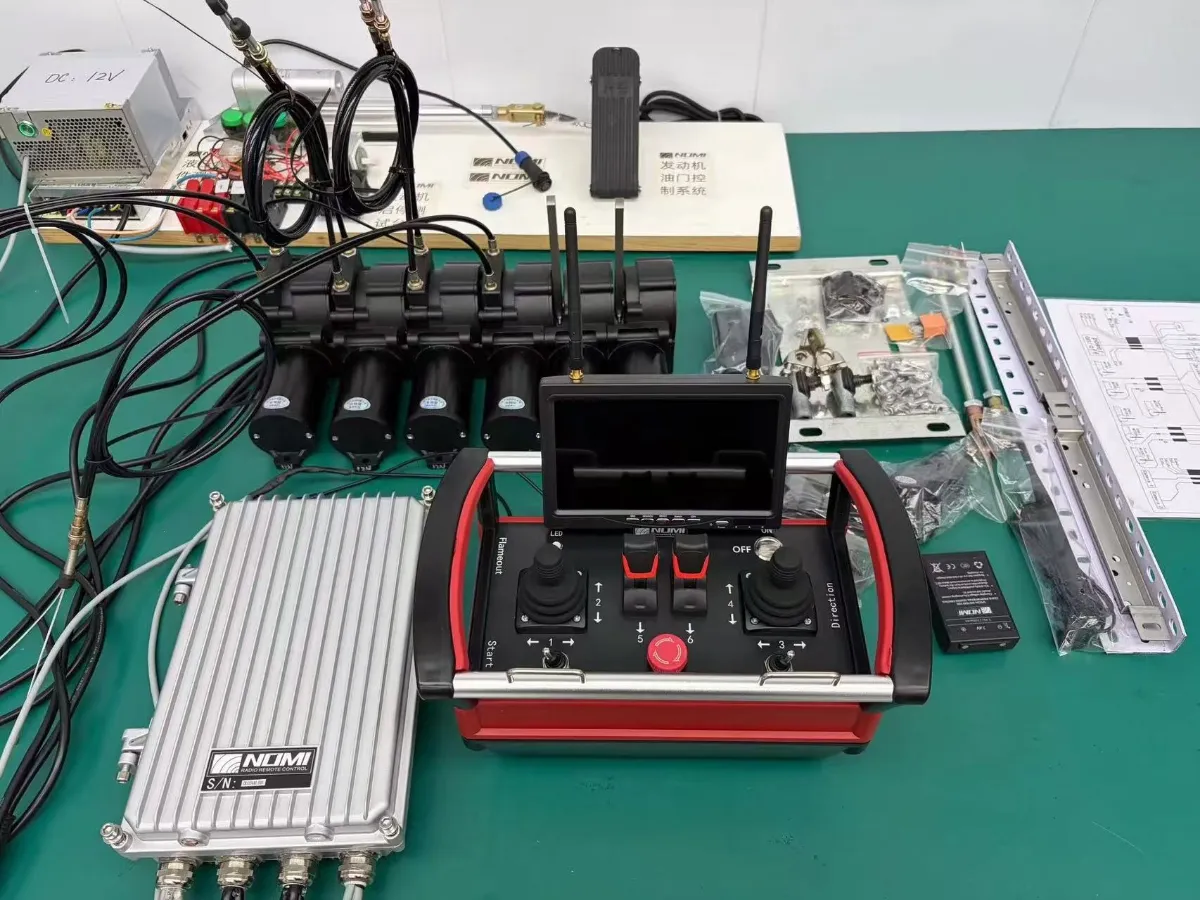
Nomi’s industrial remote-control excavator kits provide a starting point for discussing the scope of a project. The exact components and integration requirements should be confirmed for the target excavator.
Camera-assisted remote operation
A handheld remote may be sufficient when the operator can maintain an adequate direct view of the excavator and its working area. If the machine must be operated from a location where direct visibility is inadequate, a more comprehensive teleoperation system may be required.
Such a system can incorporate cameras, displays, machine-status feedback, and additional communication equipment. The video connection introduces its own engineering requirements, including image latency, viewing coverage, visibility in poor lighting, and communication reliability.
Manufacturer systems such as Caterpillar Command illustrate that remote excavator operation can involve configurations beyond a simple handheld wireless controller.
| Project requirement | Possible approach | Main decision |
|---|---|---|
| Remote commands through an existing electronic control interface | Electrical or electronic integration | Verify the interface and permitted control signals |
| Remote operation of existing hydraulic or mechanical controls | Dedicated retrofit actuation system | Determine how the existing controls will be actuated |
| Operation without adequate direct visual contact | Camera-assisted teleoperation | Define video coverage, latency, and communication requirements |
| Remote operation of additional attachments | Expanded control configuration | Verify auxiliary circuits, channels, and interlocks |
The important distinction is the scope of the conversion. A transmitter-and-receiver package, a machine conversion kit, and a teleoperation system should not be treated as equivalent quotations.
2. Assess the Excavator Before Ordering Any Equipment
A retrofit should begin with a machine assessment rather than a product catalogue.
Two excavators from the same manufacturer can have different hydraulic arrangements, electronic controllers, valve blocks, and operator interfaces. Model identification is therefore essential, but it may not provide enough information by itself.
Record the machine’s identification details
Prepare the following information:
- Excavator manufacturer, model, production year, and serial number.
- Engine and hydraulic-system configuration, where known.
- Existing operator control arrangement.
- Available electrical supply and relevant machine-interface documentation.
- Installed attachments and auxiliary hydraulic functions.
- Previous control modifications or aftermarket equipment.
- Intended remote operating distance and working environment.
Photographs of the machine identification plate, operator controls, relevant electrical connections, and hydraulic valve area can help an integration engineer understand the existing arrangement.
However, photographs are not a substitute for electrical schematics, hydraulic diagrams, or machine-specific documentation when those materials are needed to verify compatibility.
Identify the existing control architecture
The next task is to establish how commands currently reach the excavator’s hydraulic system.
| Existing arrangement | Information to establish | Implication for the retrofit |
|---|---|---|
| Mechanical controls | Linkage arrangement, available mounting space, and existing functions | Determine whether a suitable actuator-based interface can be installed |
| Hydraulic pilot controls | Pilot-control arrangement, required control behavior, and available interface options | Assess a compatible means of generating the necessary control commands |
| Electro-hydraulic controls | Valve type, electrical command signals, and controller architecture | Verify that the receiver and machine interface can communicate correctly |
| Electronic machine-control system | Available approved interfaces, control logic, and safety dependencies | Confirm integration requirements with the system supplier and, where appropriate, the original equipment manufacturer |
This assessment helps determine which conversion architecture is practical. It can also reveal when the installation requires additional engineering work or when the proposed approach should be rejected.
For example, a receiver with the correct power-supply voltage is not necessarily compatible with a machine whose control inputs require a different signal type. Electrical compatibility and functional compatibility are separate questions.
Check whether the original cab controls will remain available
Some retrofit designs retain the original cab controls, while others require a more substantial change to the machine’s control arrangement.
Do not assume that remote and manual operation can be used simultaneously, or that switching between them is automatically safe.
The project specification should state whether cab operation must remain available, how the active operating mode will be selected, and how conflicting commands will be prevented. The solution must preserve the safety of the complete machine, including the transition between operating modes.
3. Define Every Function the Remote System Must Operate
Once the existing machine has been assessed, prepare a function list. This should describe what the operator needs to do, not merely how many joysticks or buttons are available on a transmitter.
A remote system can have sufficient physical controls but still be unsuitable if its receiver outputs, signal types, control logic, or machine-side interfaces do not support the required movements.
Create a function and control matrix
Use a table like the one below to define the project before requesting a final quotation.
| Function | Required remote command | Key technical question |
|---|---|---|
| Boom | Raise and lower | Is proportional movement required, and what interface supports it? |
| Arm or stick | Move inward and outward | Are both directions available with suitable control behavior? |
| Bucket | Curl and dump | Can the control system provide the required movement and response? |
| Swing | Rotate the upper structure in both directions | How will movement and work-area hazards be managed? |
| Travel | Control left and right tracks as required | Are independent travel commands and the intended direction mapping supported? |
| Engine speed | Increase or reduce engine speed | Does the existing engine-control arrangement support remote commands? |
| Auxiliary hydraulics | Operate a breaker, grapple, or other attachment | What valve, flow, and interface requirements apply? |
| Additional functions | Operate other approved machine functions | Are dedicated outputs, interlocks, or feedback required? |
This matrix should be reviewed by the machine integrator and the remote-control supplier before components are selected.
Decide which commands require proportional control
Proportional control allows an operator to vary a command rather than merely switch a function on or off. It can be useful for boom, arm, bucket, swing, and other movements that require controlled positioning.
Some auxiliary functions may require only discrete commands. A project may therefore combine proportional joystick axes with buttons or switches.
The choice must reflect the work being performed and the behavior supported by the machine-side interface.
A proportional joystick alone does not make the entire hydraulic system proportional. The receiver, output stage, valve or actuator, and control logic must support the required operation. Actual machine response can also vary with hydraulic load, valve characteristics, and calibration.
Nomi’s industrial joystick remote controls are relevant when specifying the operator interface, but the selected model and its outputs must be matched to the required excavator functions.
Include attachments in the original specification
An excavator used with a hydraulic breaker may need a different auxiliary control arrangement from one fitted with a grapple or rotating attachment.
Before installation, confirm the attachment’s control requirements, its relationship with the existing hydraulic circuit, and any necessary interlocks. A coupler or attachment function that creates a separate safety hazard must be considered within the full machine risk assessment.
Adding a function after the initial installation can require changes to the transmitter layout, receiver outputs, wiring, control software, and validation process. It is generally more efficient to identify the complete function list in advance.
Read more: Wireless Remote Control for Excavators: Hydraulic Control, Functions and Applications.
4. Select the Wireless and Machine-Side Components
After establishing the machine configuration and required functions, the supplier can define the components needed for the project.
A typical conversion architecture may contain a transmitter, receiver, machine-side interface, control electronics, wiring and connectors, mounting hardware, and additional actuation equipment where required. Some installations also need machine-status feedback, cameras, displays, or separate safety-related devices.
Not every configuration requires every component.
Transmitter and receiver
The transmitter should provide a usable control layout for the defined functions. Joystick travel, switch arrangement, operating indications, and ergonomics should be considered alongside the number of control axes.
The receiver must provide compatible outputs for the intended interface. Check the power-supply requirements, output type, available channels, connector arrangement, and the behavior expected when the receiver loses valid communication.
Confirm that the transmitter and receiver are an approved matched combination for the proposed configuration. Do not rely only on a similar model name or radio frequency.
Actuators, valves, and controller interfaces
If the excavator requires additional actuation hardware, the supplier must determine how commands will be translated into machine movement.
Depending on the machine, the project may involve electro-hydraulic components, proportional outputs, compatible valve drivers, mechanical actuation, or electronic controller integration.
The supplier should identify which components are included in the proposed package and which must be provided or installed separately. This distinction is important because a quotation for a handheld controller may not include everything required to make an existing excavator remotely operable.
Nomi also provides broader hydraulic remote-control system options. The appropriate configuration must be confirmed for the excavator rather than inferred from the general product category.
Radio communication and operating environment
The communication system should be selected for the intended operating distance and worksite conditions.
Buildings, terrain, metal structures, antenna placement, radio interference, and the presence of other radio equipment can influence practical communication performance. A nominal range specification should therefore not be treated as a guarantee of reliable control at every location.
The applicable radio-frequency and equipment requirements should also be checked for the destination country.
If cameras or remote displays are included, their data link must be evaluated separately. A reliable command link does not automatically guarantee usable video feedback.
The intended environment should be documented as well. Dust, moisture, vibration, impact exposure, temperature, and operator handling conditions can all affect the suitability of the selected equipment.
5. Prepare the Safety Design Before Installation
Wireless remote control changes the way the operator commands the excavator. It can also introduce new failure modes involving communications, operating-mode selection, control outputs, power, and remote visibility.
These issues should be addressed during system design, not after the components have been installed.
Define emergency-stop behavior
Specify what the emergency-stop command must cause the machine to do under the intended operating conditions.
This requires a machine-level assessment. Stopping a wireless command is not necessarily equivalent to stopping every hazardous movement, and stopping a hydraulic command does not by itself establish that all stored energy or machine hazards have been controlled.
The design should also establish how an emergency stop is reset and what conditions must be met before operation can resume.
Define what happens if communication is lost
Ask the supplier for a written description of the system’s expected response when valid communication is interrupted, the transmitter switches off, the receiver loses power, or another relevant fault occurs.
The required response depends on the excavator and its risk assessment. It may involve disabling control outputs, preventing unintended restart, managing hazardous movement, and establishing a clear recovery procedure.
The design should not permit the excavator to resume movement unexpectedly when communication returns. The restart behavior must be defined and verified.
Prevent conflicting control commands
If both cab and remote operation are supported, the control architecture must define which operating mode is active and how unintended simultaneous commands are prevented.
Other considerations include enabling controls, mode indication, machine feedback, attachment interlocks, and the handling of control-system faults.
The particular measures required depend on the machine, the functions being controlled, and the intended working environment.
Consult the applicable machinery-safety standards
Three useful references for a retrofit project are:
- ISO 15817:2012, Earth-moving machinery: Safety requirements for remote operator control systems. This standard specifically addresses remote operator control systems used on earth-moving machinery. Its published scope also distinguishes operator-controlled systems from autonomous systems.
- ISO 13849-1:2023, Safety of machinery: Safety-related parts of control systems. This provides a methodology for designing and integrating safety-related control-system parts. The required performance must be determined for the particular application rather than assumed from the standard’s title.
- IEC 60204-1:2016+A1:2021, Safety of machinery: Electrical equipment of machines. This addresses electrical, electronic, and programmable electronic equipment for machines, including relevant emergency-stop and control-circuit provisions.
The applicable standards and legal requirements depend on the machine, its modification, and the country where it will operate. A reference to a standard does not prove that a remote-control product or completed excavator conversion has been certified.
A qualified integrator should document the relevant risk assessment, design decisions, and verification activities before the modified machine is released for use.
6. Install the System Using a Controlled Engineering Process
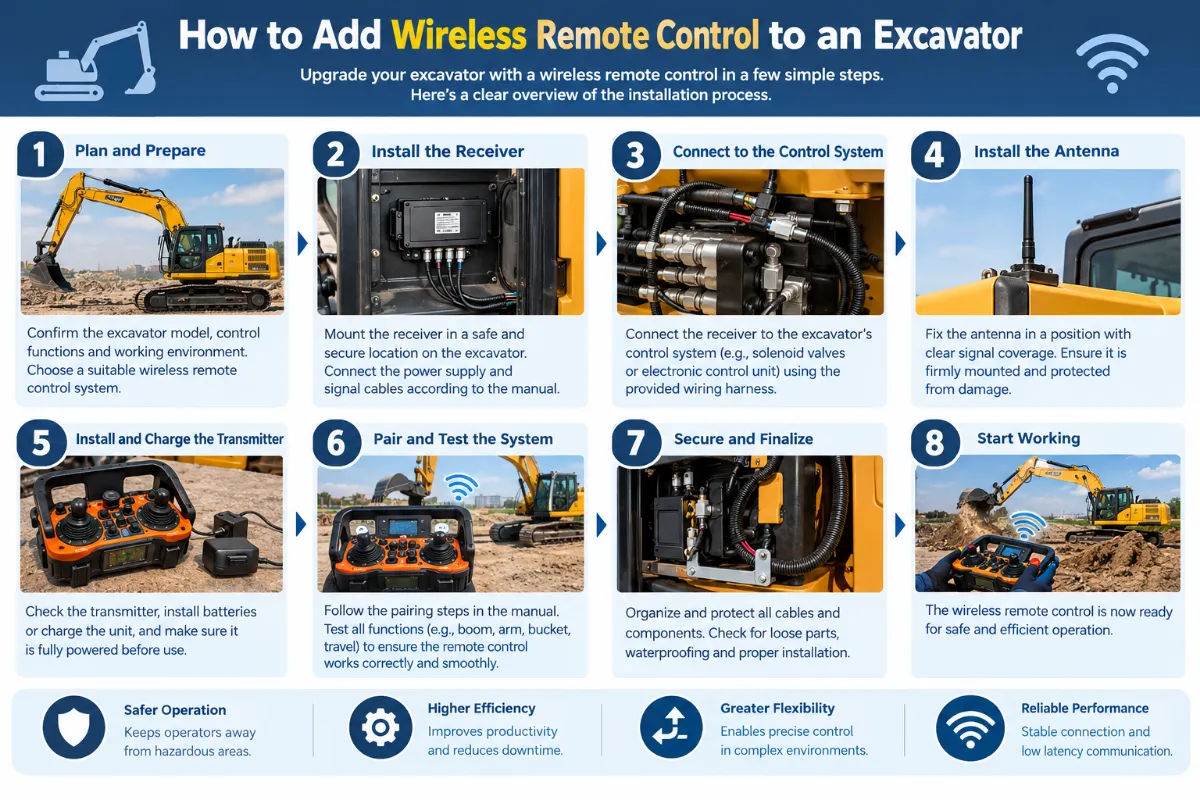
The installation process must follow the specific machine manufacturer’s instructions and the approved retrofit design. It should be performed by qualified personnel who understand the relevant hydraulic, electrical, mechanical, and safety systems.
A generic online tutorial cannot safely specify the wiring connections, actuator positions, valve adjustments, or control changes for every excavator.
Plan the installation and isolate the machine
Before work begins, review the approved installation documentation and identify all required components, mounting locations, interfaces, and inspection points.
The machine must be placed in an appropriate safe condition, with relevant energy sources isolated and stored energy managed in accordance with the OEM procedures and the site’s safety requirements.
The work plan should identify who is responsible for mechanical installation, electrical work, hydraulic integration, software or controller configuration, and final validation.
If the existing machine contains undocumented modifications, damaged wiring, leaking hydraulics, or other unresolved faults, those conditions should be assessed before proceeding.
Install the approved hardware and connections
The installation team then fits the specified transmitter-related equipment, receiver, interfaces, actuators, wiring, and other required components.
The exact work varies by architecture. An electronic interface retrofit is different from an arrangement that requires actuation of an existing control mechanism.
During installation, verify that components are securely mounted and protected from foreseeable vibration, impact, heat, moisture, and mechanical interference. Wiring and other services must be routed so that machine movement, maintenance access, or hydraulic components do not damage them.
The original controls and related safety provisions must not be modified beyond the approved design. A retrofit should never depend on bypassing protective devices or defeating an existing safety interlock to achieve the required motion.
Configure the controls and operating modes
Once the hardware is installed, the system must be configured according to the approved function matrix.
That includes confirming command directions, proportional behavior where required, receiver outputs, operating-mode selection, and any additional machine functions included in the scope.
Configuration values must come from the equipment documentation and engineering design. They should not be guessed from another excavator model or copied without verification.
7. Commission the System Before Returning the Excavator to Work
Installation is not complete when the transmitter communicates with the receiver. Commissioning must establish that the integrated system behaves as intended, including during faults.
The test plan should be specific to the machine, functions, operating environment, and safety requirements. Testing should be controlled by qualified personnel, with appropriate exclusion zones and precautions for unexpected movement.
Check the installation before activating movement
Start with a documented inspection of the installed components and connections. Confirm that the installation matches the approved drawings and component documentation, and that no wiring, hoses, guards, or moving parts have been compromised.
Verify the power supply, connector arrangement, mounting, control labels, and other applicable installation requirements before functional testing.
Any discrepancy should be resolved before proceeding.
Test each command individually
The commissioning plan should verify every included function, its direction, its control response, and any applicable interlocks.
| Test item | What to verify |
|---|---|
| Start-up and neutral state | The system enters its intended initial state without an unintended command |
| Joystick and switch mapping | Each control operates the assigned function in the correct direction |
| Proportional response | The output and machine response match the approved control requirements |
| Mode selection | The active operating mode is clear and conflicting control is prevented |
| Emergency stop | The defined stop behavior occurs and the reset procedure works as designed |
| Communication interruption | The configured response occurs under the prescribed test conditions |
| Recovery and restart | Operation cannot resume unexpectedly after a stop or fault |
| Auxiliary functions | Attachment commands and required interlocks behave correctly |
| Operator indications | Required status and fault indications are understandable |
| Documentation | Test results, unresolved issues, and acceptance decisions are recorded |
Some tests may require specialist instruments, software, diagnostic tools, or manufacturer-specific test procedures. A successful radio connection by itself is not evidence that these functions have been validated.
Progress from controlled testing to representative operation
After initial checks, test the integrated machine in an appropriate controlled area. The procedure should progress only when the previous checks have passed and it is safe to continue.
Where applicable, test the range and communication behavior under representative site conditions. Verify operator visibility, control response, and the procedures for stopping, recovering, and changing operating modes.
Any unexpected movement, communication instability, incorrect control mapping, or unexplained fault should be investigated. The machine should not be returned to service until the required acceptance criteria have been met.
8. Train Operators and Document the Completed Conversion
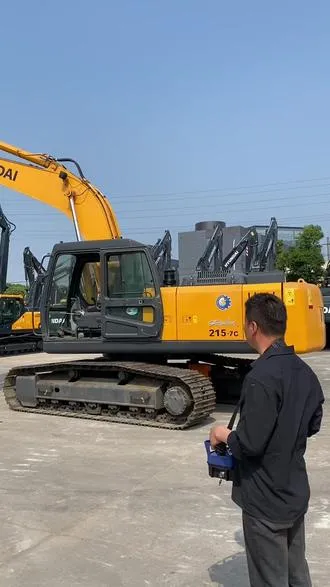
A remotely controlled excavator requires an operating procedure suited to the new control arrangement. Operators may need training on the transmitter layout, permitted operating area, visibility requirements, communication warnings, emergency stop, and recovery procedure.
Training should also cover how to identify the active control mode and what to do if the system behaves differently from its documented response.
The handover package should include the applicable operating instructions, as-built wiring or interface documentation, maintenance requirements, safety documentation, commissioning records, and any restrictions on use.
If the machine can revert to cab operation, the documentation must explain the approved changeover procedure. It should also identify which parts of the original machine or control system have been changed.
This information matters beyond the initial installation. It helps maintenance personnel diagnose faults, assess later modifications, and verify that the system continues to operate according to its approved configuration.
How to Evaluate the Completed Retrofit
A conversion should be accepted against predefined requirements rather than simply because the remote controller powers on and moves the excavator.
Before handover, the owner and responsible integrator should confirm that the agreed functions are available, the safety-related behavior has been tested, the required documentation is complete, and outstanding issues have been resolved or formally addressed.
The acceptance process should also establish who is responsible for future maintenance, software or configuration changes, and revalidation following relevant repairs or modifications.
If the proposed installation cannot demonstrate compatibility or the required safety behavior, it should not be accepted simply because the hardware has been installed.
What Affects the Cost and Duration of Adding Remote Control?
The cost and duration of a retrofit depend on the individual project. A basic transmitter-and-receiver installation is not directly comparable with a conversion requiring machine-side actuators, extensive control integration, cameras, and a separate operator station.
The main cost and scheduling factors include:
- Existing machine architecture: An established compatible interface may require a different scope of work from a machine needing additional control hardware.
- Number and type of functions: More independent movements, proportional axes, or auxiliary functions can increase the complexity of the configuration and validation.
- Mechanical and electrical integration: Mounting, wiring, interfaces, actuators, and modifications can affect engineering and installation labor.
- Safety design and verification: Required protective functions, documented testing, and machine-specific assessment form part of the conversion scope.
- Communication and visual feedback: Cameras, displays, remote stations, and their supporting communication systems can materially change the system requirements.
- Commissioning and training: Tests, fault verification, documentation, and operator training must be included in the schedule and quotation.
It is not possible to provide a reliable universal installation time or total project price without reviewing the excavator and the proposed scope.
When comparing suppliers, check whether each quotation covers the same components, engineering work, installation responsibility, safety verification, commissioning, training, and documents.
What Should You Send a Supplier Before Requesting a Quotation?
A well-prepared request helps the supplier determine whether the proposed solution is feasible before pricing individual components.
Include the following information wherever available:
- Excavator make, model, year, and serial number.
- Existing hydraulic and electrical control architecture.
- Electrical schematics and hydraulic diagrams.
- Photographs of the operator controls, relevant interfaces, and proposed installation locations.
- A complete list of required functions and attachments.
- Proportional-control requirements and desired operator-control layout.
- Required operating distance and whether direct visibility is available.
- Worksite conditions, including relevant dust, moisture, temperature, and interference considerations.
- Required emergency-stop behavior, operating-mode arrangements, and other safety expectations.
- Destination country and the intended operating application.
- Required delivery scope, including the receiver and transmitter, actuators, installation, commissioning, and training.
The supplier should identify which details remain unconfirmed and which documents or inspections are needed before finalizing the design.
To discuss a project-specific solution, contact Nomi’s technical and sales team.
Frequently Asked Questions
Can any excavator be converted to wireless remote control?
No universal compatibility should be assumed. Suitability depends on the control architecture, required functions, machine condition, available interfaces, and the safety requirements of the conversion. A machine-specific engineering review is necessary.
Can an excavator retain its original cab controls after conversion?
Some retrofit designs retain cab operation, but this depends on the architecture and approved design. The changeover between manual and remote operation must be defined and verified.
Does a remote-control retrofit require new hydraulic valves?
Not always. Some systems can use an existing compatible interface, while others require additional electro-hydraulic components or actuators. The existing valve and control arrangement must be assessed before deciding.
How should the system be tested after installation?
Use a documented commissioning plan covering component inspection, control mapping, movement response, operating-mode selection, emergency stop, communication interruption, restart behavior, and all other required functions. Testing must follow the system documentation and appropriate safety procedures.
Can a wireless remote system be used beyond direct line of sight?
Possibly, but the operator needs a suitable means of observing the excavator and its working area. Camera-assisted teleoperation may be required, depending on the application and the available visual feedback.
Does adding a remote controller automatically make an excavator safer?
No. Remote operation may reduce exposure to particular hazards, but it can introduce new control, communication, and visibility risks. The complete machine and its intended use must be assessed.
What determines the price of an excavator remote-control retrofit?
The machine’s existing controls, the required functions, hardware and actuation needs, communication system, safety design, installation work, commissioning, and training all affect the overall cost.
Should an owner install the remote-control system without specialist support?
A conversion affects the control of heavy machinery and should be performed under an approved engineering plan by qualified personnel. Generic wiring instructions cannot establish that a particular excavator will operate safely after modification.
