

A wireless remote control for a wheel loader allows an operator to command selected machine functions from a handheld transmitter or a remote operating station instead of sitting in the cab. Depending on the machine and system configuration, those functions may include lift-arm movement, bucket tilt, auxiliary hydraulics, travel, and steering. The available functions are determined by the wheel loader’s control architecture, the receiver and machine-side interfaces, and the scope of the remote-control system.
For equipment owners, the key question is whether the proposed controller can operate the functions needed for a particular material-handling task while maintaining suitable machine response, visibility, and safety. A remote joystick that operates a hydraulic valve is not automatically capable of controlling a loader’s transmission, articulated steering, or electronic machine functions.
Wheel loaders also differ from excavators in how their work is organized. Many loader operations involve approaching a pile, filling a bucket, reversing, transporting material, and discharging it into a truck, hopper, or stockpile. Remote control must therefore address not only hydraulic movements, but also machine travel and the operator’s ability to judge the working area.
What Does Wireless Remote Control Change on a Wheel Loader?
A wheel loader uses hydraulic power to move its loader arms and implement, while the machine’s drivetrain and steering system control its movement across the worksite. A wireless remote-control system changes how the operator sends commands to selected functions. It does not replace the hydraulic pump, transmission, drive system, or steering mechanism.
A typical remote-control arrangement may include:
- Transmitter: A handheld unit with joysticks, switches, or other controls.
- Wireless communication link: The radio connection carrying operator commands to the machine.
- Receiver and control interface: Equipment that interprets valid commands and provides the configured outputs.
- Machine-side control system: The approved electrical, electronic, or electro-hydraulic interface used to control the loader.
- Operator feedback: Depending on the application, visual contact, machine indicators, cameras, displays, or other feedback may be necessary.
Not every remote-control package includes every component listed above. A basic transmitter-and-receiver set may be only one part of a more extensive machine integration project.
How wheel loader control differs from excavator control
An excavator typically concentrates on boom, arm, bucket, and upper-structure movements. A wheel loader must coordinate implement operation with travel, steering, and changes in direction.
For example, loading a truck requires the operator to approach the material pile, fill the bucket, reverse, steer toward the truck, raise the loader arms, and discharge the material. If the remote-control system operates the bucket but cannot appropriately control or integrate travel and steering, it may not support the intended workflow.
This distinction should guide the initial system specification. Instead of asking only how many joysticks or output channels are available, define the complete sequence of machine actions that must be performed remotely.
Read more: Wireless Remote Control for Excavators: Hydraulic Control, Functions and Applications.
Which Wheel Loader Functions Can Be Controlled Remotely?
The functions available depend on the selected system and the wheel loader’s design. The following table is a planning reference, not a guarantee that every remote controller supports all listed functions.
| Function | Typical operator command | Important compatibility consideration |
|---|---|---|
| Loader-arm lift and lower | Raise or lower the lift arms | Confirm the hydraulic or electronic interface and proportional response |
| Bucket tilt | Curl the bucket or tip material out | Verify direction mapping, speed control, and the required working range |
| Float or other implement modes | Enable an approved machine-specific mode | Requires machine support and correct control logic |
| Auxiliary hydraulics | Operate an attachment circuit | Check valve configuration, required flow, and independent control needs |
| Quick coupler | Engage or release an approved attachment interface | Confirm all required interlocks and the machine manufacturer’s procedure |
| Travel direction and speed | Move forward, reverse, or regulate speed | May require integration with transmission or electronic drive controls |
| Steering | Direct the machine along the intended path | Articulated steering may require dedicated machine-side integration |
| Engine speed | Increase or reduce engine speed | Depends on the engine and machine-control interface |
| Parking brake and operating modes | Apply or select approved machine functions | Requires an appropriate interface and machine-level safety design |
The table separates three types of command: hydraulic implement functions, mobile-machine functions, and machine configuration or safety-related functions. Those categories can require different technical interfaces even when they are available from one transmitter.
Lift-arm and bucket control
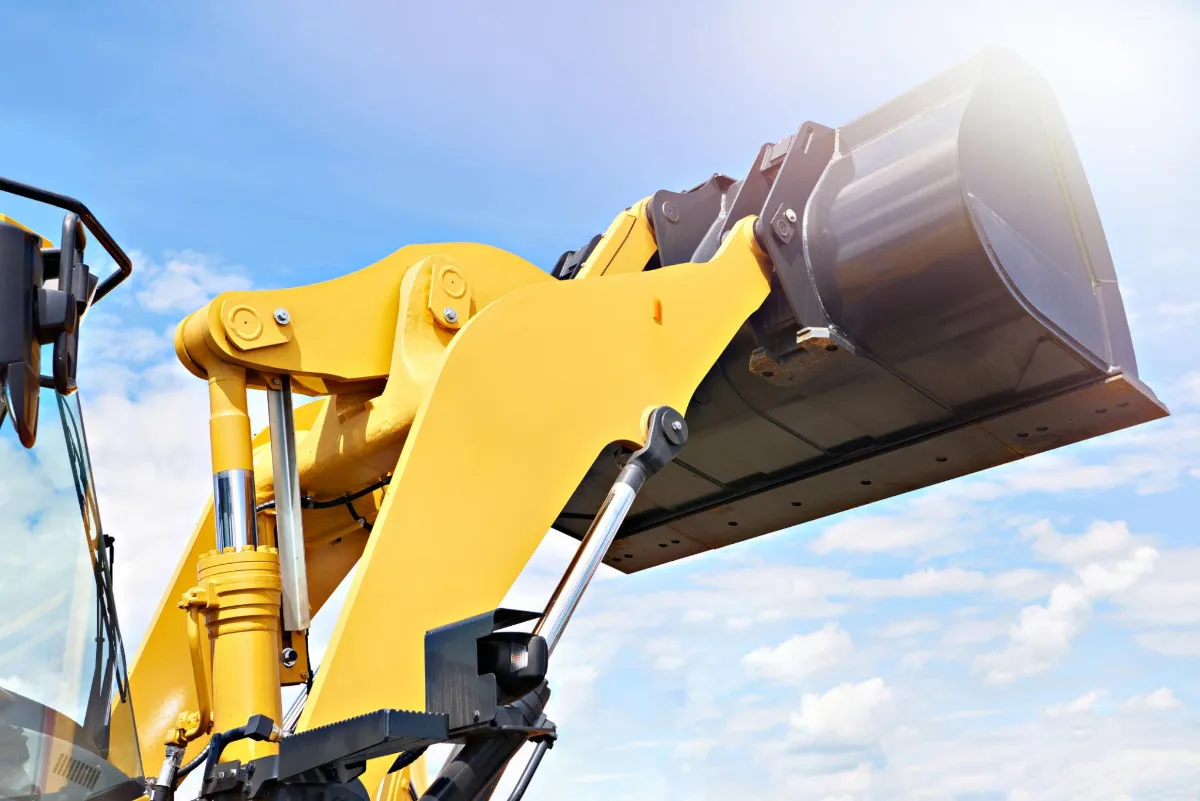
Lift-arm movement and bucket tilt are central to wheel loader operation. The lift arms position the bucket or attachment, while the tilt function controls its orientation during filling, transport, and discharge.
Proportional joystick control can be useful when movements need to be adjusted gradually. However, proportional command input does not necessarily translate into a linear change in hydraulic movement speed. The actual response depends on the valves, control calibration, hydraulic load, and machine configuration.
During system selection, specify the required movements and how the operator should control them. Do not infer compatibility simply because a transmitter has a joystick with enough axes.
Auxiliary hydraulics and attachments
Wheel loaders can use different implements depending on the job. Examples include pallet forks, grapples, bale grabs, brooms, and specialized material-handling attachments.
These implements can require more than the standard lift and tilt functions. A grapple may need an additional hydraulic opening and closing command. A rotating or otherwise powered attachment may require further functions, while a quick coupler can have a separate engagement sequence and associated safety requirements.
The remote-control system must have the necessary input controls and compatible outputs, but the attachment’s hydraulic and control requirements must also be verified.
When selecting an attachment-control configuration, provide the attachment model and its required functions. The number of channels alone does not establish whether the proposed system is suitable.
Steering and travel control
Steering and travel deserve separate attention because they affect the movement of the complete machine.
Many wheel loaders use articulated steering, where the front and rear sections pivot relative to one another. Travel may also be managed by a transmission or electronic controller rather than by simply opening or closing a hydraulic directional valve.
A wireless controller that provides proportional hydraulic outputs should not automatically be considered suitable for these functions. The machine manufacturer or integration specialist must determine how the proposed system can command steering and travel, and what feedback and safety measures are required.
If the project requires the loader to move around a stockpile, reverse near a truck, or turn within a restricted area, specify those operating requirements from the beginning.
What Types of Wheel Loader Remote-Control Systems Are Available?
The appropriate setup depends on whether the operator will maintain a direct view of the loader, how much machine feedback is needed, and whether the project requires a machine-specific integrated system.
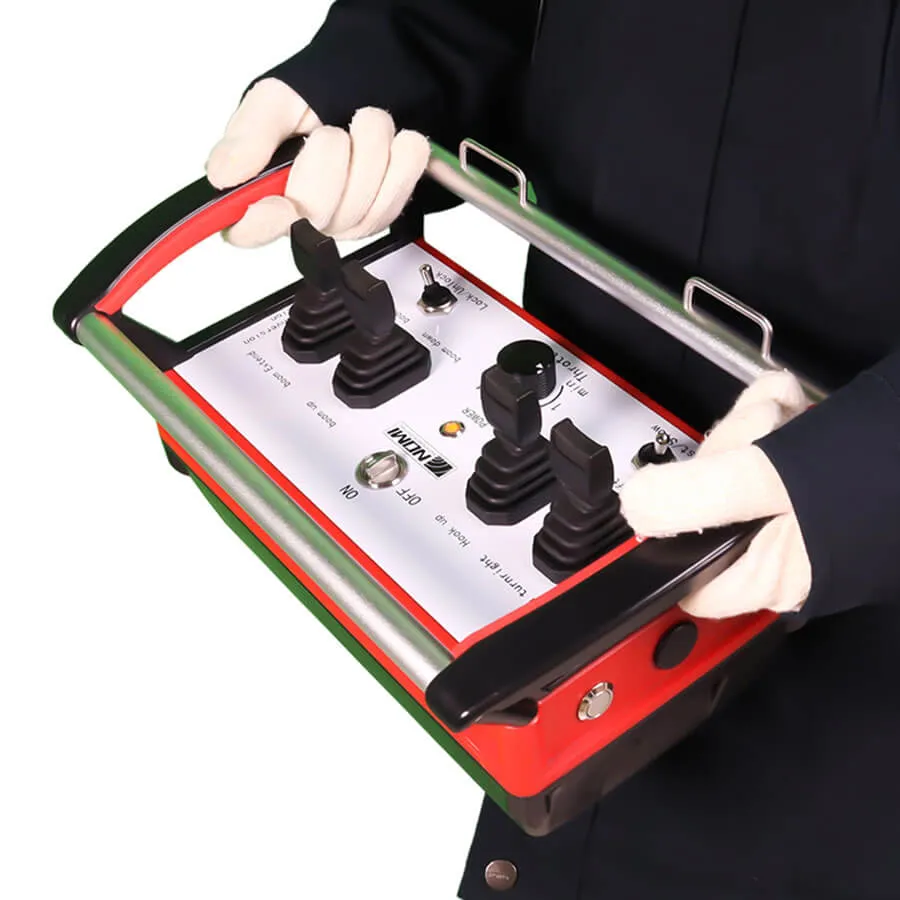
Handheld line-of-sight control
In a line-of-sight setup, the operator uses a portable controller while maintaining direct visual contact with the machine and its working area.
This approach may be suitable for defined tasks where the operator can observe the loader, judge its position, and remain outside the relevant hazard area. The control layout should support the required functions without forcing the operator to look repeatedly away from the worksite.
Line-of-sight operation is not appropriate for every environment. Dust, blind corners, crowded traffic routes, large stockpiles, and restricted visibility can make it difficult to judge the loader’s movement safely.
Remote command station
A remote command station provides an operator interface away from the machine. Depending on the system, it may include familiar control layouts, machine displays, multiple camera views, and other status information.
Caterpillar’s Command remote-control technology documents both line-of-sight consoles and remote command stations for selected machines, including wheel loaders. The available configurations and operating distances are specific to the relevant Cat models and systems, not specifications that can be transferred to generic aftermarket equipment.
A command station may be appropriate when the operating task requires more comprehensive feedback than a handheld transmitter can provide.
Camera-assisted teleoperation
Teleoperation adds visual or other machine feedback to support operation when the operator cannot adequately observe the loader directly.
Volvo Construction Equipment’s 2021 Remote Timber research project demonstrated remote operation of an L180 High-lift wheel loader for handling timber over a closed 5G network. The trial used cameras and sensors positioned around the machine to supply information to the remote station. It illustrates the requirements of precision material handling, but it should not be treated as proof that any wheel loader can be operated over any 5G network.
Camera-assisted systems need to be evaluated for viewing coverage, lighting, image latency, transmission reliability, and the operator’s ability to judge distance and movement. A communication link that carries movement commands is not necessarily sufficient to provide usable video feedback.
Standard remote controller or integrated teleoperation system?
| Requirement | Handheld wireless controller | Integrated teleoperation system |
|---|---|---|
| Local direct visibility | May be sufficient | Can also support line-of-sight operation |
| Camera-based feedback | Not necessarily included | Commonly required for non-line-of-sight work |
| Basic hydraulic implement commands | Possible if the interface is compatible | Possible, subject to machine integration |
| Steering and drivetrain control | Requires specific compatibility | May be included in an approved integrated configuration |
| Remote operation from a separate station | Depends on operating range and task | Designed for the defined remote station and communication setup |
| Machine status and diagnostic feedback | Model-dependent | Can include dedicated displays and feedback systems |
| Installation scope | May range from a simple interface to a complex conversion | Typically requires broader system planning and integration |
The correct choice depends on the job, not on which option has the most advanced technology. A simple arrangement may be adequate for a limited, visible task, while operation in a remote station or poorly visible environment may require a more integrated solution.
Where Is Wireless Remote Control Useful for Wheel Loaders?
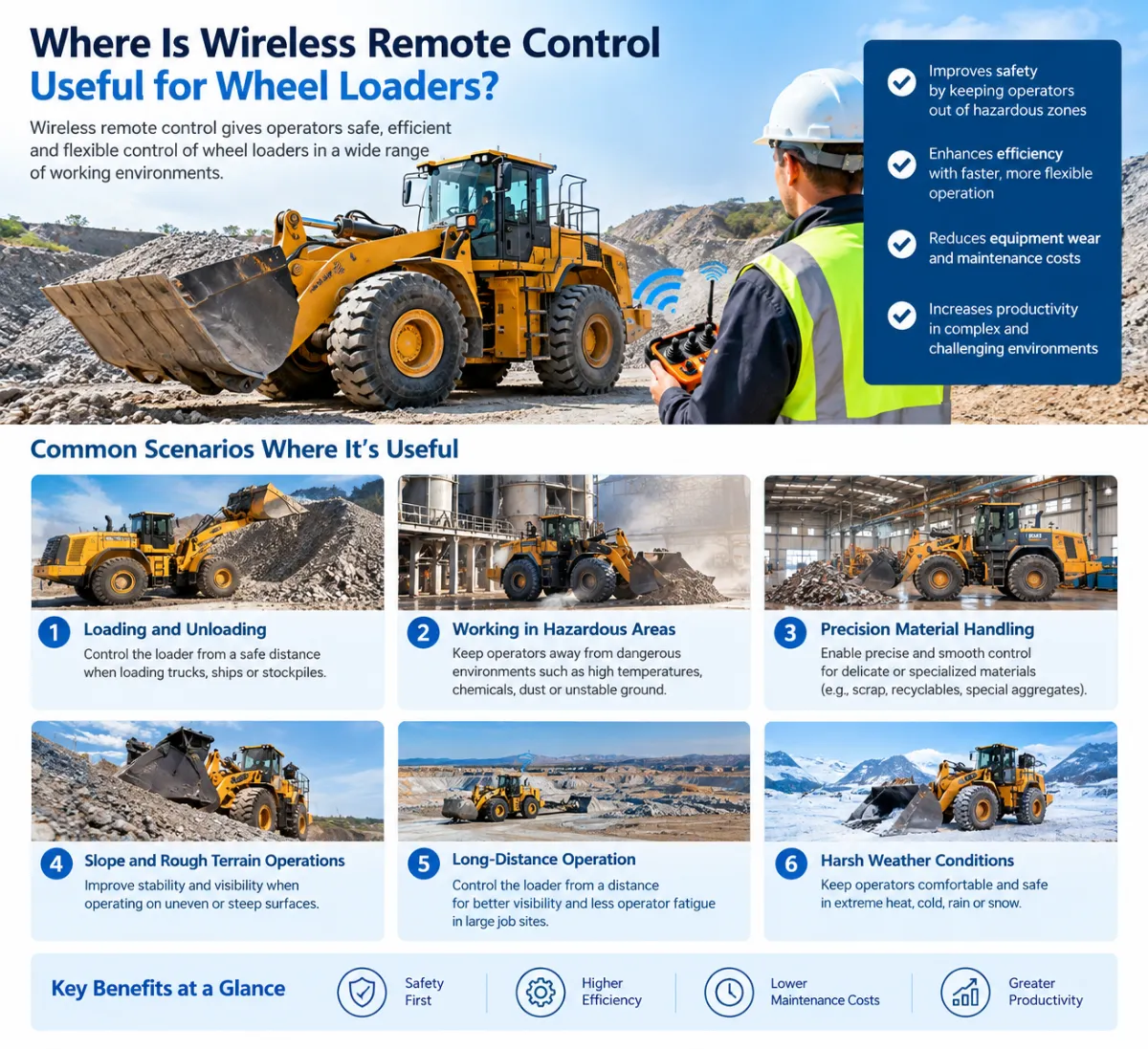
Wheel loader remote control is most relevant when moving the operator away from a hazardous location or enabling a particular machine operation from a more suitable position. The benefit must be assessed for the actual worksite, rather than assumed for every loading cycle.
Quarrying and aggregate handling
Wheel loaders are used to move bulk materials, manage stockpiles, and load transport vehicles. Remote operation may be considered where site conditions create a reason to remove the operator from the cab or change the operator’s position.
Caterpillar’s quarry and aggregates information identifies applications involving unstable surfaces and work near high walls. Its Command for Loading systems illustrate how selected wheel loaders can be operated remotely in such environments.
The operating design still needs to address machine stability, edge hazards, bucket visibility, traffic management, and the ability to identify people or equipment entering the working area.
Recycling, demolition, and hazardous material handling
Remote control may be useful in selected operations involving hazardous materials, demolition debris, or environmental cleanup. Caterpillar identifies demolition, environmental cleanup, and the handling of materials such as fertilizer, wood chips, and sawdust among applications for its Command for Loading technology.
These applications can have different requirements. A loader working in a dusty recycling area may need different visibility provisions from one handling loose material in an open yard.
Remote control does not eliminate the hazards associated with unstable material, falling debris, changing ground conditions, or interaction with other equipment. The system must be matched to the worksite’s risk assessment.
Forestry and high-lift material handling
Forestry applications may involve handling long, irregular loads such as logs. Such tasks can require precise positioning, careful load management, and reliable operator feedback.
Volvo CE’s high-lift teleoperation trial explored remote log picking, loading, and organization at a timber terminal. Cameras and sensors supported the remote operator’s view of the process. This example illustrates how the complexity of the task can determine the required feedback architecture.
For comparable projects, buyers should identify the attachment, working envelope, load-handling requirements, operator visibility, and communication infrastructure before requesting a system quotation.
Industrial plants and restricted-access operations
Some industrial yards, processing plants, and material-handling facilities have restricted-access areas or tasks that make remote operation worth evaluating.
Before proceeding, determine whether remote operation provides a meaningful advantage over conventional cab operation. The assessment should account for travel paths, pedestrian traffic, loading accuracy, visibility, communication coverage, and the process for stopping or recovering the machine.
A remote controller should not be treated as a substitute for a defined work procedure or suitable physical segregation where those controls are required.
How to Select the Right Remote Control for a Wheel Loader
A useful selection process begins with the intended work, then checks the machine interface, operator feedback, and required safety behavior. This avoids purchasing a controller based solely on channel count, advertised range, or physical appearance.
Define the working cycle
Describe the actual operation. For example, a stockpile-loading cycle may require the loader to approach a pile, position the bucket, collect material, reverse, turn, travel to a truck, and discharge the load.
List which of these actions must be controlled remotely. If only one hydraulic implement function is being controlled, the requirements may be relatively limited. If the complete loading cycle must be performed remotely, steering, travel, machine-state feedback, and operating modes become part of the system specification.
Confirm the machine interface
Provide the loader manufacturer, model, production year, serial number, and available control-system documentation.
Where possible, include the hydraulic schematic, electrical wiring diagrams, transmission or steering interface information, and details of the installed attachments.
The supplier should identify whether the proposed system can work with the existing interface, needs additional electro-hydraulic components, or requires more extensive OEM or integrator involvement.
Evaluate operator feedback
The operator needs enough information to judge the loader’s movement and the surrounding work area.
For a line-of-sight system, confirm that the operating position provides adequate direct visibility throughout the intended task. If the operator must work outside direct visual contact, define the camera views, displays, communication link, and other machine feedback required.
Do not treat radio range as a substitute for visibility or situational awareness.
Check environmental and communication requirements
Consider dust, moisture, vibration, temperature, antenna placement, radio interference, and the layout of the worksite. The system’s actual operating performance can differ from a nominal range stated under other conditions.
For camera-assisted teleoperation, evaluate video performance separately from command communication. Confirm the relevant radio-equipment requirements for the country of use.
Verify safety and maintenance requirements
Ask for the intended emergency-stop behavior, communication-loss response, restart procedure, operating-mode arrangements, and any machine-specific interlocks.
The complete system’s safety requirements depend on the intended functions and the risks associated with the loader and its application. Protective behavior should be documented and verified during commissioning.
Also clarify the required inspection, maintenance, fault reporting, and operator training procedures before the machine is accepted for service.
Common Mistakes When Buying a Wheel Loader Remote-Control System
Selecting the transmitter by channel count alone. A sufficient number of joystick axes does not establish that the receiver outputs or machine interface support the intended functions.
Assuming hydraulic control covers steering and travel. Wheel loader movement may involve integrated transmission, steering, and electronic machine-control functions that require separate consideration.
Choosing a system only by advertised radio range. Range figures do not guarantee reliable operation in a particular yard, quarry, industrial plant, or enclosed area.
Ignoring attachment-specific control requirements. A grapple, fork attachment, sweeper, or other implement may require auxiliary functions or interlocks beyond standard lift and tilt movements.
Treating a handheld controller as a teleoperation station. Non-line-of-sight operation may require cameras, displays, machine-state information, and additional communication infrastructure.
Assuming one configuration fits every wheel loader. Machine generation, installed electronics, steering and drive arrangements, and valve interfaces can all affect compatibility.
Overlooking safety documentation. Generic descriptions of fail-safe behavior or references to standards do not establish that the proposed configuration meets the requirements of a specific machine and use case.
What Should a Buyer Include in a Request for Quotation?
A technically useful request for quotation gives the supplier enough information to assess the machine and define the project scope.
| Information to provide | Why it matters |
|---|---|
| Wheel loader make, model, year, and serial number | Identifies the target machine and helps establish compatibility |
| Existing hydraulic and electronic control architecture | Determines the available interfaces |
| Hydraulic and electrical schematics, where available | Supports technical assessment |
| Required lift, tilt, steering, travel, and auxiliary functions | Defines the necessary controls and outputs |
| Attachment details | Identifies additional hydraulic functions or interlocks |
| Operating distance and worksite layout | Helps establish communication requirements |
| Direct line-of-sight or camera-assisted operation | Defines the operator feedback required |
| Environmental conditions | Helps assess enclosure, installation, and communication needs |
| Emergency-stop and communication-loss requirements | Defines safety-related expectations |
| Destination country | Supports applicable radio and machinery requirements |
| Required supply scope | Clarifies whether the quotation covers a controller, receiver, machine-side hardware, integration, installation, commissioning, and training |
These details also help suppliers compare their proposed solutions accurately. One quotation may cover a transmitter and receiver only, while another may include machine-side integration and camera equipment. Their prices should not be compared as if the scope were identical.
How Nomi Can Help with Wheel Loader Remote-Control Requirements
Nomi specializes in industrial wireless remote-control products for hydraulic machinery and construction equipment. Its public website includes industrial hydraulic remote-control systems and industrial joystick remote controls, which can serve as starting points for discussing a project involving proportional commands or hydraulic functions.
However, the suitability of any specific configuration for a wheel loader must be confirmed against the machine’s control architecture and required functions. The presence of a joystick remote-control product does not by itself establish compatibility with a loader’s steering, drivetrain, or complete machine-control system.
For a project inquiry, provide the loader model, intended work cycle, required hydraulic functions, travel and steering requirements, attachment information, and whether direct visibility will be maintained. Include technical drawings where available.
The next step is to establish which functions can be supported by the selected control interface and whether additional machine integration or a more comprehensive teleoperation system is required. To discuss requirements and request a configuration-specific quotation, use Nomi’s contact page.
FAQ
1. What functions can a wireless remote control operate on a wheel loader?
Depending on the system and machine interface, remote commands may cover lift-arm movement, bucket tilt, auxiliary hydraulic functions, travel, steering, and selected machine functions. The supported functions must be confirmed for the specific wheel loader and remote-control configuration.
2. Can a hydraulic wireless remote control operate wheel loader steering?
Not automatically. Steering may be integrated with the machine’s hydraulic or electronic control architecture. A supplier must determine how the proposed system can interface with the loader’s steering mechanism and required control logic.
3. What is the difference between a wheel loader remote controller and a teleoperation system?
A remote controller sends operator commands to compatible machine interfaces. A teleoperation system can add cameras, displays, machine-state feedback, and other communication infrastructure for operation when direct visual contact is limited or unavailable.
4. Can a wireless remote control operate loader attachments?
Potentially, provided the remote-control system, hydraulic circuits, receiver outputs, and machine interface support the attachment’s required functions. Attachments with auxiliary hydraulic or interlocking requirements need separate compatibility checks.
Proportional control may be preferable when the operator needs variable movement and gradual positioning. Push buttons may suit discrete functions. The appropriate layout depends on the required machine functions and the control architecture.
6. Can an existing wheel loader be retrofitted with wireless remote control?
Some machines may be suitable for a retrofit, but compatibility depends on the model, installed controls, hydraulic and electronic interfaces, and intended scope. The project may require additional machine-side components or OEM-supported integration.
7. What applications are suitable for remote-controlled wheel loaders?
Possible applications include selected quarry operations, hazardous-material handling, recycling, industrial material handling, and forestry-related tasks. The appropriate configuration depends on the specific hazards, visibility requirements, and machine functions needed.
8. How should buyers evaluate the radio range?
Consider the actual site layout, obstacles, interference, antenna placement, and operating distance. For camera-assisted operation, the video link and operator feedback must be evaluated separately from the control link.
9. Which safety requirements should be confirmed before purchase?
Ask about emergency-stop behavior, communication-loss response, restart conditions, operating-mode selection, applicable interlocks, and relevant documentation. The requirements must be evaluated for the complete machine and intended application.
10. What information is needed for a wheel loader remote-control quotation?
Provide the loader make and model, year and serial number, control architecture, required functions, attachments, travel and steering needs, operating distance, worksite conditions, visual-feedback requirements, destination country, and requested integration scope.
