

If you are looking for highly rated wireless remotes for heavy equipment, do not judge a system only by its online rating, advertised range or number of buttons. For industrial machinery, a suitable wireless remote control must match the machine’s control architecture, hydraulic or electrical interface, operating environment, required control precision and safety functions.
For hydraulic heavy equipment, the most important distinction is often between proportional control and simple on/off control. Joystick-based proportional systems are appropriate when the operator needs variable speed and smooth movement, while push-button systems can be suitable for simpler discrete functions. The correct choice depends on the machine and application, not simply on which transmitter looks more advanced.
Nomi develops industrial wireless remote control systems for hydraulic machinery, cranes, construction equipment and other industrial applications. Its product range includes hydraulic proportional, joystick and push-button industrial radio remote controls, with configurable functions for different equipment requirements.
What Makes a Wireless Remote Control “Highly Rated” for Heavy Equipment?
The phrase “highly rated” can be misleading when used for industrial remote controls.
A consumer product may be rated according to online reviews, while an industrial remote control needs to be evaluated against engineering requirements. A remote with hundreds of positive reviews may still be unsuitable if its output interface does not match the machine’s hydraulic valve or if its environmental protection is inadequate.
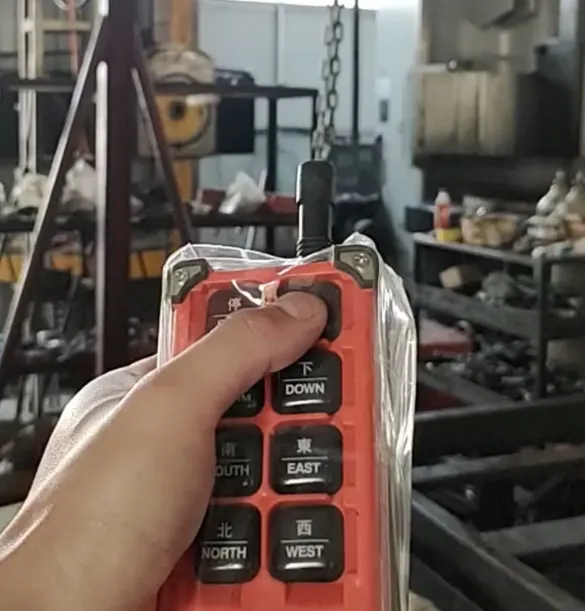
For heavy equipment, a better evaluation framework includes:
| Evaluation factor | What to check | Why it matters |
|---|---|---|
| Control type | Proportional or on/off | Determines how machine movement is controlled |
| Joystick configuration | Number of axes and functions | Must match machine functions |
| Receiver output | Relay, analog, PWM, CAN or other interface | Determines machine compatibility |
| Wireless range | Required operating distance | Must cover the actual work area |
| Signal-loss behavior | Defined safe response | Important for controlled stopping |
| Emergency stop | Dedicated safety function | Provides an additional means of stopping hazardous motion |
| Environmental protection | IP rating, temperature, vibration | Heavy equipment often operates outdoors |
| Battery system | Battery type and operating time | Affects operational continuity |
| Frequency | Suitable for the target market | Radio requirements vary by country |
| Compatibility | Valve, ECU or machine controller | Prevents integration problems |
| Documentation | Wiring, manuals and technical data | Supports installation and maintenance |
| Supplier support | Engineering and after-sales support | Important for customized systems |
This approach is more useful than simply asking which remote control has the highest rating.
Joystick vs. Push-Button: Which Type Is More Suitable?
One of the first decisions is the control interface.
A joystick remote provides variable movement across an axis. A push-button remote normally provides discrete commands such as start, stop, raise, lower, extend or retract.
Neither technology is automatically better.
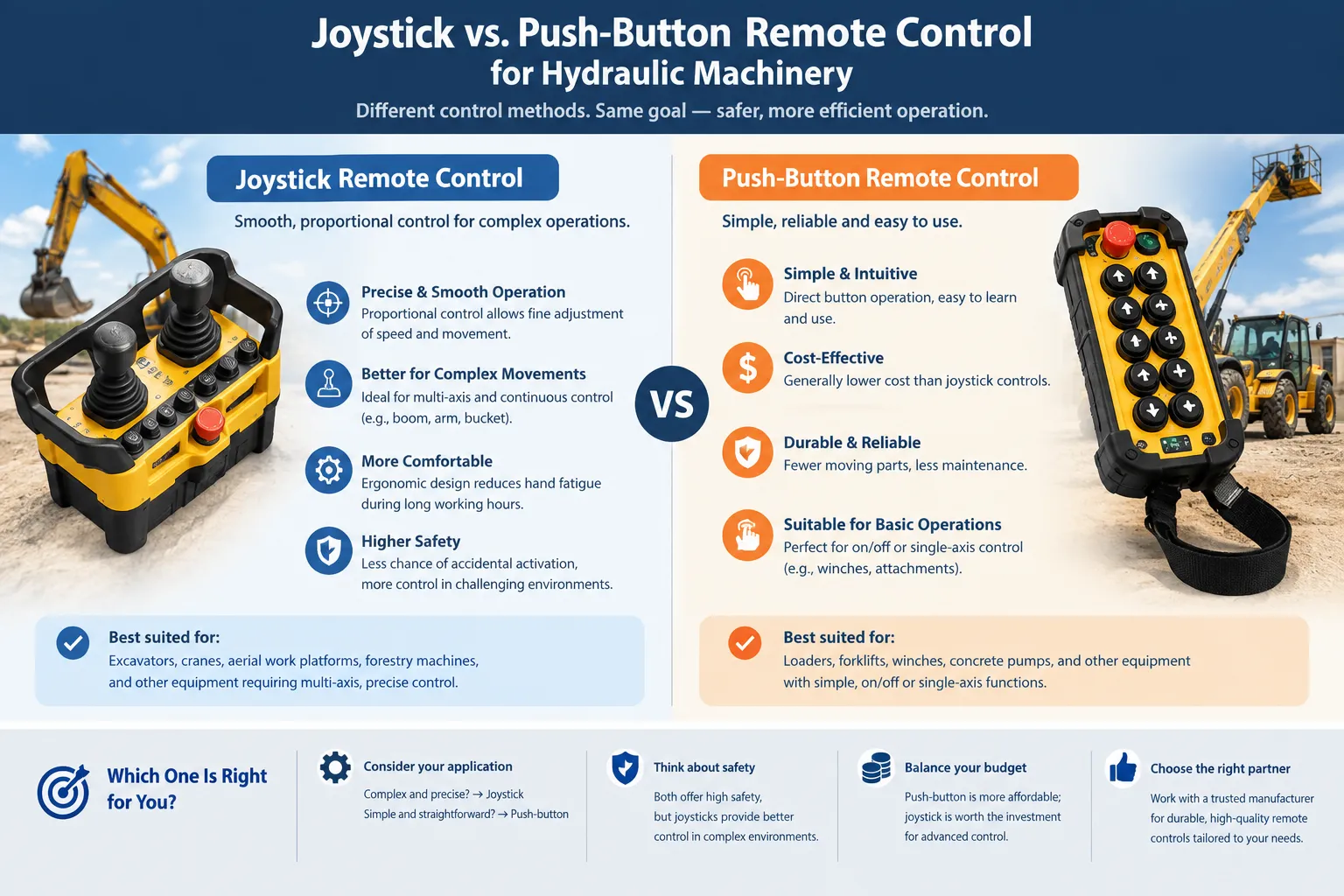
Joystick remote controls
Joystick systems are generally more suitable when the operator needs:
- Variable speed control.
- Smooth acceleration and deceleration.
- Fine positioning.
- Simultaneous control of several proportional functions.
- More natural control of hydraulic movement.
- Continuous adjustment rather than fixed speed steps.
This is particularly relevant to cranes, excavators, concrete equipment and other hydraulic machines where the operator needs to control how quickly an actuator moves.
Nomi’s industrial joystick remote control range is designed for applications including construction equipment and other industrial machinery, with configurable control layouts and emergency-stop functionality.
Push-button systems are more appropriate when machine functions are primarily discrete.
Typical functions include:
- Start and stop.
- Raise and lower.
- Extend and retract.
- Forward and reverse.
- Auxiliary equipment activation.
- Lighting or other auxiliary functions.
Push-button systems can also be combined with other controls when a machine requires both discrete and proportional functions.
Proportional hydraulic remote controls
A proportional system is different from a simple wireless switch.
The operator’s joystick movement represents the desired level of machine movement. The receiver then provides a corresponding output to the machine’s hydraulic control system.
For example, a small joystick movement may command slow actuator movement, while greater joystick displacement commands greater output.
This can be important when the machine requires smooth positioning rather than simply moving at full speed or stopping.
For applications that require this type of control, a dedicated hydraulic remote control is generally more appropriate than a basic wireless switching system.
What Specifications Matter Most?
Buyers often focus on wireless distance first. That is understandable, but range is only one part of the system.
1. Control distance
The advertised range should be interpreted carefully.
A manufacturer’s stated range may represent an open-area or unobstructed measurement. Actual performance can be affected by:
- Steel structures.
- Concrete buildings.
- Machine frames.
- Cab structures.
- Terrain.
- Other radio equipment.
- Antenna location.
- Local interference.
- Frequency regulations.
For this reason, buyers should specify the required working distance, rather than simply asking for the longest possible range.
Nomi’s published product information includes standard models with approximately 225 m of remote control distance, while certain configurations can be customized. The actual required distance should therefore be discussed with the supplier based on the application.
2. Response time
Response time affects how quickly an operator’s command reaches the machine.
Nomi’s published industrial radio remote control information specifies a response time of no more than 20 ms for certain models.
However, response time should not be considered in isolation.
A buyer should ask:
- Is the stated value transmitter-to-receiver latency?
- Does it include machine output response?
- Is it measured under normal radio conditions?
- Does proportional output introduce additional processing time?
For precision applications, the complete control chain matters more than a single transmitter specification.
3. Proportional resolution
For joystick systems, proportional resolution determines how finely the operator’s movement can be represented electronically.
Higher resolution can provide more command steps, but resolution alone does not guarantee better machine control.
The final behavior also depends on:
- Joystick mechanics.
- Sensor technology.
- Software mapping.
- Deadband.
- Receiver output.
- Hydraulic valve characteristics.
- Valve amplifier settings.
- Machine response.
This is why buyers should evaluate the entire control system rather than selecting a remote solely because it has a larger numerical resolution.
Why the Receiver Is Just as Important as the Transmitter
A common purchasing mistake is to evaluate only the handheld transmitter.
In an industrial wireless system, the receiver is equally important.
The basic control chain is:
Operator → transmitter → radio communication → receiver → machine controller or hydraulic valve → actuator
The transmitter generates the operator’s command. The receiver must interpret that command and provide the correct electrical output to the machine.
Depending on the machine, the receiver may need to provide:
- Relay outputs.
- Analog voltage.
- Analog current.
- PWM.
- CAN bus.
- Other machine-specific interfaces.
For hydraulic machinery, the receiver may need to communicate with proportional valve amplifiers or solenoid-controlled directional valves.
A visually impressive transmitter cannot compensate for an incompatible receiver interface.
Hydraulic Compatibility Should Be Verified Before Ordering
For a hydraulic machine, compatibility is one of the most important purchasing questions.
Before requesting a quotation, collect the following information:
- Machine make and model.
- Machine operating voltage.
- Hydraulic valve manufacturer.
- Hydraulic valve model.
- Number of hydraulic functions.
- Whether each function is proportional or on/off.
- Solenoid voltage.
- Solenoid current or resistance.
- Existing control method.
- Required receiver output.
- Required operating distance.
- Number of joysticks.
- Required buttons or switches.
- Required emergency-stop arrangement.
- Operating environment.
For retrofit applications, the hydraulic valve and electrical interface should be verified before selecting the remote.
Nomi’s hydraulic remote control systems are intended for applications where wireless commands need to be integrated with hydraulic machinery. A supplier should receive sufficient machine information before confirming compatibility.
IP Rating: What Should Heavy Equipment Buyers Look For?
Heavy equipment is frequently exposed to:
- Rain.
- Dust.
- Mud.
- Hydraulic oil.
- Cleaning water.
- Temperature changes.
- Vibration.
- Mechanical impact.
The transmitter and receiver therefore need appropriate environmental protection.
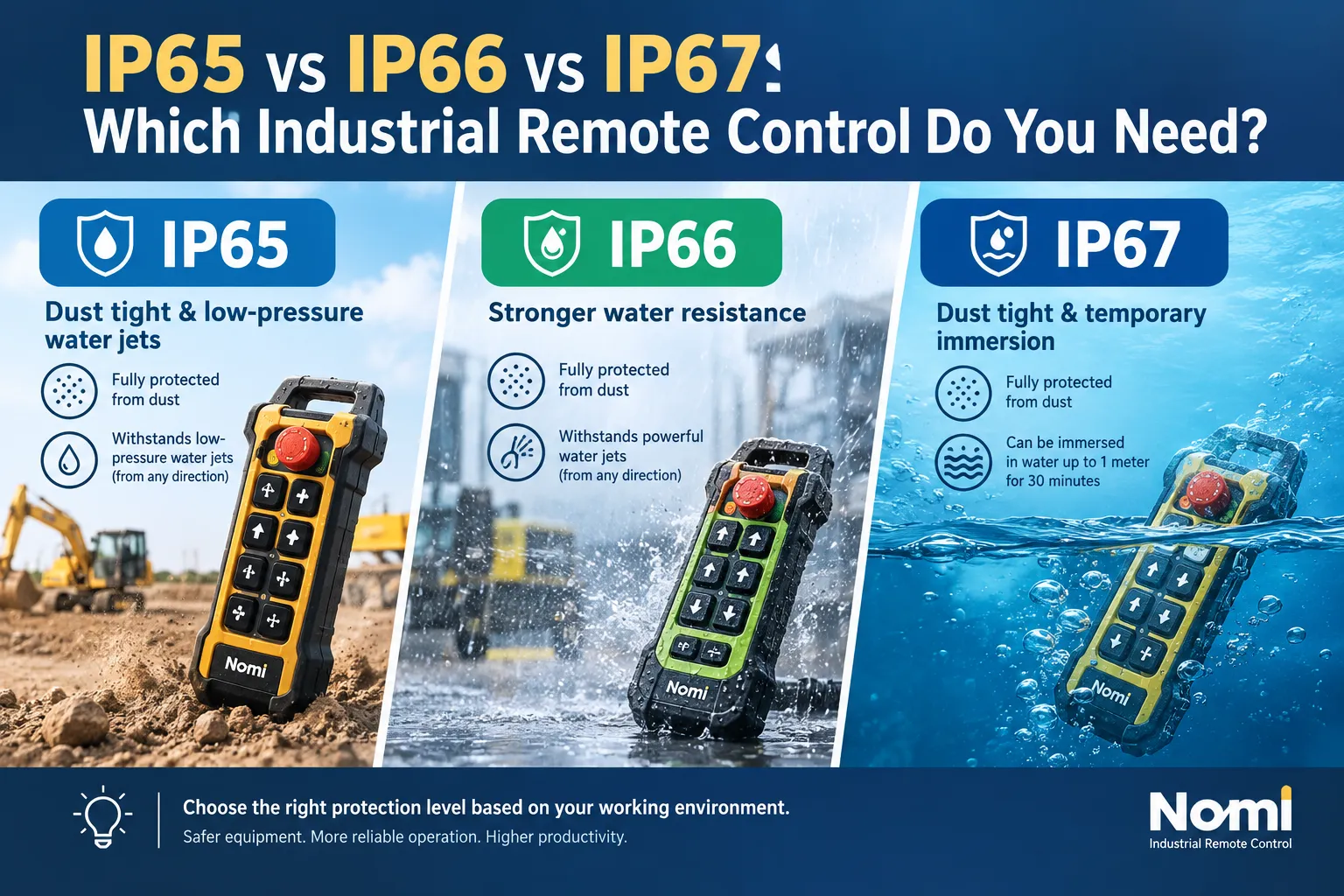
IP ratings are defined under IEC 60529. The rating describes protection against solid particles and water ingress.
Read more: IP65 vs IP66 vs IP67: Which Industrial Remote Control Do You Need?
A simplified comparison is:
| Rating | General protection | Typical consideration |
|---|---|---|
| IP54 | Limited dust protection and water splashing | Cleaner indoor or protected environments |
| IP65 | Dust-tight and protected against water jets | Many outdoor industrial applications |
| IP66 | Dust-tight and protected against powerful water jets | Heavy outdoor exposure |
| IP67 | Dust-tight and temporary immersion protection | Outdoor equipment and demanding environments |
| IP68 | Dust-tight and protection against immersion under specified conditions | Requires attention to manufacturer’s specified test conditions |
An IP rating should never be treated as a complete durability specification.
A machine working in mud, vibration and freezing temperatures needs more than water resistance.
The buyer should also consider:
- Operating temperature.
- Shock resistance.
- Vibration resistance.
- Connector sealing.
- Joystick boot protection.
- Housing material.
- Battery compartment sealing.
- Chemical exposure.
Nomi publishes an operating temperature range of approximately -25°C to +85°C for certain industrial remote control models, but the applicable model and configuration should always be confirmed before purchase.
Safety Features Matter More Than Wireless Range
For heavy machinery, safety should be considered at the system level.
Important functions can include:
- Emergency stop.
- Signal-loss detection.
- Fail-safe output behavior.
- Prevention of unintended activation.
- Transmitter-receiver pairing.
- Machine identification.
- Controlled restart.
- Operator visibility.
- Appropriate safety-related control architecture.
ISO 13849-1:2023 provides a methodology for designing and integrating safety-related parts of control systems. It applies to safety-related control systems using electrical, hydraulic, pneumatic and mechanical technologies.
For machinery placed on the EU market, Regulation (EU) 2023/1230 contains specific requirements concerning wireless control. In particular, communication failure must not lead to a hazardous situation, and remote-controlled machinery must include automatic stopping measures for specified fault conditions.
The important point for buyers is that a wireless remote control should not be judged only by its radio specification.
The safety behavior of the complete machine-control system must be evaluated.
What Happens If the Wireless Signal Is Lost?
Signal loss is an important question that buyers should ask before purchasing.
Suppose an operator moves outside the effective operating area or the radio communication is interrupted.
A properly designed industrial system should have a defined response to this condition. Depending on the machine and safety architecture, the receiver may stop or de-energize relevant outputs rather than continuing to operate using the last command.
The exact behavior must be specified for the application.
Ask the supplier:
- What happens when the transmitter is switched off?
- What happens when the transmitter battery is depleted?
- What happens when the radio signal is interrupted?
- What is the receiver watchdog timeout?
- Does the machine restart automatically after communication is restored?
- Is manual reset required?
- How is the emergency stop implemented?
- Which safety-related standards apply to the system?
These questions are more meaningful than simply asking whether a remote control is “safe.”
How to Compare Wireless Remotes for Different Heavy Equipment
Different machines require different control architectures.
| Equipment | Typical control requirement | Remote type to consider |
|---|---|---|
| Excavator | Multiple proportional hydraulic movements | Multi-axis joystick or proportional hydraulic system |
| Truck crane | Boom, slew, extension and auxiliary functions | Multi-axis joystick plus buttons |
| Concrete pump truck | Boom and auxiliary hydraulic control | Joystick/proportional system |
| Hoist | Hoist, trolley and travel | Joystick or push-button depending on control requirements |
| Loader | Hydraulic functions and auxiliary controls | Proportional joystick |
| Dump trailer | Hydraulic raise/lower | Push-button or simple hydraulic remote |
| Winch | Variable speed and direction | Proportional joystick or dedicated control |
| Agricultural machinery | Mixed hydraulic and auxiliary functions | Customized joystick/button combination |
| Industrial machinery | Application-dependent | Customized industrial radio remote |
This table is only a starting point. The actual machine interface should determine the final configuration.
When Should You Choose a Proportional Remote?
A proportional wireless remote may be appropriate when:
- Machine speed needs to be continuously adjusted.
- Operators need fine positioning.
- Hydraulic functions require variable flow.
- Sudden starts and stops should be minimized.
- Multiple machine movements must be controlled.
- The existing machine uses proportional hydraulic valves.
- Operator control accuracy is important.
For these applications, a joystick interface usually provides a more direct way to control variable machine movement.
When Is a Push-Button Remote Enough?
A push-button system may be sufficient when:
- Machine functions are primarily on/off.
- Only a small number of functions are required.
- Precise speed control is not necessary.
- The hydraulic system already manages speed through another mechanism.
- Cost and simplicity are important.
- Auxiliary functions are the main remote-control requirement.
Nomi also offers [push button remote controls] for industrial applications where discrete commands are more appropriate.
The key is to match the remote interface to the machine rather than buying a more complex system than necessary.
What Should Buyers Ask a Wireless Remote Control Supplier?
Before purchasing, ask the supplier for technical information covering at least these areas.
Machine compatibility
- What machines has this system been designed for?
- Can it interface with my hydraulic valve?
- What solenoid voltage is supported?
- What output signals are available?
- Is CAN bus available if required?
Radio system
- What frequency is used?
- Is the frequency legal for my country?
- What is the rated open-field range?
- What range should I expect in an actual industrial environment?
- How does the system respond to interference?
Safety
- What happens after signal loss?
- Is there an emergency stop?
- What happens after the transmitter is turned off?
- Is a manual reset required?
- What safety architecture applies to the complete system?
Mechanical and environmental durability
- What is the IP rating?
- What is the operating temperature?
- What vibration and shock testing has been performed?
- Is the transmitter suitable for outdoor use?
- How are the joystick and switches protected?
Documentation
Ask for:
- Technical datasheet.
- Wiring diagram.
- User manual.
- Receiver output information.
- Applicable declarations or certificates.
- Installation instructions.
- Pairing procedure.
- Maintenance information.
A supplier that cannot provide basic technical documentation should be evaluated carefully, especially for a customized industrial application.
Common Mistakes When Buying Heavy Equipment Wireless Remotes
Mistake 1: Choosing by range alone
A longer advertised range does not automatically make a remote better.
The real question is whether the system can maintain reliable communication throughout the required operating area.
Mistake 2: Assuming every joystick is proportional
A joystick-shaped transmitter does not automatically mean the machine receives proportional control.
Check the receiver output and the hydraulic interface.
Mistake 3: Ignoring the existing valve
For hydraulic retrofits, valve compatibility is critical.
The valve model, coil voltage, current and control type should be verified before ordering.
Mistake 4: Buying based on IP rating alone
IP protection does not describe every aspect of durability.
Vibration, temperature, impact, chemical exposure and connector quality also matter.
Mistake 5: Ignoring signal-loss behavior
A buyer should understand exactly what the machine does when communication is interrupted.
Mistake 6: Assuming CE or FCC solves every safety requirement
Radio certification and machinery functional safety are different issues.
A radio approval does not automatically mean that a complete machine-control system satisfies every machinery safety requirement.
Mistake 7: Choosing a product before defining the machine functions
The correct sequence is:
Machine requirements → control functions → electrical/hydraulic interface → safety requirements → environmental conditions → remote configuration
not:
Remote model → attempt to make it fit the machine.
A Practical RFQ Checklist for Heavy Equipment Remote Controls
When contacting a supplier, you can provide the following information:
| Item | Information to provide |
|---|---|
| Machine | Make and model |
| Application | Crane, excavator, loader, pump, etc. |
| Control method | Hydraulic, electrical, CAN, etc. |
| Machine voltage | 12 V, 24 V or other |
| Hydraulic valve | Manufacturer and model |
| Functions | Number of controlled functions |
| Proportional functions | Number required |
| On/off functions | Number required |
| Joysticks | Number and axes |
| Buttons | Quantity and functions |
| Emergency stop | Required or existing |
| Range | Required working distance |
| Environment | Indoor/outdoor/marine/etc. |
| Temperature | Minimum and maximum |
| IP requirement | Required protection level |
| Frequency | Target country/market |
| Quantity | Number of systems |
| Documentation | Required certificates and technical documents |
Providing this information can significantly reduce the time required for supplier evaluation and quotation.
Nomi’s Approach to Industrial Wireless Remote Control
Nomi’s product portfolio covers hydraulic industrial radio remote controls, joystick industrial radio remote controls and push-button industrial radio remote controls.
Its published hydraulic product information includes proportional linear output, adjustable speed, waterproof and dustproof construction, anti-interference characteristics and customizable button functions.
The company’s published product information also identifies applications including construction machinery, lifting machinery, hydraulic equipment, cranes, excavators, concrete pump equipment and other industrial machinery.
For buyers who need a customized system, the important question is not simply which standard transmitter is available. The better question is whether the supplier can match the transmitter, receiver, machine interface and required control functions.
For more specialized applications, Nomi’s joystick remote controls provide an option for machines that require proportional or multi-axis control.
For crane applications, buyers can also review the available construction crane remote controls and compare the control architecture with their existing machine.
FAQ
1. What is a highly rated wireless remote for heavy equipment?
For industrial applications, “highly rated” should refer to suitability, reliability, safety, compatibility and environmental durability rather than simply online customer reviews. A suitable remote should match the machine’s control requirements and operating environment.
Not universally. Joystick remotes are generally more suitable for proportional and variable-speed control, while push-button remotes can be suitable for discrete on/off functions. The appropriate choice depends on the machine.
3. What is a proportional hydraulic remote control?
A proportional hydraulic remote control allows the operator to vary machine movement according to joystick or control displacement. The receiver provides a corresponding control signal to the hydraulic system.
4. How far can an industrial wireless remote control operate?
The usable range depends on the specific system, antenna arrangement, environment, frequency and obstacles. An advertised open-field range should not automatically be treated as the guaranteed working distance on a construction site.
5. What IP rating should a heavy equipment remote have?
The appropriate IP rating depends on the environment. Outdoor equipment exposed to rain, dust and cleaning water may require substantially more protection than indoor machinery. Buyers should also consider vibration, temperature, impact and chemical exposure.
6. What information should I give a supplier before buying?
At minimum, provide the machine model, operating voltage, number of functions, hydraulic valve information, proportional/on-off requirements, desired range, operating environment and target country.
7. What happens if the wireless signal is lost?
The receiver should have a defined response to communication failure. Depending on the machine and safety architecture, the system may stop or de-energize relevant outputs. The exact behavior should be confirmed with the supplier.
8. Can a wireless remote be added to an existing hydraulic machine?
In many applications, wireless remote control can be implemented as a retrofit. However, compatibility with the hydraulic valves, solenoids, electrical system and machine safety architecture must be checked before installation.
9. Does CE certification mean that a wireless remote is safe for every machine?
No. Radio/electrical conformity and machinery functional safety are separate considerations. The complete machine-control system must satisfy the requirements applicable to the specific machine and market.
10. How should I compare two wireless remote control suppliers?
Compare the complete system rather than just the transmitter. Review machine compatibility, receiver outputs, safety functions, radio requirements, environmental ratings, documentation, customization capability, warranty and technical support.
Final Buying Principle
There is no single wireless remote control that is automatically the right choice for every heavy machine.
A remote control that works well for a dump trailer may not be appropriate for a multi-function excavator. A push-button system may be sufficient for discrete functions but unsuitable when continuous proportional hydraulic control is required. Likewise, a system with a long advertised radio range may still be inappropriate if its receiver cannot communicate correctly with the machine.
For this reason, “highly rated” should mean more than positive reviews.
For heavy equipment, a strong candidate is a system that:
- Matches the machine’s control architecture.
- Provides the required proportional or on/off functions.
- Has an appropriate receiver interface.
- Provides defined behavior during communication loss.
- Includes suitable emergency-stop functionality.
- Has environmental protection appropriate for the working conditions.
- Meets applicable radio and machinery requirements.
- Comes with adequate technical documentation.
- Can be supported by the supplier during installation and commissioning.
The best purchasing decision is therefore not to find the remote with the most impressive specification. It is to find the system whose specifications are appropriate for the actual machine and operating environment.
If you are evaluating a wireless remote for an excavator, crane, loader, concrete pump truck, winch or other hydraulic machine, provide the machine model, hydraulic valve information, voltage, number of functions, required control distance and operating environment to the supplier before requesting a final configuration and quotation.
