

A hydraulic wireless remote control for a motor grader allows an operator to command selected blade, frame, and other machine functions from a wireless transmitter through a compatible receiving and control system. Depending on the grader’s architecture, the system may operate hydraulic valve functions directly, interface with electro-hydraulic controls, or form part of a more extensive remote-operation arrangement.
Motor graders require a different control approach from excavators and wheel loaders because grading depends on the coordinated adjustment of the moldboard, its supporting mechanisms, and the machine’s position. Left and right blade lift, blade tip, circle rotation, sideshift, drawbar centershift, articulation, and wheel lean can all influence the cutting edge’s position and the way material moves across the surface.
The key to selecting a suitable system is therefore to identify which functions must be controlled remotely, how the existing grader processes those commands, and whether the proposed interface can deliver the required movement and safety behavior. A wireless joystick with enough axes is not automatically compatible with every motor grader.
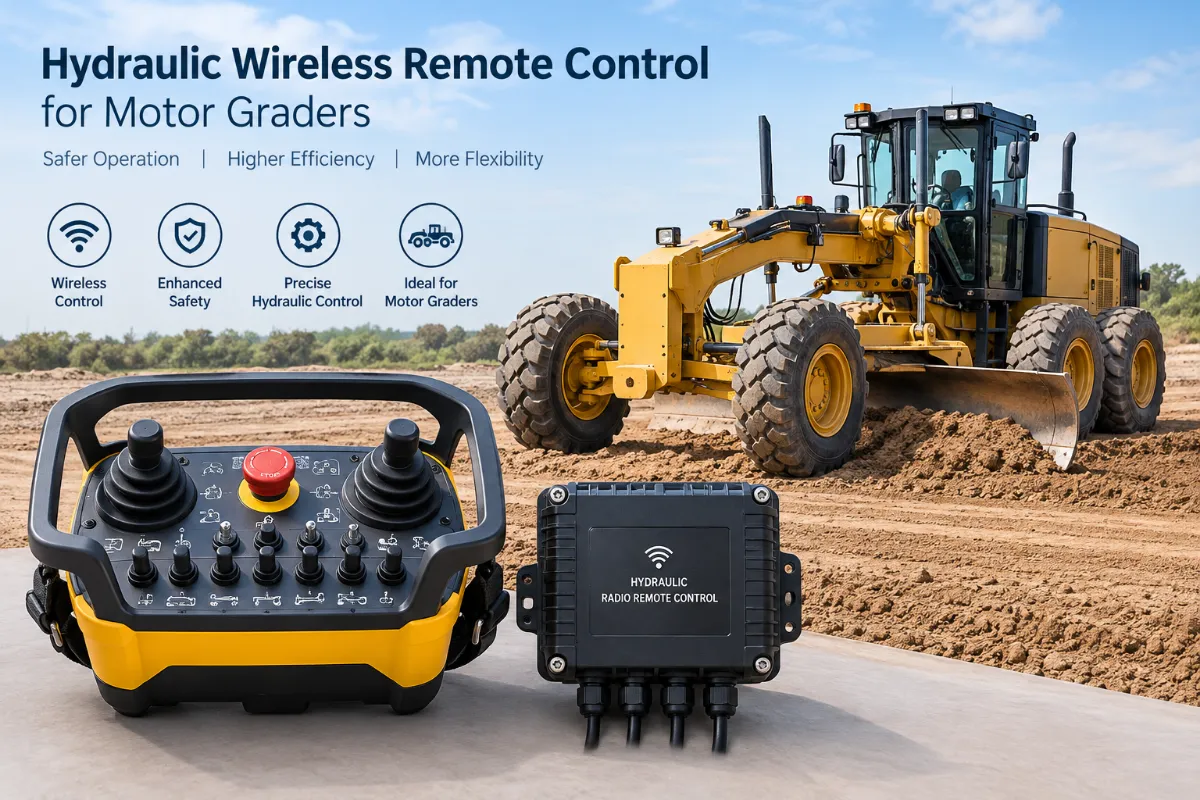
Why Motor Graders Need a Different Remote-Control Approach
A motor grader is designed to produce a controlled surface by adjusting a long moldboard, commonly called the blade, relative to the machine and the material being worked. Its productivity and grading quality depend on the relationship between blade position, blade angle, machine travel, and ground conditions.
This creates a more specialized control requirement than simply extending or retracting a hydraulic cylinder.
Caterpillar’s motor grader lever-control guide identifies several separate functions on its grader models, including blade tip, independent left and right blade lift, blade sideshift, circle drive, drawbar and circle centershift, articulation, and wheel lean. The exact functions and operating arrangements vary by machine.
A remote-control configuration should begin with the required grading movements rather than a generic count of transmitter channels.
The main hydraulic functions of a motor grader
| Grader function | What it changes | Why it matters during grading |
|---|---|---|
| Left blade lift | Raises or lowers the left end of the moldboard | Adjusts blade height and contributes to blade slope |
| Right blade lift | Raises or lowers the right end of the moldboard | Works with the left lift to establish blade position and cross-slope geometry |
| Moldboard tip | Changes the forward or backward tip of the blade | Changes how the cutting edge engages and moves material |
| Circle rotation | Rotates the blade assembly around the circle | Changes the moldboard’s horizontal orientation |
| Moldboard sideshift | Moves the blade laterally | Positions the cutting edge relative to the machine and working area |
| Drawbar or circle centershift | Moves the supported blade assembly laterally | Helps establish blade reach and working geometry |
| Frame articulation | Changes the angle between the front and rear machine frames | Affects maneuverability, blade position, and machine behavior under certain grading loads |
| Front wheel lean | Tilts the front wheels laterally | Can help manage side draft and machine tracking |
| Ripper or scarifier, when fitted | Raises or lowers the attachment | Supports the preparation of compacted or hard surfaces |
| Snow wing or other auxiliary equipment, when fitted | Operates the additional attachment’s approved functions | Adds controls beyond the standard moldboard arrangement |
This table is a functional overview, not a universal list of outputs for every motor grader. Optional equipment and model-specific control arrangements may add further functions.
Blade lift and moldboard tip are separate control requirements
The left and right blade-lift functions are distinct because the ends of the moldboard may need to move independently. Their commands should be mapped correctly to the grader’s actual control interface.
Moldboard tip is different. It changes the blade’s forward or backward orientation, affecting how the cutting edge engages the material.
Caterpillar’s motor grader operating tips explain that moldboard tip and blade angle influence the way material is cut, rolled, and spread. These are operating relationships, not fixed settings that can be applied to every material or grading condition.
For remote operation, the important consideration is whether the operator can adjust the necessary axes smoothly and independently. A control that can only activate a valve at a fixed rate may not offer the same degree of adjustment as a properly configured proportional system.
Circle rotation and sideshift determine blade geometry
The circle drive rotates the moldboard assembly. Sideshift moves the blade sideways, while drawbar or circle centershift changes the position of the supporting assembly relative to the machine.
These functions work together to position the cutting edge for different tasks. They should not be combined into one generic “blade movement” requirement when specifying a remote-control system.
If precise adjustment is required, identify which functions must operate independently and whether any combinations of movements are needed simultaneously. The answer will affect the required joystick axes, receiver outputs, and compatibility with the existing hydraulic or electronic controls.
Articulation and wheel lean affect the whole machine
Frame articulation and wheel lean are particularly important when the grader works around turns, manages side draft, or performs certain slope and ditching tasks.
Caterpillar explains that articulation can help shorten the turning radius, counter side draft, and assist maneuvering around tight corners. Wheel lean can also help with steering corrections and certain side-slope conditions.
A remote system that controls the moldboard but not the required machine-positioning functions may be appropriate for a limited task, but it should not be represented as a complete remote-driving solution.
Before ordering, establish whether the project needs implement-only control or remote operation of the entire grader.
Read more: Hydraulic Wireless Remote Control for Bulldozers.
Proportional Hydraulic Control: Why It Matters for Grading Quality
Grading frequently involves small, deliberate corrections to blade position and machine movement. Proportional control can help the operator make gradual adjustments instead of switching a function between fixed on and off states.
However, proportional control describes the command behavior, not a guarantee of a particular surface tolerance.
Proportional versus on/off control
An on/off command generally requests a discrete state, direction, or activation. Depending on the hydraulic system, movement may occur at a fixed configured rate whenever the command is active.
A proportional command varies according to joystick displacement or another proportional input. When the receiving interface and hydraulic valve support proportional operation, the command can regulate the actuator response across a defined range.
| Requirement | On/off control | Proportional control |
|---|---|---|
| Discrete auxiliary function | May be sufficient | May be unnecessary |
| Gradual blade-height adjustment | More limited | Offers variable command adjustment |
| Fine positioning of the cutting edge | Depends on the machine and fixed movement rate | Can provide more flexible positioning |
| Independent adjustment of multiple axes | Depends on available controls and outputs | Possible when the full system supports it |
| Continuous hydraulic movement control | Not inherently provided | Requires a compatible proportional control path |
| Surface accuracy | Depends on the entire grading process | Still depends on the operator, machine condition, material, setup, and any grade-control equipment |
A proportional joystick does not automatically produce a linear relationship between joystick displacement and blade speed. Hydraulic load, valve characteristics, output scaling, and control calibration can all affect the actual response.
The transmitter, receiver, valve driver, and machine-side control interface must be considered together.
Fine control near the joystick’s neutral position
During grading, an operator may need to make small adjustments without producing an unexpectedly large movement.
The control system’s neutral behavior, deadband, output curve, and resolution therefore deserve attention. An incorrectly configured neutral range can make small adjustments difficult or, in an unsuitable configuration, contribute to unwanted motion. An overly aggressive response around the center of travel can make precision movements harder to manage.
These parameters should be established using the equipment’s documentation and the requirements of the grader. There is no single deadband or response curve that can be recommended for every model.
Simultaneous movement and independent axes
Some grading operations require the operator to adjust several functions in a coordinated sequence. For example, blade lift, circle rotation, and sideshift may need to be adjusted at different points in a pass.
The relevant question is not simply whether the transmitter has enough axes. The receiver and machine control system must accept the necessary simultaneous commands and generate the required outputs without unintended interference between functions.
Ask the supplier to state which axes can operate simultaneously, which functions have restrictions, and whether the selected control system supports the required proportional behavior.
Nomi’s industrial joystick remote controls provide a relevant product category for evaluating joystick-based command options. The exact transmitter layout and output configuration must still be matched to the target grader.
Read more: Wireless Remote Control for Wheel Loaders.
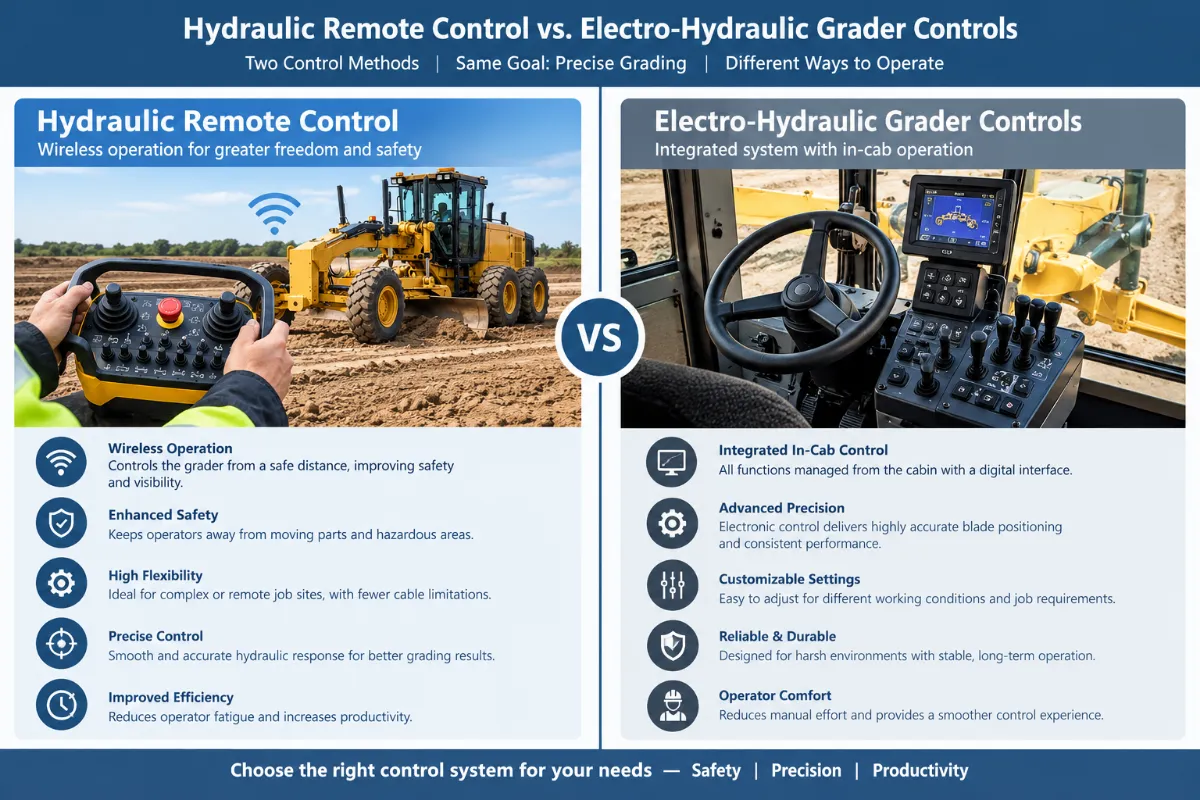
Hydraulic Remote Control vs. Electro-Hydraulic Grader Controls
Before selecting a transmitter and receiver, determine how the grader currently receives operator commands. Two motor graders may have different interfaces even if their working functions appear similar.
Graders with lever-operated hydraulic controls
On a grader with lever-operated controls, the operator’s input may directly operate a hydraulic control valve through the existing control mechanism.
A retrofit might use an engineered actuation arrangement to operate selected controls, provided the mechanism, force requirements, valve behavior, available space, and safety conditions permit it.
This approach must be evaluated on the actual machine. A general-purpose actuator should not be assumed to reproduce the original controls’ entire behavior merely because it can physically move a lever.
The project also needs to establish whether the original cab controls will remain available, how operating modes will be managed, and what changes are required to protect the original machine functions.
Graders with electro-hydraulic controls
Some modern motor graders use electronic joysticks and electro-hydraulic control systems. In these machines, the operator’s input is interpreted by the electronic control architecture before being translated into the required hydraulic action.
Caterpillar’s Model 16 motor grader specifications describe a configuration with two electro-hydraulic joysticks assigned to different steering and implement functions.
An aftermarket wireless receiver cannot be presumed to connect directly to such a machine. The available interface, permitted inputs, electronic controller logic, required communication protocol, and safety-related behavior must be checked.
Some conversions may require the machine manufacturer or an experienced integration specialist to establish an approved interface.
How the two approaches differ
| Consideration | Lever-operated hydraulic controls | Electro-hydraulic controls |
|---|---|---|
| Command interface | Physical control mechanism and hydraulic valve arrangement | Electronic command interface and machine controller |
| Potential retrofit approach | Compatible actuation of selected controls, if engineered for the machine | Approved electronic or electro-hydraulic integration |
| Main compatibility questions | Mechanical travel, required actuation force, valve behavior, and safe mounting | Input signals, controller logic, communications, diagnostics, and safety functions |
| Original cab operation | Depends on the proposed mechanical and mode-selection arrangement | Depends on the machine’s control architecture and approved integration |
| Commissioning | Requires verification of control motion, direction, and machine response | Requires verification of input mapping, control logic, hydraulic response, and relevant diagnostics |
Neither approach is universally better. The appropriate solution depends on the machine and the required scope of remote operation.
For a general overview of available system options, Nomi’s industrial hydraulic remote-control systems page is a starting point for discussing control requirements. It should not be interpreted as a model-specific compatibility declaration for every motor grader.
Remote Hydraulic Control Is Not the Same as Automatic Grade Control
This distinction is important when a project involves precision grading or construction surveying.
Wireless remote control carries operator commands to the machine. Grade-control technology measures or estimates grading conditions and may provide guidance or automatic adjustment, depending on the system. The two technologies can potentially be used together, but one does not automatically provide the functions of the other.
What grade-control systems do
Depending on the equipment, a grading system may use cross-slope measurement, laser references, a total station, GNSS positioning, sensors, displays, and control logic to help the operator achieve a target surface.
For example, Caterpillar’s cross-slope operating guide describes the setup of cross-slope functions on applicable grader systems. The required setup and supported functions are specific to the equipment.
A wireless remote transmitter does not automatically measure the cutting edge’s height, establish a design elevation, or maintain a target slope.
When should both systems be considered?
A remote controller may be used when the operator needs to control certain grader functions wirelessly. A grade-control system may be needed when the task requires a defined grade or slope referenced to design information.
If both are part of the project, determine how the remote controls interact with existing automation, operator displays, lockouts, and machine-side control logic. Some functions may be incompatible with remote operation unless the integration is specifically designed and validated.
Do not assume that any remote controller can connect to any grade-control system. The appropriate interface and permitted control modes need to be confirmed with the equipment manufacturers or responsible integrator.
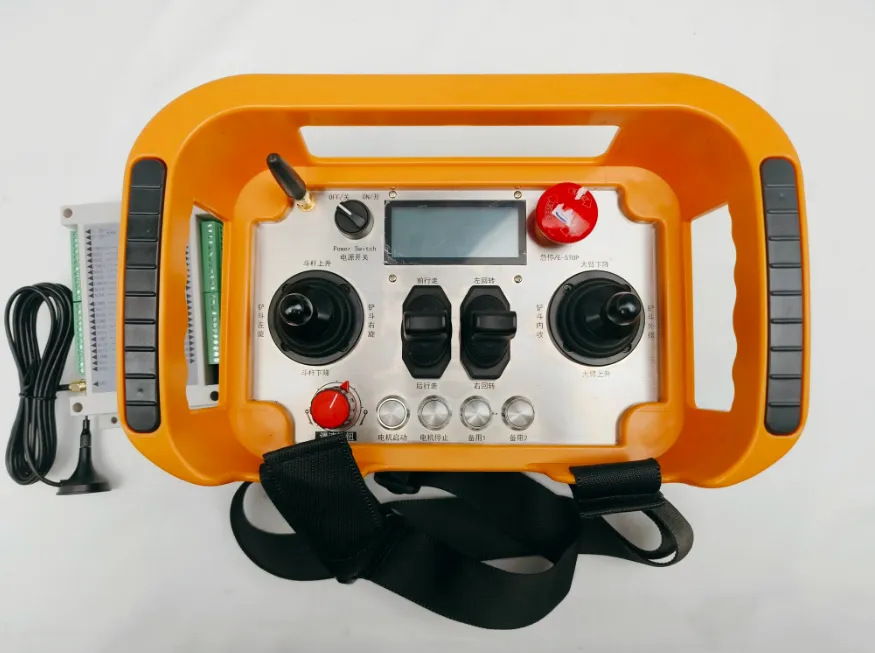
Where Can Hydraulic Wireless Remote Control Be Useful for Motor Graders?
The potential applications depend on what problem the remote-control system is intended to solve. Remote operation should not be treated as a universal replacement for an operator in the cab.
Road construction and final grading
Motor graders are used for road construction, maintenance, site preparation, and related earthmoving work. Their ability to adjust blade position and manage the cutting edge makes them useful for establishing and maintaining surface geometry.
Remote control may be considered when the work requires the operator to command selected grader functions from another suitable location. However, the feasibility depends on the required blade adjustments, machine movement, available visibility, and the communication setup.
A system intended only to move the blade is different from one intended to operate the complete grader through a grading pass.
Road maintenance and unpaved surfaces
Routine road maintenance can involve reshaping surfaces, redistributing material, and maintaining drainage profiles. The grader’s blade configuration, material conditions, and control response all affect the task.
For a remote-control project, identify which movements must be commanded remotely and whether the operator can assess the blade’s engagement with the material. A controller cannot compensate for inadequate visibility or an unsuitable grading procedure.
Mining haul roads and industrial sites
Motor graders play a role in the construction and maintenance of mine haul roads. Caterpillar describes this application in its large motor grader resources.
Remote operation may be worth evaluating when a site has a defined reason to position the operator away from a particular hazard or use a separate control location. Such applications require careful attention to machine movement, working-area access, visibility, communication reliability, and the procedures for fault recovery.
Snow removal and specialized attachments
Some graders use snow wings, additional blades, rippers, or scarifiers. These attachments can add hydraulic functions and change the required control layout.
The system specification should identify each installed attachment and its required movements. It should also confirm that the relevant hydraulic circuits, controls, and interlocks are supported.
An attachment shown in a motor grader brochure should not be assumed to be included in the base machine’s control configuration, and a remote-control kit should not be presumed to support every optional attachment.
Safety, Compatibility, and Applicable Standards
Remote control changes how commands reach the grader, but it does not remove the hazards associated with moving heavy equipment, rotating wheels, articulation points, hydraulic energy, or the working blade.
The system needs to be assessed for its intended application and the consequences of control faults.
Emergency stop and communication loss
Before selecting a remote-control system, establish how the machine should respond when an emergency-stop command is activated, communication is lost, power is interrupted, or another relevant fault occurs.
The correct response depends on the grader’s architecture and risk assessment. It should be documented by the responsible designer or integrator and verified during commissioning.
It is not sufficient to assume that disabling the radio receiver always produces the required machine-level stopping behavior.
Operating modes and control conflicts
If both cab and remote operation are supported, establish how the active control mode is selected and how unintended conflicting commands are prevented.
The operator also needs clear indications of the active mode and a defined procedure for returning control to the cab when necessary. These requirements should be built into the system design rather than left to informal operating practices.
Relevant standard
ISO 15817:2012, Earth-moving machinery: Safety requirements for remote operator control systems specifies essential safety requirements for remote operator control systems used on earth-moving machinery as defined in ISO 6165. ISO identifies the 2012 edition as current following its 2023 review.
The standard is a relevant starting point for determining applicable design requirements. It does not establish that a particular wireless controller or completed motor grader conversion is compliant or certified.
The machine’s intended use, modification, control architecture, and destination market must be considered when determining applicable regulations and standards.
How to Specify a Hydraulic Wireless Remote Control for a Motor Grader
A useful technical specification begins with the functions that must be controlled and the machine interface that will receive the commands.
Step 1: Identify the machine
Record the grader manufacturer, model, production year, serial number, control arrangement, and installed options.
If possible, obtain the relevant hydraulic and electrical diagrams, descriptions of the controller system, and documentation for optional equipment. These details help the supplier distinguish an achievable retrofit from one requiring further engineering.
Step 2: List the required control axes
Specify which of the following functions must be available remotely:
- Left and right blade lift.
- Moldboard tip.
- Circle rotation.
- Moldboard sideshift.
- Drawbar or circle centershift.
- Frame articulation.
- Wheel lean.
- Travel, steering, or other machine functions, if required.
- Optional attachment functions, where installed.
Not every project needs every function. Clearly identifying the scope prevents paying for unneeded controls while avoiding the more serious problem of discovering that a required function is unsupported after installation.
Step 3: Define proportional behavior and simultaneous commands
For each axis, state whether proportional control is required or a discrete command is sufficient. Identify which axes must be operated simultaneously and which combinations can be restricted by the machine or operating procedure.
If the work involves fine grading, discuss the intended control feel and the response of the existing hydraulic system. Output resolution alone does not establish the accuracy of the completed machine.
Step 4: Confirm the receiver and machine interface
The supplier should identify the relevant interface requirements, which may include power supply, signal type, available outputs, controller communication, valve-driver requirements, connector arrangements, and mounting provisions.
Ask which components are included in the quotation and which must be provided by the machine owner, OEM, or integration contractor.
Step 5: Define safety and commissioning requirements
Agree on the intended emergency-stop behavior, communication-loss response, startup and restart conditions, operating-mode selection, and other relevant protective functions.
The project should include an appropriate commissioning and acceptance plan. Before the machine returns to service, the required control directions, proportional response, operating modes, fault behavior, and other specified functions should be verified.
Information to include in a quotation request
| Information | Purpose |
|---|---|
| Grader model, year, and serial number | Identifies the target machine |
| Existing control type | Establishes the likely integration approach |
| Hydraulic and electrical diagrams | Supports compatibility assessment |
| Required axes and functions | Determines control layout and output requirements |
| Proportional versus on/off requirements | Defines command behavior |
| Grade-control or automation equipment | Identifies possible integration dependencies |
| Optional attachments | Establishes additional control needs |
| Operating range and worksite conditions | Supports communication-system evaluation |
| Safety requirements and operating modes | Defines system-level expectations |
| Destination country | Supports regulatory and radio-equipment checks |
| Requested project scope | Clarifies whether the quotation includes only the remote controller or also engineering, installation, and commissioning |
Common Mistakes When Selecting a Motor Grader Remote Control
Choosing by transmitter channel count alone. A high channel count does not prove compatibility with the grader’s control interface or confirm that the required functions can operate simultaneously.
Assuming all hydraulic functions are independent. Modern machine controllers may coordinate or constrain certain functions. The permitted combinations must be verified.
Treating blade control as complete machine control. Operating the moldboard does not necessarily provide remote steering, articulation, travel, braking, or other machine functions.
Confusing remote control with grade automation. A wireless command interface does not automatically provide design-grade measurements or automated blade adjustment.
Ignoring optional equipment. Snow wings, rippers, scarifiers, and other installed equipment can change the required control configuration.
Assuming all motor graders share the same lever layout. Models and generations differ. The actual machine documentation should determine the control mapping.
Accepting unsupported performance claims. Range, response, safety ratings, and compatibility claims should be supported by documentation for the specified configuration.
How Nomi Can Help with Motor Grader Remote-Control Requirements
Nomi’s public company overview lists motor graders among the construction machinery applications for its industrial wireless remote-control products. The company also lists hydraulic remote-control systems and joystick remote controls among its product categories.
For a motor grader project, these categories provide starting points for discussing the command interface and proportional-control requirements. The suitability of a particular system must still be confirmed against the target grader’s model, control architecture, installed options, and required functions.
A useful technical inquiry should include the machine model, the axes to be controlled, the existing hydraulic or electro-hydraulic interface, any grade-control equipment, and the intended application. Where possible, provide the relevant drawings and photographs of the current controls.
The next step is to establish which commands can be supported and what additional machine-side integration may be required. To discuss the requirements, use Nomi’s contact page.
Hydraulic Wireless Remote Control for Motor Graders: Frequently Asked Questions
1. What functions can a wireless remote control operate on a motor grader?
Depending on the machine and system configuration, remote commands may operate left and right blade lift, moldboard tip, circle rotation, sideshift, drawbar or circle centershift, articulation, wheel lean, and selected auxiliary functions. Travel, steering, and other machine controls require separate compatibility verification where they are included in the project.
2. Why does a motor grader need more control axes than a simple hydraulic machine?
A motor grader uses several independent movements to position the moldboard and adjust the cutting edge. The required axes depend on the grader model, installed options, and intended task. The number of transmitter axes must be matched to the functions actually required.
3. Is proportional control necessary for motor grader blade movement?
Not for every function, but proportional control can be useful for gradual blade positioning and variable movement speed. The full control path must support proportional operation, and the final machine response depends on the hydraulic system and calibration.
4. Can a wireless remote control be added to an existing motor grader?
Potentially, but compatibility depends on the control architecture, valve interface, electronic controllers, installed options, and required functions. A machine-specific engineering review is necessary before selecting components.
5. What is the difference between lever-operated hydraulic controls and electro-hydraulic controls?
Lever-operated systems may transmit the operator’s input through a physical mechanism to hydraulic valves. Electro-hydraulic systems interpret electronic commands before controlling the hydraulic output. The retrofit approach depends on which architecture is installed.
6. Can remote control be integrated with a motor grader’s grade-control system?
It may be possible where the machine and grade-control equipment support the proposed integration. The remote-control interface and grade-control functions must be evaluated together. A wireless joystick does not automatically provide automatic grade control.
7. Can a remote-control system operate the moldboard and frame articulation simultaneously?
That depends on the transmitter axes, receiver outputs, machine controller, and the permitted operating logic. Simultaneous movement should be explicitly specified and verified for the intended machine configuration.
8. Which motor grader specifications should be provided for a quotation?
Provide the manufacturer, model, production year, serial number, existing control architecture, hydraulic and electrical diagrams where available, required functions, installed attachments, grade-control equipment, and intended working environment.
9. Which safety standard is relevant to remote operation of a motor grader?
ISO 15817:2012 addresses essential safety requirements for remote operator control systems used on earth-moving machinery as defined in ISO 6165. Applicability, other relevant requirements, and evidence of compliance must be determined for the actual machine and destination market.
10. Does Nomi offer a universal wireless remote control for all motor graders?
Universal compatibility should not be assumed. Nomi lists motor graders among the applications of its industrial remote-control products, but the specific configuration must be confirmed against the machine’s controls and required functions before purchase.
