

The right choice between an OEM industrial remote control and a standard industrial remote control depends primarily on how closely the available system matches your machine’s control architecture. A standard remote is often sufficient when your machine uses conventional functions, electrical interfaces, and operator controls. An OEM or customized solution becomes more appropriate when the machine requires specific joystick layouts, proportional hydraulic control, unique I/O configurations, machine-specific safety functions, special housings, or integration with an existing control system.
The key question is therefore not simply “Which remote control is better?” It is how much customization does the machine actually require?
For hydraulic machinery, cranes, construction equipment, concrete machinery, excavators, and other mobile or industrial equipment, the decision should be made by evaluating the machine interface, required functions, operating environment, safety architecture, production volume, and long-term support requirements.
What Is the Difference Between a Standard and an OEM Industrial Remote Control?
A standard industrial remote control is an existing product configuration developed for a defined group of applications. The transmitter housing, control elements, receiver, communication architecture, and electrical interfaces are generally predetermined.
An OEM industrial remote control is developed or configured specifically for an equipment manufacturer, machine model, application, or production program.
However, “OEM” does not necessarily mean that every component is designed from zero.
In practice, an OEM project can range from relatively simple customization to substantial engineering work.
| Configuration | Typical approach | Engineering requirement |
|---|---|---|
| Standard product | Use an existing transmitter and receiver configuration | Low |
| Configured standard | Change buttons, switches, labels, function mapping or other options | Low to medium |
| OEM customization | Adapt the interface, electrical outputs, enclosure or control logic to the machine | Medium |
| Custom system | Develop significant hardware, software, mechanical and integration elements | High |
This distinction matters because buyers sometimes request a “custom OEM remote” when an existing industrial remote-control platform could already satisfy most of the machine requirements.
For example, Nomi’s current product range includes dedicated hydraulic remote-control systems, joystick remote controls, push-button remote controls, crane controls, and concrete pump truck remote-control solutions.
A practical starting point is therefore to determine whether an existing platform already provides the required control functions before commissioning a completely customized design.
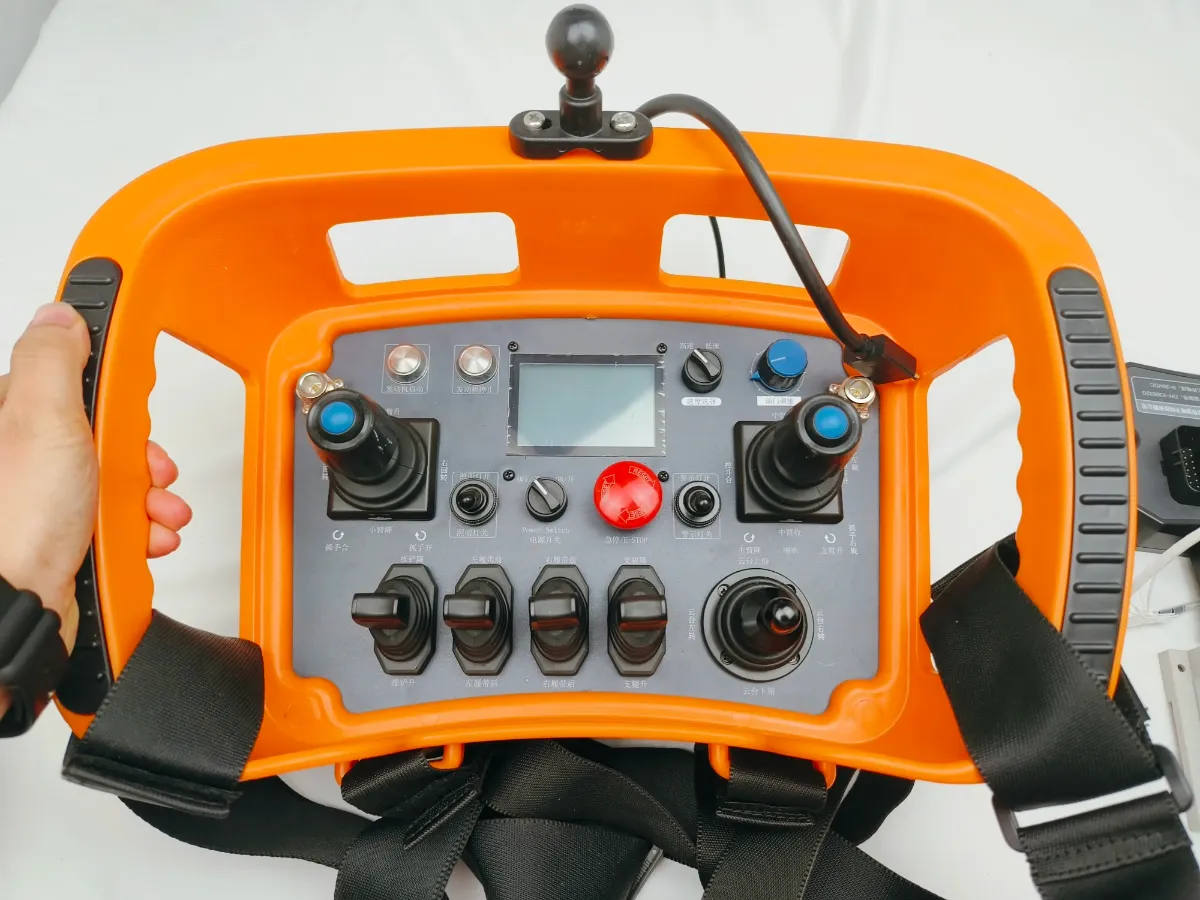
When Is a Standard Industrial Remote Control Enough?
A standard industrial remote control is generally worth considering when the machine has conventional control requirements and the available product already matches the important interfaces.
Typical conditions include:
- The required number of control functions is already available.
- The machine uses conventional electrical control interfaces.
- The required transmitter layout is close to an existing configuration.
- The application does not require unusual feedback or display functions.
- The environmental requirements are within the product’s specified range.
- The required hydraulic functions can be controlled through available on/off or proportional outputs.
- The machine does not require a proprietary communication protocol.
- The expected quantity does not justify extensive engineering customization.
For example, a conventional overhead crane may require basic hoist, trolley, bridge travel, horn, and emergency-stop functions. Existing industrial push-button remote-control configurations may already provide the required operator interface.
Similarly, a hydraulic machine with a conventional number of proportional functions may be able to use an existing joystick-based platform rather than requiring a new transmitter design.
Nomi’s current product information includes both joystick and push-button industrial remote-control categories, reflecting the fact that different machines require different operator interfaces.
Advantages of a standard solution
A standard product can reduce:
- Initial engineering work
- Development time
- Prototype requirements
- Technical uncertainty
- Spare-parts complexity
- Qualification effort
- Initial procurement complexity
There is also an important maintenance advantage.
If the same standard transmitter and receiver are used across multiple machines, technicians may only need to maintain one product family instead of several machine-specific designs.
When a standard product should not be forced into the machine
The main mistake is assuming that a standard product is automatically the right choice because it is already available.
A standard remote should not be selected simply because its transmitter looks similar to the required product.
The receiver must also match the machine’s actual electrical and control architecture.
For hydraulic equipment, this can include:
- Number of hydraulic functions
- On/off versus proportional control
- Valve type
- Solenoid voltage
- Solenoid current
- Analog output requirements
- Digital output requirements
- Control direction
- Emergency-stop architecture
- Machine supply voltage
- Existing controller or PLC interface
A transmitter can have the correct number of joysticks while the receiver still has an incompatible output architecture.
That is why machine-interface compatibility should be checked before comparing prices.
When Does an OEM Remote Control Make More Sense?
OEM customization becomes more relevant when the remote control is part of the machine’s overall product architecture rather than simply an accessory.
Several situations can justify an OEM approach.
1. The machine has unusual control functions
A machine may require a combination such as:
- Multiple proportional hydraulic axes
- Several on/off auxiliary functions
- Engine throttle control
- Pump control
- Special enable switches
- Dedicated emergency-stop functions
- Machine status indicators
- Operator feedback
- Special function selectors
A standard remote may provide some of these functions but not the complete combination.
2. The operator interface is machine-specific
The physical arrangement of controls can affect how an operator uses the machine.
A manufacturer may need:
- Specific joystick positions
- Different switch arrangements
- Custom button labels
- Dedicated function selectors
- Special emergency-stop placement
- Left-hand or right-hand operation
- Chest-mounted or handheld operation
- Machine-specific identification
- Custom housing or panel layouts
Nomi’s joystick remote-control category is specifically positioned for applications requiring proportional control, while its push-button category addresses applications where discrete control functions are more appropriate.
3. The machine requires proportional hydraulic control
This is particularly important for hydraulic machinery.
An on/off control command and a proportional control command are not interchangeable.
With on/off control, the output essentially switches between defined states. With proportional control, the command can represent different levels of valve actuation, allowing the operator to control movement more progressively.
For applications such as lifting, positioning, boom movement, excavation, material handling, or concrete placement, the required control behavior may depend heavily on the hydraulic valve and machine architecture.
Nomi’s hydraulic remote-control information describes systems that can interface with proportional and on/off hydraulic directional valves.
If the machine requires proportional movement, the buyer should not only ask whether a remote has “joysticks.” The more important question is whether the transmitter, receiver, output signal, valve interface, and calibration are compatible as a complete control chain.
4. The machine has an existing proprietary control system
An OEM machine may already contain:
- PLCs
- CAN-based controllers
- Electro-hydraulic valve controllers
- Proprietary wiring
- Existing safety circuits
- Machine-specific diagnostic systems
In this situation, the remote control may need to communicate with the machine’s existing architecture instead of simply switching individual outputs.
That can turn the project from a simple product purchase into a system-integration project.
OEM vs. Standard Industrial Remote Controls: A Practical Comparison
| Factor | Standard Remote Control | OEM / Customized Remote Control |
|---|---|---|
| Initial engineering | Lower | Higher |
| Product availability | Usually faster | May require development |
| Custom layout | Limited or predefined | Machine-specific |
| Control functions | Standard configurations | Configurable or custom |
| Hydraulic interface | Existing options | Can be engineered for application |
| Electrical interface | Predetermined | Can be adapted |
| Branding | Usually standard | Can support OEM branding where offered |
| Documentation | Standard | Project-specific documentation may be required |
| Prototype work | Often limited | More likely |
| Validation effort | Lower | Higher |
| Initial unit cost | Often lower | Often higher |
| Long-term standardization | High | Depends on project design |
| Suitability for unique machines | Limited | Higher |
| Suitability for large OEM programs | Depends on platform | Often more suitable |
The table should not be interpreted as saying that one category is universally better.
The correct choice depends on how much deviation exists between the machine’s requirements and the standard product.
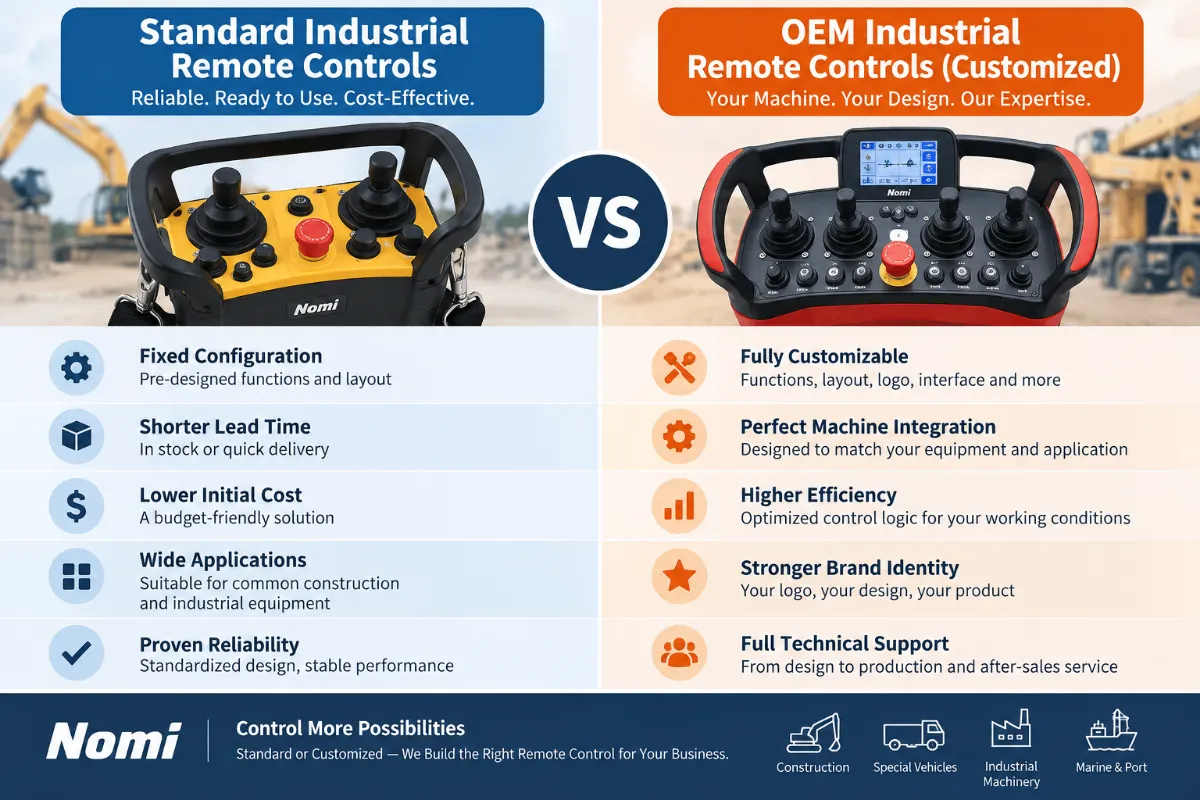
What Parts of an Industrial Remote Control Can Be Customized?
“Customization” can mean very different things.
Before requesting an OEM quotation, buyers should identify exactly which layer needs to change.
Transmitter
Possible customization areas may include:
- Joystick quantity
- Joystick position
- Push buttons
- Toggle switches
- Selector switches
- Emergency-stop arrangement
- Indicator lights
- Display elements
- Labels
- Housing configuration
- Operator carrying method
The transmitter is the part the operator interacts with directly, so ergonomics should be considered alongside electrical functionality.
Receiver
The receiver is equally important because it provides the interface between wireless commands and the machine.
Depending on the system architecture, the receiver may need to handle:
- Digital outputs
- Relay outputs
- Proportional outputs
- Analog signals
- Machine enable signals
- Safety-related outputs
- Communication interfaces
For hydraulic systems, matching the receiver output to the valve or valve amplifier is particularly important.
Software and Function Mapping
Customization can also involve how controls are assigned.
For example, one joystick axis may command boom movement while another controls telescoping. A button may activate an auxiliary hydraulic function, while another may control a machine enable circuit.
The important point is that customization should be documented as a defined function map rather than described only as “custom control.”
Mechanical Integration
A remote control can also require machine-specific mechanical considerations.
Examples include:
- Receiver mounting
- Antenna placement
- Wiring harness routing
- Connector selection
- Protection from vibration
- Protection from water and dust
- Accessibility for maintenance
Nomi’s hydraulic remote-control information emphasizes the importance of matching the receiver-to-valve electrical interface, including output voltage, current, and the distinction between proportional and on/off valve control.
Which Specifications Should Buyers Compare?
Comparing remote controls only by operating distance or transmitter appearance can lead to a poor purchasing decision.
A more useful comparison starts with the machine.
1. Number of functions
First determine how many independent machine functions must be controlled.
Do not count only physical buttons.
A two-direction joystick may represent two proportional axes, while a button may represent a single discrete function.
2. Control type
Determine whether each function is:
- On/off
- Multi-step
- Proportional
- Analog
- Digital
- Communication-based
A machine can require a combination of several control types.
3. Hydraulic interface
For hydraulic machinery, provide the supplier with the relevant valve information whenever possible.
Useful information includes:
- Valve manufacturer
- Valve model
- Coil voltage
- Coil current
- Number of valve sections
- Proportional or on/off operation
- Existing amplifier
- Existing controller
- Wiring diagram
Nomi’s hydraulic remote-control selection information similarly emphasizes documenting the existing directional-control valve, solenoid specifications, machine electrical supply, operating environment, and required number of functions before selecting a retrofit system.
4. Power supply
The remote-control receiver must be compatible with the machine’s actual electrical supply.
Do not assume that a nominal 12 V or 24 V machine can accept any product marketed for that voltage.
The supplier should confirm the actual permissible input range and electrical protection requirements.
5. Environmental conditions
Specify the actual working environment.
Consider:
- Rain
- Dust
- Mud
- Oil
- Vibration
- Mechanical shock
- Temperature
- Washdown
- Outdoor exposure
- Marine environments
- Potentially hazardous areas
The IP rating is only one part of environmental suitability.
6. Radio requirements
The required radio configuration depends on the target market and local regulatory requirements.
A system intended for Europe and a system intended for North America may have different regulatory considerations.
For radio equipment placed on the EU market, the Radio Equipment Directive establishes requirements for applicable radio equipment and the associated EU Declaration of Conformity.
For the United States, applicable RF equipment is subject to FCC equipment-authorization requirements.
Therefore, buyers should specify the destination market before finalizing the wireless architecture.
Read more: How to Select the Right Joystick Remote Control for Cranes, Excavators and Winches.
Safety Should Be Evaluated as a System, Not Just a Remote
A remote control should not be treated as a standalone safety device simply because it contains an emergency-stop button.
Machine safety depends on the complete control system, including the transmitter, receiver, machine controller, actuators, hydraulic components, emergency-stop architecture, and safety-related control functions.
IEC 62745:2017 specifically addresses cableless control systems of machinery and requirements for communication between operator control stations and machine control systems.
ISO 13849-1:2023 provides a methodology and requirements for the design and integration of safety-related parts of control systems. It applies across electrical, hydraulic, pneumatic, and mechanical technologies, but it does not itself determine the required performance level for every specific machine.
This distinction is important.
A supplier saying that a remote control is “safe” is not enough information for an OEM machine manufacturer.
The buyer should ask:
- What safety functions are implemented?
- How does the machine respond to loss of communication?
- How is emergency stop integrated?
- What happens if the transmitter battery becomes depleted?
- How are unintended commands prevented?
- How are transmitter and receiver paired?
- What validation documentation is available?
- Which safety standards apply to the complete machine?
The applicable requirements depend on the machine and market, so the remote supplier should not be expected to determine the complete machinery compliance strategy without the machine manufacturer’s input.
What Does OEM Customization Cost More Than a Standard Product?
The difference is not necessarily the hardware itself.
OEM projects can introduce additional costs associated with:
- Engineering
- Mechanical design
- Electrical design
- Software configuration
- Prototype development
- Sample production
- Testing
- Validation
- Documentation
- Tooling, where applicable
- Production setup
- Long-term engineering support
However, the opposite can also occur.
A standard product may initially appear cheaper but require:
- Additional interface modules
- External converters
- Wiring modifications
- Custom brackets
- Additional commissioning
- Engineering work
- Machine-side modifications
- Operator retraining
The real comparison should therefore be based on total integration cost, not only the remote-control unit price.
A useful procurement calculation is:
Total solution cost = remote-control hardware + integration + installation + commissioning + validation + maintenance + spare parts + future engineering changes
For a one-off machine, a standard product with minor adaptation may be sensible.
For a machine manufacturer producing the same model repeatedly, the economics can be different because engineering costs may be distributed across many machines.
learn more: How to Choose a Wireless Remote Control for Hydraulic Machinery.
When Does OEM Customization Become Economically Justifiable?
Consider OEM customization when one or more of the following conditions apply:
Repeated production
If the same remote-control configuration will be installed on many machines, customization costs can be distributed across the production volume.
Machine differentiation
If the remote-control interface is an important part of the machine’s operation, a machine-specific configuration may provide a better operator experience.
Complex hydraulic control
Machines requiring several proportional axes, auxiliary hydraulic functions, and special control logic may benefit from a system designed around the machine architecture.
Existing control architecture
If the machine already has a sophisticated electrical or hydraulic control system, a customized receiver or communication interface may reduce integration complexity.
Long product lifecycle
For machines expected to remain in service for many years, the OEM should consider spare parts, replacement transmitters, receiver compatibility, and future revisions before selecting the initial system.
When Should You Stay With a Standard Product?
A standard product may remain the more practical option when:
- The machine has conventional functions.
- Existing interfaces already match.
- The quantity is small.
- The machine does not require special operator controls.
- The application does not require proprietary communication.
- The standard product has the required environmental and regulatory characteristics.
- Replacement availability is more important than customization.
- The machine manufacturer wants to minimize engineering responsibility.
This is especially relevant for retrofit applications.
For example, Nomi offers hydraulic remote-control systems intended to add wireless operation to existing hydraulic machinery. The product range includes applications for excavators, cranes, concrete pump trucks, dump trailers, and other equipment.
A retrofit does not automatically require an entirely new OEM remote-control design.
Common Mistakes When Choosing Between OEM and Standard Remotes
Mistake 1: Choosing by transmitter appearance
Two remotes may look almost identical while having completely different receiver outputs.
Better approach: compare the complete transmitter, receiver, electrical interface, and machine control architecture.
Mistake 2: Comparing only unit price
A lower purchase price can disappear after additional wiring, interface modules, commissioning, and engineering work are added.
Better approach: compare total integration cost.
Mistake 3: Assuming “OEM” means completely new development
Many OEM projects can be based on an existing platform.
Better approach: ask the supplier which parts can be configured and which parts require new development.
Mistake 4: Ignoring the hydraulic valve interface
For hydraulic machinery, the valve interface is often more important than the number of joystick axes.
Better approach: provide valve model and electrical specifications before requesting final confirmation.
Mistake 5: Treating certifications as interchangeable
A radio certification, product declaration, and machinery safety assessment are not necessarily the same thing.
Better approach: specify the target market and identify exactly which compliance documents are required.
Mistake 6: Forgetting spare parts
An OEM remote may work well during production but create difficulties years later if replacement transmitters or receivers are not available.
Better approach: agree on spare-parts availability and product lifecycle support before approving the design.
Mistake 7: Customizing unnecessary features
Every custom feature adds engineering or validation requirements.
Better approach: customize only the elements that solve a real machine requirement.
What Information Should You Send an OEM Remote-Control Supplier?
A good RFQ should provide enough information for the supplier to determine whether an existing product or customized system is appropriate.
Use this checklist:
| Information | Example requirement |
|---|---|
| Machine type | Excavator, crane, loader, pump truck |
| Machine model | Exact machine model |
| Machine quantity | Prototype, 10 units/year, 500 units/year |
| Control functions | Boom, arm, bucket, travel, auxiliary |
| Control type | On/off or proportional |
| Hydraulic valve | Manufacturer and model |
| Valve coil | Voltage and current |
| Machine voltage | 12 VDC, 24 VDC, etc. |
| Existing controller | PLC, CAN, valve amplifier, etc. |
| Transmitter layout | Joystick, buttons, switches |
| Emergency stop | Required configuration |
| Environment | Indoor, outdoor, dust, rain, washdown |
| Required range | Actual working distance |
| Target market | EU, USA, Asia, etc. |
| Compliance documents | Applicable requirements |
| Communication | RF, CAN, other interfaces |
| Mounting | Receiver and antenna requirements |
| Documentation | Wiring diagram, manual, test documents |
| Branding | Standard or OEM branding |
| Spare parts | Expected service period |
The more complete this information is, the less likely the project will require repeated clarification.
A Practical Decision Tree for Buyers
The following approach can simplify the decision.
Step 1: Does an existing standard product meet the machine’s functional requirements?
If yes, evaluate the standard solution first.
Step 2: Does the standard receiver match the machine’s electrical and hydraulic interface?
If yes, continue evaluating integration.
If no, investigate whether the interface can be configured or whether an OEM receiver is required.
Step 3: Does the operator require a machine-specific layout?
If no, a standard transmitter may remain sufficient.
If yes, investigate configurable or OEM transmitter options.
Step 4: Does the machine require proportional control or special control logic?
If yes, verify the complete signal chain from joystick to receiver to valve or machine controller.
Step 5: Is the same configuration required across multiple machines?
If yes, calculate the engineering cost across the expected production volume.
Step 6: Are there specific regulatory or safety requirements?
If yes, identify them before final product approval rather than after production.
Step 7: Can the supplier support the system throughout its lifecycle?
Check documentation, spare parts, replacement units, firmware or configuration management, and technical support.
How Nomi Fits Into the Decision
Nomi focuses on industrial wireless remote-control solutions for hydraulic machinery and construction equipment. Its current product range includes hydraulic remote controls, joystick remote controls, push-button remote controls, construction crane remote controls, overhead crane and hoist control systems, and application-specific systems for equipment such as excavators and concrete pump trucks.
For buyers evaluating an OEM project, the important question is not simply whether a supplier can put a different logo on an existing transmitter.
The more useful questions are:
- Can the supplier understand the machine’s control architecture?
- Can the transmitter layout match the operator’s workflow?
- Can the receiver interface with the machine’s hydraulic or electrical system?
- Can proportional control be implemented where required?
- Can the supplier provide the technical documentation required for integration?
- Can the supplier support prototypes as well as production quantities?
- Can the supplier provide a standard product when customization is unnecessary?
Nomi’s hydraulic remote-control product information specifically identifies machine-side considerations such as valve specifications, electrical supply, number of functions, operating environment, and proportional versus on/off requirements as part of system selection.
For a machine manufacturer, this engineering compatibility is usually more important than whether a remote is simply described as “OEM.”
Final Decision: OEM or Standard?
The decision can be summarized in one principle:
Choose a standard industrial remote control when the machine can use an existing configuration without compromising control, integration, safety, or lifecycle requirements. Consider an OEM or customized solution when the machine’s control architecture, operator interface, hydraulic functions, electrical interfaces, or production requirements cannot be adequately served by an existing product.
OEM does not automatically mean better.
Standard does not automatically mean basic.
A well-matched standard remote can be the most efficient solution for a conventional machine. A customized OEM system can make more sense when the remote control is an integral part of a specialized machine design or a repeated production program.
Before making the decision, compare the two options against the same technical checklist: control functions, hydraulic interface, electrical interface, operator layout, environmental conditions, safety architecture, regulatory requirements, integration effort, production volume, spare parts, and lifecycle support.
That comparison gives the machine manufacturer a more reliable basis for deciding whether customization is genuinely necessary.
